

You’ll likely have lots of questions, not just about how much it will cost to move in but how much it will cost on an ongoing basis, and when it comes time to leave.
We understand you need certainty about your financial future, and that you might feel concerned about affordability and hidden costs. Let’s walk through each step of the process so you know exactly what to expect.
Payments – how much, when, and will they change over time?*
The most common types of agreement in RetireAustralia villages are leasehold and licence, where you purchase a long-term lease to live in your home. Here we break down the costs for leasehold and licence villages.
To increase financial certainty, we’ve made our contracts as clear and transparent as possible. We specify, upfront, which costs you’ll need to pay, and what they cover. Here’s a quick breakdown of the fees you’ll need to pay for the duration of your stay in one of our licence or leasehold villages:
* Please note, the costs are a little different for our freehold (strata title) villages in Sydney, New South Wales and in Logan, Queensland.
Entry payment
Your entry payment gives you the right to reside in your new home on a long-term lease (usually 99 years). Unlike most property transactions, you will not have to pay stamp duty on your apartment. This equates to a significant cost saving on entry.
This payment is relative to the locally property market and demand for homes in the retirement village.
Monthly service fees
By law, RetireAustralia makes no profit from village fees, which are charged on a cost-recovery basis and only increase in line with village costs.
Fees cover village operating costs including:
- Council rates
- Water rates
- Building insurance
- Building and garden maintenance
- 24-hour emergency call system
- Access to and upkeep of communal village facilities
You can also rest assured that it can’t be increased greater than the Consumer Price Index without the approval of village residents. For further peace of mind, these fees are audited by an independent party each year.
Management fee*
What is the management fee
The management fee, (sometimes referred to as deferred management fee, exit fee or departure fee) is payable when you leave the village and allows us to keep our entry prices as competitive as possible, leaving you with more cash in your pocket to enjoy life in the village after you move in.
The management fee is the only fee that allows RetireAustralia to reinvest back into your village, through capital replacement works, maintenance of communal facilities, and village upgrades. It also covers the refurbishment, sales and marketing costs of homes and the remainder is profit. This not only benefits you during your time in the village but also helps maintain the value of your home, which is important when it comes time to sell.
How is the management fee calculated?
When it comes time to leave the village, you’ll receive an exit entitlement, which is the purchase price minus the management fee. This fee is capped at 35% of your entry price and is stepped during your first three years in a village. There are no further increases after this period, no matter how long you stay.
From the day you move in, you’ll be able to calculate how much you will receive when you exit the village – making your future budgeting clear and predictable.
Management fee example
To calculate your exit entitlement when leaving the village one would have to use the purchase price less the exit fee.*
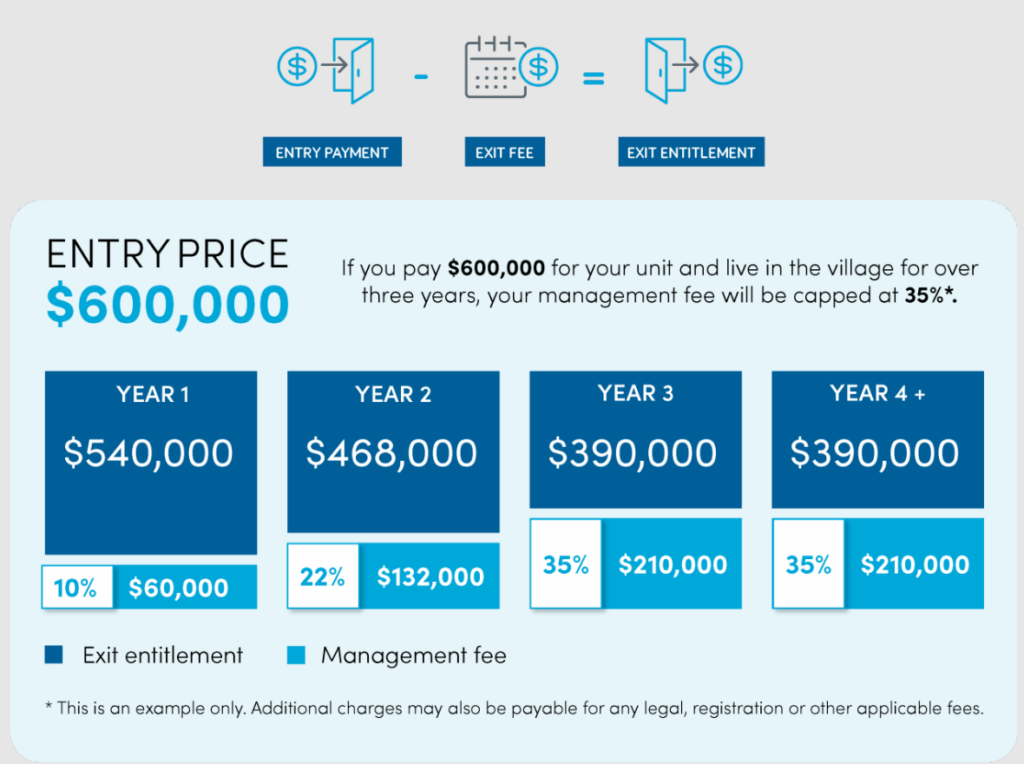
Please note, the management fee is a little different for our freehold (strata title) villages in Sydney, New South Wales and in Logan, Queensland.
What do I get for my money?
Our residents tell us that choosing to move into a retirement village is about far more than bricks and mortar. In reality, it’s an investment in you. You’ll be moving into a friendly community filled with people at the same stage of life, and you’ll have access to a range of amenities.
These vary depending on the village you choose but can include things like:
- Swimming pool
- Gymnasium
- Tennis court
- Bowling green
- Hair salon
- Community centre
- BBQ areas
- Residents’ bar
- Billiards room
- Library
You can also get involved in a range of interest groups, social activities and events from happy hour to mini-golf and more – it’s really up to you and the community.
What’s more, when you can enjoy a low-maintainence lifetstyle as we take care garden and building maintainence, so you’ll actually have time to explore new interests!
These intangible benefits are an important consideration, and should be weighed up alongside the financials. Moving into a retirement village is about so much more than the property. Residents tell us that the lifestyle, health and wellbeing benefits enhance their quality of life immeasurably.
What if my care needs change?
If your needs change, you can rest easy knowing you can access care and support if you need it. In RetireAustralia villages, you have a range of care and support services to choose from, whether that means ongoing daily support in a serviced apartment in many of our villages in New South Wales, or South Australia, or flexible care and support delivered in your home by our Support at Home team. Care is tailored to your individual needs and funded privately or through government funding.
How can I compare the cost of living in a retirement village with other options?
A true cost of living comparison can only be obtained by spending time with a sales consultant in a village, talking through your circumstances and needs, and understanding the fees and inclusions in your chosen village. You also need to do your own homework and make sure you have an accurate picture of your current living expenses to make the comparison valid.
In a general sense, retirement villages offer great cost of living value but trying to put a specific dollar figure to this comparison can easily become misleading. Your own cost of living and those applicable to villages can vary substantially, so it’s best to check with your village of choice directly.
On top of the hard costs listed above which village fees cover, the costs associated with living in a retirement village also provide residents with a sense of community and belonging, support from friends and staff, and numerous opportunities to lead a happy, active and healthy life.
Placing a value on these intangible benefits is very personal to each individual. To get more of an insight into what it is like to live in one of our retirement villages, take a look at our retirement stories and insights.