
Home Care Packages and Support at Home: what’s changed and what it means for you

Here’s a clear, plain English guide to what’s changed, what hasn’t, and what it means for everyday life.
A quick look back: what were Home Care Packages?
For many years, Home Care Packages helped older Australians stay living safely and independently at home.
Once approved, people were placed into one of four funding levels: from basic support through to high-level care. That funding could be used for things like:
- Personal care
- Cleaning and meals
- Nursing support
- Physiotherapy or other allied health services
Importantly, people could choose their own provider and shape their care around what mattered most to them.
What is Support at Home?
From 1 November 2025, Home Care Packages were replaced by a new program called Support at Home.
This change affects:
- People already receiving a Home Care Package.
- Anyone who was on the waiting list.
- Anyone applying for in-home support from that date onwards.
If you were already receiving a Home Care Package, nothing was required of you.
You were automatically moved across to Support at Home, with no need to reapply or change providers.
What’s different under Support at Home?
1. Care is more closely matched to your needs
Instead of 4 broad package levels, Support at Home now has 8 funding classifications, with support of up to $78,106 per year.
This means care can be better tailored to what you actually need, rather than fitting into a one-size-fits-all category.
2. Services are grouped more clearly
Support is now grouped into 3 simple areas:
- Clinical Care, such as nursing and physiotherapy.
- Independence Support, such as personal care, social support, mobility support and respite, to help you stay mobile, connected and independent.
- Everyday Living, tasks like cleaning, meals, gardening and minor home maintenance.
These categories matter because they affect how much, if anything, you may be asked to contribute.
3. Budgets are managed quarterly
Your funding is now held by Services Australia and paid quarterly. Your provider invoices for services after they’re delivered, and you can carry over a small amount of unused funding each quarter.
4. Extra help for home modifications
Support at Home includes separate funding of up to $15,000 for assistive technology and home modifications.
This is in addition to your regular care budget, making it easier to pay for things like mobility aids or safety improvements at home.
5. What will it cost?
Costs depend on:
- The type of support you receive.
- Your pension status, income and assets.
In simple terms:
- Clinical care (such as nursing or physiotherapy) is fully funded, no out-of-pocket costs.
- Independence support may require a small contribution.
- Everyday living services usually involve a higher contribution.
For someone on a full pension, this could mean:
- Around 5% for some independence supports.
- Up to 17.5% for everyday living services.
Your provider sets the price for each service. Your contribution is a percentage of that price, and the Government pays the remainder as a subsidy.
There is a lifetime cap on what you can be asked to contribute towards non-clinical services. Contributions made under Support at Home are counted if you later move into aged care. The cap is indexed over time (around $135,000 as at November 2025), and Services Australia keeps track of your contributions.
If you were already on a Home Care Package
Your situation depends on when you were approved.
- If you were receiving (or were approved for) a Home Care Package on or before 12 September 2024, you’re protected by a “no worse off” principle. This means your government set contribution arrangements will be the same as, or lower than, what would have applied under the Home Care Packages rules. Your provider can help explain what this means for your services and invoices.
- If you entered Support at Home from 1 November 2025, you may be asked to contribute to some services, even if you hadn’t previously paid an income tested fee.
If you’re unsure where you sit, your provider can help, or you can contact My Aged Care on 1800 200 422.
What hasn’t changed
Some important things remain the same:
- You still need an aged care assessment.
- You can still choose your own provider.
- You can request a reassessment if your needs change.
- Clinical care remains fully government-funded for everyone.
What this means going forward
Support at Home is designed to better reflect real needs and provide clearer pathways to care, but how it affects you depends on when you entered the system and the type of support you need.
If you’re already receiving care, the most helpful step is a conversation with your provider to understand how the changes apply to you.
If you’re new to in-home care, an aged care assessment is the best place to start. The new 8-level system allows more flexibility to shape support around your life, not the other way around.
Live in RetireAustralia community?
If you live in a RetireAustralia community, our Support at Home team would be happy to help you navigate the My Aged Care assessment process. Your Village Manger or on-site Support at Home team member can direct you to the next steps.
If you’re not eligible for government-funded Support at Home services but would still like to receive assistance to help with everyday life, they are available on a fee-for-service basis.
Want to discover whether life in a retirement village is right for you? Get your free guide to retirement village living.

Finding community and connection at Carlyle Gardens
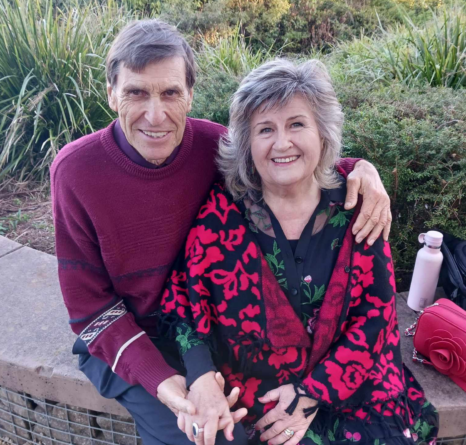
When life changes unexpectedly, sometimes it opens the door to something better than you imagined. For this May and Trevor, that turning point came 2.5 years ago.
After running a successful business in the Bundaberg region, Trevor experienced health issues and was no longer able to work. The couple made the difficult decision to sell their business and soon realised their 1-acre property just outside town had become a bit too much to manage.
“We needed something more manageable,” May explains. “Somewhere that still felt like home, but without the upkeep.”
What followed was an 18-month search across retirement villages, over-50s communities, townhouses and units. But no matter how many places she visited, May kept coming back to one.
The place that kept calling them back
“At Carlyle Gardens Retirement Village, it was the gardens between the homes that appealed to me,” May says. “The outlook and the space. It just felt different.”
The beautifully maintained gardens offer privacy between villas, while still fostering a sense of connection. And being within walking distance of the beach only adds to the appeal.
While still considering their options, Lauren the sales consultant at Carlyle Gardens stayed in touch, sending newsletters and updates.
“Even just reading the newsletter, I could feel there was life here,” says May. “There were activities happening and people connecting. I’d received other newsletters from other places, but this one felt alive.”
One Friday, May made a call. “I just had this feeling to ring and ask if anything was available.”
Surprisingly, there was!
Ticking every box
May set off to visit the village the following Monday. Trevor wasn’t well enough to attend and told her gently, “You go. You look. You decide.”
The moment she stepped inside the villa, she knew.
“It ticked every box. I wanted a room for my crafts, I love crafts, and space for my books. I’ve got quite a little library. And it had that space,” May explains.
She returned home and told her husband that she thought she had found the place. They visited together the next day and he agreed. Their home went on the market and sold within a week.
“It was just before Christmas,” she recalls. “It almost felt meant to be.”
A visible change
Since moving in, the transformation, particularly in Trevor, has been remarkable. Before relocating, he wasn’t getting out much and was spending a lot of time at home on his own.
“Since we’ve moved here, he’s up. He’s connecting with neighbours. He rides his bike around the village, it’s safe here. He goes for walks. He pops in to see the other fellas. He even went to play snooker.”
Friends who have visited have noticed the difference in the Trevor.
“They’ve said it’s like a weight has lifted off his shoulders,” says May.
That kind of change is life changing. It speaks to something deeper than simply convenience, it’s belonging.
Thriving, not just living
Life has also changed for the better for May.
“I’ve started walk aerobics twice a week – that’s 5km each time,” she says. “I’ve taken up line dancing. I play cards on Thursday mornings.”
May loves village life, which includes meeting new people, building friendships and staying active. But what she appreciates most is the balance it offers.
“The homes aren’t on top of each other, which gives you a real sense of privacy. You can garden as much or as little as you want and best of all, there’s no mowing! But when you’re out walking, people stop for a chat. You feel welcomed.”
Community dinners, pizza nights and sausage sizzles provide opportunities for socialising as a couple, but they also have plenty of time for their individual interests and friendships.
“It’s good to have your own things,” May says. “Then you come back and share.”
Support that continues
Another standout for her has been the village team at Carlyle Gardens. The team’s consistency and support, especially during a major life transition for the couple, has meant the world.
“They’ve been so helpful. The whole process of moving in was terrific, and it didn’t stop after we moved in, it’s continued to be terrific,” she says. “I know I’m gushing, but it’s from the heart. We’re just so thankful.”
When asked what she would tell someone considering a move, her answer is simple:
“It’s such a lovely community to live in. The gardens. The privacy. The connection. You don’t have the upkeep, but you still have independence. It’s perfect.”
She’s already recommended it to several friends and one couple is now considering making the move themselves.
Sometimes downsizing isn’t about giving something up. It’s actually about gaining connection, health, ease and a fresh start by the sea.
Discover if Carlyle Gardens could be the right retirement community for you.
You might also be interested in:
Planning for retirement living? Here’s what matters most

Downsizing is more than just moving into a smaller home – it’s about moving to a home that suits you and the next chapter in your life. Whether it’s freeing up money, time or making a move that suits your future care needs, downsizing can bring substantial benefits. It’s also a decision packed with emotional, practical and financial complexities. Let’s explore the real reasons people move to a retirement village, the common barriers and regrets, and the key considerations for choosing a community that truly feels like home.
Get an expert perspective on retirement village costs
1. Why do people downsize?
The two biggest motivators are:
- Freeing up money
- Freeing up time
Often, these goals go hand-in-hand. Moving to a smaller, more manageable home reduces maintenance costs, utility bills and general upkeep expenses. Many find that their current home has become too large – full of unused rooms and storage space for adult children’s long-forgotten belongings.
People also want to stop paying for gardening, cleaning gutters and maintaining pools that are rarely used. It becomes a matter of evaluating what you truly use and enjoy in your home and whether the effort and expense are still worth it.
2. Retirement living vs aged care: know the difference
A common misconception is that retirement villages are just “nicer nursing homes”. They’re not.
Retirement villages are designed for independent living, often with future care in mind. Many now include care infrastructure discreetly built in, such as spacious kitchens, reinforced walls for future grab rails and emergency call systems, without making you feel like you’re in care.
This allows people to age in place, avoiding unnecessary moves to aged care facilities unless absolutely required. More than 80% of people receiving aged care do so at home, and for many, that “home” is in a retirement village.
3. The financial upside (and downside)
When considering a move to a retirement village, I always advise people to start with the fundamentals: review the contract thoroughly and make sure you understand the financial implications. As someone with a background in finance, I cannot overstate the importance of crunching the numbers—even if it feels tedious, it’s essential.
I also recommend visiting a financial advisor who specialises in retirement living. This will ensure that you get the best outcome for your situation.
When considering the financials of a move into retirement living, I recommend a simple three-part breakdown:
- Ingoing
- Ongoing
- Outgoing
This gives you the full picture of costs at entry, during your stay and when you leave. Comparing based on purchase price alone (for example $700,000 versus $800,00) is simple but misleading as you are ignoring two thrids of the transaction. By considering the inoing cost together with the ongoing costs (like general service charges), and the outgoing (exit fees) you will understand the true costs.
While downsizing can free up capital, it’s also vital to understand other financial implications and benefits. These could include:
- Superannuation incentives: The government’s downsizer super contribution allows people over 55 to contribute up to $300,000 per person ($600,000 per couple) from the sale of their home to super, even if they’ve hit their contribution caps or don’t meet work tests.
- Impact on the age pension: Downsizing might reduce your pension depending on how much equity you release. I like to compare pension means testing to a Rottweiler (asset test) and a Chihuahua (income test) – the asset test often bites harder. So, for example, a pensioner may think it’s best to purchase the cheapest apartment in a retirement village, but actually the more expensive one can be of greater benefit. That’s because for every $100,000 you go over the asset threshold your pension reduces by $7800 a year, if that money is in your home you can getthe benefits of an increase to your pension and a nicer home.
4. The emotional and practical hurdles
There are two main barriers to downsizing to a retirement village:
1. “What am I going to do with all my stuff?” Years of accumulated furniture, keepsakes, tools and memorabilia make it hard to let go. It’s a significant emotional hurdle.
2. Financial confusion Even seasoned property owners find retirement village contracts and costs confusing. This isn’t like any real estate transaction they’ve encountered before, making people hesitant and fearful of making a mistake.
When thinking about the financial implications of downsizing, it can be easier to put it on the backburner for another day. To overcome this, seek professional advice from financial and legal specialists in retirement living who have done this many times over. You should also visit a number of villages to see how the benefits of downsizing can be worth the effort.
5. The benefits of living in a retirement village
If there’s one universal regret I hear from downsizers, it’s this: “I wish I’d done it sooner.”
Once people move into retirement living, their newlifestyle with reduced stress and increased social connection often lead to unexpected benefits, including better health. I’ve witnessed this firsthand with my grandmother. After moving into a retirement village, her social life boomed and her health improved to the point where she successfully underwent open-heart surgery at age 82, something doctors said wouldn’t have been possible before.
What often surprises people is that the greatest indicator of long-term happinessin a retirement community has little to do with the financies. Instead, it comes down to how you spend your time, who you spend it with and the activities and connections that fill your days.
That’s why I often say it’s about more than the contract or the costs – it’s also about the vibe. Ultimately, you need to find a community where you feel a genuine sense of belonging.
6. Finding the right community (it’s all about the vibe)
Don’t fall into the trap of choosing a village based solely on proximity to your current home or family. While convenience matters, the right vibe matters more. You’re choosing a lifestyle, not just a location.
As I’ve mentioned, the key to a successful retirement village move isn’t just the contract or the cost. It’s about belonging.
I always advise that people trying to find a village should:
- Get a copy of the social calendar.
- Circle the activities you’d want to participate in. Are there many? Are there few?
- Ask to attend a class or event.
- Visit during open days or happy hours and chat with the residents.
By taking part you’ll get a better sense of what it’s like to live there and what it’s like to be part of that community. The people you spend time with and the experiences you share are key influences on your happinessand enjoyment of village life .
Please remember
Downsizing isn’t just a property decision, it’s a lifestyle decision.
Done right, it can be transformative. But you need to:
- Crunch the numbers.
- Understand the contract.
- Choose a community that aligns with your lifestyle.
- Think not just one, but two steps ahead. You might not need care now, but what lies ahead?
And above all, don’t let uncertainty delay what could be the best move of your life, ask questions and seek advice.
Considering downsizing or exploring retirement living options? Make sure you’re informed, and don’t go it alone, expert advice tailored to retirement living can make all the difference.
Why being part of a brand-new community is a smart move

Choosing a brand-new retirement community isn’t just about finding a new address, it’s about stepping into a modern lifestyle with long-term benefits. Here’s why moving into a newly built community is great for your budget, lifestyle and social life.
1. Lower energy bills
Brand-new homes are built with today’s standards in mind. This includes better insulation, double glazing, and energy-efficient appliances. That means more comfort and lower ongoing costs.
2. Modern layouts and features
Enjoy the convenience of contemporary design – light-filled rooms, smart storage, stylish kitchens, and spacious designs that makes life easier now and in the future. The apartments at Arcadia have been designed with wide walkways, deep showers, accessible fixtures, and reinforced bathrooms walls, ready to adapt if your needs change.
3. Strong value potential
Getting in early often means securing a sharper price – the way the Brisbane property market has been, things will likely only go up! You’ll also have the first choice of your favourite layouts, aspects, and locations within the community.
4. Help shape a new community
In a brand-new retirement community, everyone starts together. You’ll have the chance to help set the tone, whether it’s forming activity groups, organising events, or shaping community traditions.
5. Make friends from day one
With everyone settling in at the same time, it’s easy to meet people, connect quickly, and build a strong, supportive network.
6. A community that reflects you
From shared spaces to social activities, you’ll be part of creating the feel and culture of the community – making it truly feel like home.
Moving into a brand-new retirement community isn’t just a smart housing choice, it’s an investment in a modern, connected, low-maintenance lifestyle. It’s a chance to get the best value, enjoy contemporary comforts, and help build something special from the very beginning.
Contact your sales consultant if you have any more questions about what life at Arcadia could look like for you.
You might also be interested in:
Not receiving our Vitality monthly newsletter yet? Share your details below and we’ll send you monthly updates, helpful tips, and inspiring stories to support you on your retirement journey.


What you really need to know about retirement living contracts

When it comes to buying or selling a home, many of us feel confident – we’ve done it before, we understand the process and the contracts usually feel manageable. But stepping into the world of retirement villages is an entirely different ball game. As a lawyer working in retirement living, I often meet people who are seasoned property buyers and sellers. Yet when they come to see me about a retirement village contract, they’re often surprised, and sometimes overwhelmed, by how different it is. Let’s unpack why that is, and what you really need to think about when considering a move into a retirement village.
Expert perspective on retirement village contracts
1. Real estate vs retirement living: why they’re worlds apart
A standard real estate contract is typically 10–20 pages and focuses on one thing: settlement day. Once that’s done, you’re done. The contract is complete.
Retirement village contracts are fundamentally different. They cover:
- The lead-up to your move.
- The settlement itself.
- Every day you live in the village.
- What happens when you leave – even after you’ve passed away.
Comparing the two is like comparing apples to lamingtons – it just doesn’t make sense.
2. The most important question you should ask
Whenever I meet someone considering a retirement village, my first question is always: Why this village?
Too often, people get caught up in the contractual details (important, yes) but forget to consider how the village fits into their life. What matters most in your day-to-day? Is it community? Security? Low-maintenance living? Each person has unique needs and so each village is equally unique.
3. Understanding the real costs and your rights
One of the biggest traps people fall into is only focusing on the ingoing contribution – the price tag. But this is just one piece of a complex financial puzzle.
Here’s what you really need to consider:
- Upfront cost: The ingoing contribution to secure your unit.
- Fees on entry: Administration, legal or other fees on entry.
- Ongoing fees: General services, maintenance and other levies – and what you are actually getting for those fees
- Exit fees: These can be unlimited, but are usually around 30% – 35% of the amount you pay or the amount that the unit is resold for. The amount you pay depends on how long you stay and what number is used to calculate them.
- Capital gains: Many assume they’ll get it, but many villages retain any gains.
- Maintenance responsibilities: Are you responsible for everything inside your unit? Or does the operator cover all or some of it?
Each village differs, and your contract will spell it out. Your contract will also outline all of your rights, responsibilities and obligations. Reading and understanding the fine print is critical to ensuring a smooth life in your new home.
Did you know? There is no stamp duty payable on entry to Arcadia. Saving you around $100,000 up front on a 3-bedroom apartment.
4. Care needs: plan for the future now
Most people move into a retirement village while they’re active and independent. But life changes, and your needs will too. You should look at the home that you’re moving into and consider if it will suit your needs – not just today, but next year and in 5 or 10 years. You should also think about care, including:
- What care services does the village support?
- Can you access government-funded care at home?
- Will you have to move to higher care later on?
While retirement villages aren’t nursing homes, many do support aging in place with onsite services or partnerships. It’s worth asking about these and start your planning early.
5. Reputation and redevelopment: know who you’re buying from
Choose a village operated by a reputable provider with a strong track record is always a good starting point. Ask other residents how they’re treated. Look for independent accreditation, it’s not everything, but it does give you peace of mind that the operator meets a high standard that is independently verified.
And keep in mind that many villages are being redeveloped to meet future demand. That’s a good thing, but it might mean temporary disruptions. Make sure you understand what’s planned and how it might affect your daily life.
6. Ask the real-life questions
Your contract isn’t just legal jargon, it shapes your lifestyle. Think practically and ask the questions that matter to you most:
- Can I bring my dog?
- Can my grandkids stay overnight… or for the school holidays?
- Do I get a car park?
- Can I charge my scooter or my electric vehicle in my car park?
No question is too small if it matters to your quality of life. Make a list and bring it to your advisor.
Also, consider updating your will and power of attorney. These may need to be revised to account for leasehold property or the structure of your village agreement.
7. Assembling the right advice team
Moving into a retirement village is a big decision – emotionally, legally and financially. Having the right team around you is essential.
The team could include:
- A lawyer with expertise in retirement living (which is not necessarily the lawyer you have used to do your last conveyance or your will).
- A financial adviser who can assess the long-term impact on your finances and who understand the unique landscape of retirement villages.
- Trusted family or friends to support your decision-making.
- Your future executors, who may need to understand your obligations when you leave or pass away.
This isn’t about questioning your capability, it’s about setting you up for success.
Remember, it’s about more than the contract
Yes, I love diving into every clause when a new contract hits my desk – it feels like grand final day to me. But nobody is throwing a party for Clause 5.3A. What really matters is how you feel long after the ink has dried on the contract. How you live, laugh and connect in your new home and your new community.
So yes, get all the legal advice, and financial planning you need to feel comfortable and fully understand your contract. But just as importantly, find a village that feels right. Because this really could be your forever home.
Why retirement living is the perfect fit for Carl and Louise

In mid-June 2024, Brisbane couple, Carl and Louise, returned from an 11-week adventure across the USA, Europe, the UK, Canada, and Alaska. It was the kind of trip they’ve always loved – full of discovery, culture, and movement.
But at 80, they stepped back through their front door, looked at one another and admitted:
“It was exhilarating … but it absolutely wore us out,” says Carl.
After decades of adventure, including emigrating to the UK in 1983, then again to Australia in 1989, they realised it was time for a new chapter. They’ve built a big life together since marrying in 1965, a milestone they will celebrate again soon with their 60th wedding anniversary.
With 4 children and 9 grandchildren, most living in nearby, they knew the next stage of life should be easier, more enjoyable, and closer to loved ones. And so, the search for the right retirement village began.
Finding the right place to call home
They explored Brisbane’s top retirement villages, wanting somewhere modern, supportive, and social. The moment they arrived at RetireAustralia’s The Green Retirement Village in Tarragindi, something just clicked.
“We walked in, looked around, and said, ‘This is it’,” says Carl.
The village was brand new, beautifully designed, and offered all the lifestyle features they were looking for, including:
- Café
- Cinema
- Fully equipped gym
- Beautiful gardens
- Generous hotel-like amenities, such as reception, library, resident kitchen and BBQ, private dining room and resident lounge.
And the location sealed the deal – close to the city, QPAC, medical services, shops, and public transport.
“Everything we enjoy is right here or just a short walk away,” says Carl.
“When we look out our window, we love the way the sunlight dances on the leafy hills and the higgledy-piggledy roofs of Tarragindi,” says Louise.
Within 3 weeks, they had picked their apartment and made the move. They soon discovered that this decision was one of their best.
“We’ve made a lot of big decisions in our life, but moving to retirement living has been the best decision we’ve ever made,” says Carl.
A home filled with light, comfort, and charm
Their new apartment quickly became a sanctuary. Every detail felt intentional and welcoming.
- Generous bedrooms.
- A modern kitchen that leads into a cosy lounge.
- Floor-to-ceiling sliding doors that fill the home with light.
- A safety-screened veranda lined with potted lilies and vases of flowers.
- Shelves inviting them to display the nicknacks collected from a lifetime of travel.
“How can life get better when your home wraps its arms around you like this?” says Louise.
Their bathrooms offer the same sense of ease: non-slip tiles, simple one-touch shower mixers, and neat mirrored cabinets with everything in reach.
The walls, now alive with their treasured paintings, books, and keepsakes, make the apartment feel unmistakably theirs. And with 2 walk-in robes and ample storage, everything has a place.
Their new life
They quickly discovered that the team were every bit as impressive as the facilities.
“They’re warm, they’re genuine, and nothing is ever too much trouble,” says Carl.
That level of care gave them a sense of safety and comfort that mattered more than they expected.
It isn’t just the village team who make them feel at home, from the very first day, the residents welcomed them with open arms.
“There’s so much warmth and wisdom here, people offer help before you even ask,” says Carl.
Having lived in 3 different countries over the years, they immediately recognised something special: a community that feels close-knit without being closed off.
Their diary filled faster than it had in decades. With so many activities available, they’ve become more active, more social, and more connected. Happy hour, catered dinners, opera group, Tai Chi and Zumba, line dancing, bowls, and group outings are just a few of the favourites.
“We’ve never been so busy, and we’re loving every minute of it,” says Louise.
Taking on the role of Chairman of the Resident Committee has been a highlight for Carl.
“The more you get involved, the more rewarding the lifestyle becomes,” he explains.
Why they recommend it
After navigating big international moves, raising 4 children, and embracing grandparenthood, they know the value of choosing the right place at the right time. And for them, choosing retirement living, has been one of the best decisions of their long and love-filled life together.
“There was no crisis, no pressure from the family. We simply wanted comfort, connection, and a lifestyle that supports ageing well,” says Carl.
Their children are delighted with their decision, and the couple say they now have the perfect balance of independence and support.
“If home maintenance feels like a burden, or you want more community in your life, don’t wait. Retirement living can be life changing,” says Carl.
“The best thing is, it just keeps getting better!” says Louise.
We can’t wait to welcome you home

As your move-in date approaches, it natural to feel a mix of excitement and anticipation. At Arcadia, we’re here to make your transition as smooth and enjoyable as possible. Drawing on our experience welcoming residents to our communities, we’ve put together a guide to help you preapre for your new life at Arcadia.
The settlement process
Your sales consultant will keep you updated on construction progress and let you know when your apartment is nearly ready. You’ll have the opportunity to visit before moving in, so you can start picturing yourself in your new home.
If you need to sell your current home, work with your solicitor who will coordinate with RetireAustralia’s solicitors to manage the sale and settlement dates. Once ready to set a settlement date, simply inform your sales consultant and solicitor (or RetireAustralia’s solicitors if you don’t have one).
RetireAustralia’s solicitors will send you or your solicitor a settlement statement with all the payment details, including EFT information. Arrange for funds to be sent to your solicitor or RetireAustralia’s solicitors on or before settlement day. Once the funds are received, we’ll contact you to arrange collect your keys.
The contract will be finalised and your lease registered, with copies sent to you or your solicitor. Before or at settlement, you’ll have the chance to walk through your apartment and complete a condition report, ensuring everything is as you expect.
Get ready to connect
Once you know your settlement date, you can start organising removalists and begin packing. Don’t forget to arrange the disconnection and reconnection of utilities and services – these details are easy to overlook when you’re busy moving and they are essential for a smooth move.
Services and utilities you will need to contact may include:
- Electricity, gas and water
- Insurance (contents, car)
- Internet and phone
- Mail and newspaper subscriptions (redirect as needed)
You will also need to update your address with key institutions and agencies, such as:
- Car registrations/Driver’s licence
- Electoral Office
- Bank
- Centrelink and Medicare
Moving day
On arrival, check that all services (electricity, internet, phone, etc.) are connected in your new apartment. Set up your bed first – keep pillows, sheets, and blankets easily accessible for your first night.
Pack an “essentials” box with:
- Kettle and tea/coffee
- Toilet paper
- Toiletries
- Towel
- Snacks or breakfast items
This way, you’ll have everything you need for a comfortable first evening.
Settling into village life
Your Village Manager will welcome you home and provide key information during your first days, including emergency procedures, important phone numbers, and details of daily life in the community. You’ll also learn about resident groups, committees, and activities – giving you plenty of opportunities to explore and get involved at your own pace.
As one resident, Judy shares:
“The first few days we didn’t really leave the apartment, because we were busy unpacking. We’d just bump into people in the garage or the foyer, but everyone was very friendly and welcoming. We then made a point of going to happy hour, so that we could get to know people.”
Your new beginning
Moving to Arcadia is more than just a change of address – it’s the start of a new chapter filled with comfort, connection, and community. If you have any questions or would like more information about your new life at Arcadia, please contact your sales consultant. We’re here to help every step of the way.
Not receiving our Vitality monthly newsletter yet? Share your details below and we’ll send you monthly updates, helpful tips, and inspiring stories to support you on your retirement journey.
A day in the life at Arcadia

Imagine waking to peaceful surrounds, where the day unfolds for you to enjoy. This is what you can expect when you move into your new apartment at Arcardia – premium living with genuine community spirit. Whether you’re ready to slow down, speed up, or simply go with the flow, Arcadia will offer you the freedom to live life your way.
Apartments designed for living well
Your spacious apartment at Arcadia has been thoughtfully designed to support you at every stage of life. Enjoy a home that blends contemporary style with discreet age-friendly features – so you can live comfortably and independently for years to come.
Whether you’re entertaining friends on the balcony or enjoying a quiet moment in your open-plan living area, your home at Arcadia is designed for both connection and relaxation. Every detail is considered to help you live well, every day
Location, location, lifestyle
As you step outside your apartment, you’re greeted by the greenery of Brisbane’ best-kept secret – Yeronga. The nearby parks and riverside walks beckon you to start your day with a stroll. Just minutes away, the bustling cafés, shops, medical services, and public transport await, offering the perfect blend of peaceful living and city excitement. With Brisbane’s CBD only 15 minutes away, you’re perfectly positioned to enjoy the best of both worlds.
Here are just some of the local places for you to enjoy:
Yeronga Community Gardens
The Yeronga Community Gardens is more than just a garden, it’s a vibrant space where people of all ages come together to grow food, share knowledge, and build friendships. It’s just a 10-minute walk from Arcadia.
Next to the BCC Composting Hub, junction of Taunton & Oakwood Streets, Yeronga 4103
Yeronga Community Centre – Community Plus+
Want to make a difference? The Yeronga Community Centre is a great place for volunteers to lend a hand. Currently located on Villa Street, the centre will soon move between buildings 3 and 4 at Arcadia.
62 Park Rd, Yeronga 4104 (entrance via Villa St)
Yeronga Park Swimming Complex
Ready for to do some laps? The Yeronga Park Swimming Complex is just 11 minutes on foot or a quick 2-minute drive away. The complex offers a heated outdoor 50m pool, along with a 25m indoor pool.
55 School Rd, Yeronga.
Services that simplify life
Life at Arcadia is made easy with a dedicated team working behind the scenes. From the Village Manager to the garden and maintenance crew, everything runs smoothly. The 7-day concierge service offers hotel-style convenience, helping with bookings, deliveries, tech support, and more. Lifestyle coaching helps you stay connected to your passions and community – whether that is a local art class, finding a travel agent or community group.
Ameniable amenities
Whether you’re making new friends or catching up with old ones, Arcadia offers many opportunities for socialising and fun. Imagine happy hour at the resident bar, a movie in the cinema, or yoga in the gym. The library, rooftop BBQ, dining spaces, games room, and more are all there to help you enjoy life.
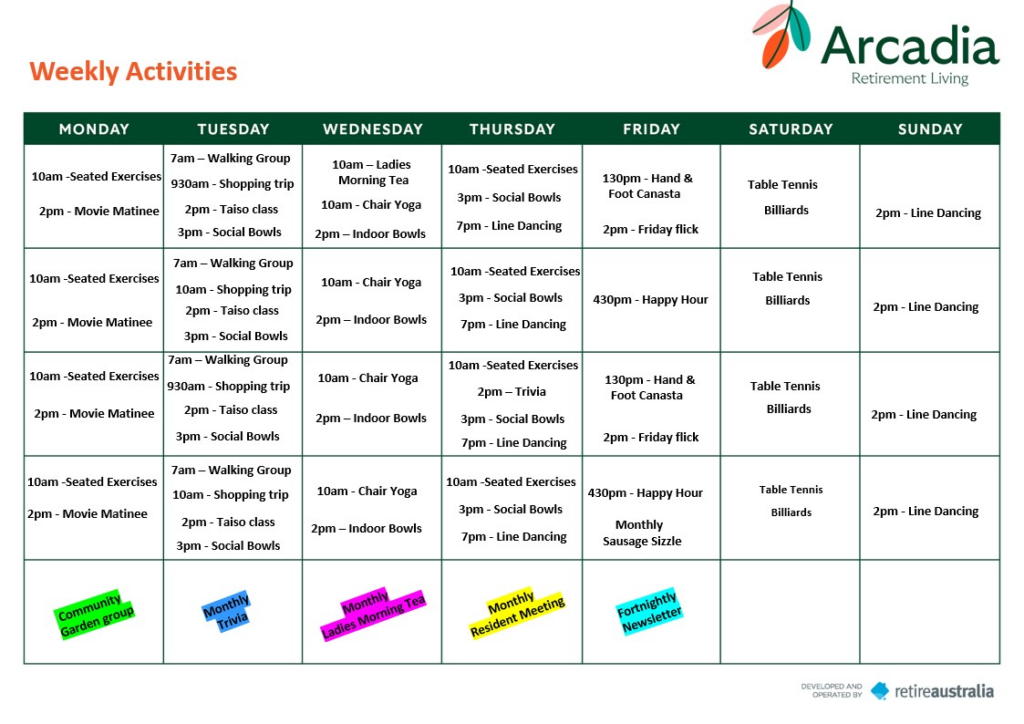
Not to mention a great array of activities to keep your days busy and full of fun. See an example of what an activities calendar at Arcadia could look like:
Security and support
At Arcadia, your safety and comfort are always a priority. Discreet security features, a 24/7 emergency call system, and pet-friendly living create a welcoming environment where you can truly feel at home.
Should you ever need it, support is available around the clock– right in your own apartment. What’s more, our on-site Care Hub offers both short and long-term care in a warm, homelike setting, without the barriers often found in traditional aged care.
Enjoy peace of mind, knowing you’re supported every step of the way – so you can focus on enjoying life your way.
If you have any queries or would like more information about your new life at Arcadia, please contact your sales consultant.
You might also be interested in:
Not receiving our Vitality monthly newsletter yet? Share your details below and we’ll send you monthly updates, helpful tips, and inspiring stories to support you on your retirement journey.
The benefits of retirement living

Retirement living is about more than just a new address. It’s a lifestyle choice that can bring greater connection, peace of mind, and more time for what matters most. Recent research and resident feedback show just how much of a difference it can make.
1. Community and connection
Humans are wired for connection, and community matters. Retirement communities offer a sense of belonging where neighbours become friends, and there’s always the option to join in with social activities, group outings, or a quiet chat. You choose how involved you want to be.
- According to the Better Housing for Better Health Report, residents in retirement communities are up to 5 times more socially active after moving in.
- As one resident shared in our recent satisfaction survey: “I love living here and I have good neighbours and friends here.”
2. Staying active and healthy
With shared spaces, organised activities, and walkable grounds, it’s easier to keep moving and stay engaged in a retirement community. Many people find they’re more active and spend less time worrying about chores or safety. The Retirement Living Council found that residents are 20% less likely to be hospitalised and 15% more frequently physically active after moving into a retirement community.
3. Boost your mood and outlook
Just as importantly, retirement living supports mental wellbeing. The link between physical and mental health is clear, residents in retirement communities are 41% happier than their peers.
Community life fosters purpose, combats loneliness, and helps protect against anxiety and depression. As Beyond Blue notes: “Being connected to others is important for mental wellbeing and can be a protective factor against anxiety and depression.”
4. Peace of mind
Safety and security are key reasons people choose retirement living. Features like an on-site team, an emergency call system and supportive neighbours provide reassurance for both residents and their families.
- In the 2024 RetireAustralia Resident Satisfaction Survey, 91% of residents said they are satisfied with the suitability of their accommodation to meet their needs as they age.
One resident commented: “Overall feel safe. Units are very well positioned. Staff go out of their way to be helpful. Am thankful I am able to live here.”
5. Support, now and in the future
Retirement communities often offer support services—from support booking hotels and taxis, to help with meals, cleaning, and personal care—so you can live independently, knowing help is there if you ever need it. This built-in safety net lets you plan ahead with confidence.
6. More time for what you love
Downsizing means less upkeep and more time for simple pleasures—walks in the garden, hobbies, or catching up with family and friends. With a low-maintenance home, and plentiful amenities, you can focus on what matters to you.
87% of residents in RetireAustralia’s 2024 Resident Satisfaction Survey said they are satisfied with living in their village, and 82% are satisfied with the level of service provided.
To find out more about what to expect at Arcadia, contact your sales consultant.
You might also be interested in:
Not receiving our Vitality monthly newsletter yet? Share your details below and we’ll send you monthly updates, helpful tips, and inspiring stories to support you on your retirement journey.
Selling with less stress

Selling your family home is a big milestone. It’s natural to feel a mix of emotions – balancing open homes, paperwork, and saying goodbye to a place full of memories. Whether you’ve bought and sold many properties before, or it’s been a while, these tips will help make the process much more manageable.
Start early and stay organised
Preparing early makes everything feel easier.
- Create a simple timeline with key steps like decluttering, small repairs, and choosing a real estate agent.
- Tackle one task at a time. Even 30 minutes a week adds up.
- Keep a moving folder with important paperwork so nothing gets misplaced.
Consider timelines
In Queensland, the entire home-sale and settlement process usually takes about 8 to 12 weeks from start to finish. Though it can be faster or slower depending on market conditions and how prepared you are.
Here is a rough timeline of what you can expect:
Preparing your home for sale: 2–6 weeks (depending on readiness).
Listing and marketing: 3–6 weeks.
Contract of sale and cooling-off: immediate to 5 business days after signing.
Conditional period (finance, building, pest): typically 14–21 days.
Unconditional contract: immediately after all conditions satisfied.
Settlement: the standard is 30 days from contract date, but this is negotiable. Can often be up to 90 days.
Moving out: 1–3 days before settlement.
In today’s unpredictable housing market, there are options for extended settlements or rent-back agreements. Speak to your real estate agent and conveyancer early about timing flexibility.
Lean on the experts
You don’t have to do it all yourself.
- Real estate agents handle marketing, open homes, and negotiations.
- Downsizing consultants or removalists can help with sorting and logistics.
- Tradespeople can take care of small, value-boosting jobs.
Choose people you trust and who understand your goals.
Focus on quick wins
You don’t need a full renovation to impress buyers. Simple touches can make a big difference:
- Fresh paint and clean windows.
- Tidy garden and welcoming entryway.
- Decluttered spaces that let buyers imagine themselves at home.
Manage the emotional side
It’s natural to feel attached to your home. Give yourself time to reflect on the life that you’ve lived there.
- Take photos or create a memory book.
- Pass on keepsakes to family members.
- Remember, the sale is a positive step toward new opportunities.
Keep stress in check
Small routines can make things run smoothly:
- Pack a “go bag” with essentials for open home days.
- Schedule inspections at times that suit you.
- Look after yourself: walk, rest, or catch up with friends to recharge.
Looking ahead
Selling doesn’t have to feel overwhelming. With some early planning, the right support, and a focus on what matters, you can move through the process with confidence. And soon, you will be looking forward to your next chapter at Arcadia.
You might also be interested in:
Not receiving our Vitality monthly newsletter yet? Share your details below and we’ll send you monthly updates, helpful tips, and inspiring stories to support you on your retirement journey.