As we age and our care needs increase, the decision to enter into aged care is often challenging. And whether you’re making this decision for yourself or a loved one, questions of care, respect and quality of life are usually top of mind.
Perhaps the biggest consideration of all though, is whether or not you (or your loved one) will ever really feel at home again. Well, unfortunately, in many traditional aged care settings the answer is no.
There’s often no option to bring your own furniture, no ability to bring pets, no guarantee couples will be close by (or even in the same facility), and little choice when it comes to how and when care needs are attended to.
This is what makes Glengara Care such a breath of fresh air in the aged care space. The care model is led by a team of registered nurses, so residents at Glengara Care not only have the security of knowing the highest level of care is always on call, but also the comfort of being able to make it their home in every sense of the word.
How is Glengara Care different to traditional aged care?
Glengara Care was conceived and constructed with quality of life and the wellbeing of residents as its core philosophy. This means Glengara Care residents can:
Move in as a couple
Bring their own furniture
Bring pets
Cook their own meals (if they choose)
Have family and friends visit and stay
Lock their door
Choose the care they want, and when they want it
Be involved in as much or as little as they want in the stunning Glengara Retirement Village
It’s designed to feel like home, a place where health and wellbeing can improve and where privacy, dignity and independence are valued.
Glengara Care is truly redefining aged care on the Central Coast. And while we won’t pretend that moving to aged care isn’t still a challenging time, the certainty, choice and care offered to residents (and their families) certainly makes things easier.
In addition to caring for our many happy residents, we also offer short-term respite stays for those who are recovering or need extra support to get back on their feet.
Interested in learning more? Contact our sales consultants and arrange an inspection today.
Retirement living expert Rachel Lane, author of the best-seller “Aged Care, Who Cares’’ and “Downsizing Made Simple’’, says that when people are choosing a retirement village, they often don’t pay enough attention to the things that will affect them both while living in the village and when they leave.
“Retirement villages can be very different, and it is not as simple as comparing apples with apples,” Ms Lane said.
“For a true cost comparison, you need to look beyond the upfront fees and factor in ingoing, ongoing and outgoing costs such as exit fees.”
The latest retirement community on the Gold Coast, The Verge at Burleigh G.C., offers a contract specifically designed to increase financial certainty for retirees. It gives retirees clarity, certainty and confidence at every stage.
The team at RetireAustralia, who own and operate the new vertical retirement village overlooking the 10th tee of the Burleigh Golf Course, say they understand that retirees need certainty about their financial future.
“Moving into a retirement village is a big decision and retirees might feel concerned about affordability and hidden costs,” said RetireAustralia Chief Executive Officer, Dr Brett Robinson.
“It’s important to us that retirees and their family members have peace of mind from the very beginning. That’s why our sales contract for The Verge offers a simplified financial process and a high level of financial clarity at every stage,’’ Dr Robinson said.
“We specify, upfront, what the costs are and what they cover. So residents know exactly what they will need to pay for the duration of their stay at The Verge. The monthly service fees will be charged on a cost-recovery basis only and cannot be increased more than the Consumer Price Index without the approval of village residents.
“For further peace of mind, from the day residents move in, they will know the outgoing payment they will receive. In uncertain times, many people find it comforting to know where they stand financially. ”
Set beside Burleigh Golf Club’s 10th tee, The Verge offers residents access to a rooftop terrace, bar and Wellness Centre with a gym, consultation rooms for allied health professionals, indoor and outdoor activity areas and its own “Tee House” café. The location also offers an exceptional coastal lifestyle, close to the beach and top dining experiences, shopping and entertainment hubs.
Lorelei Bache, the first future resident to register an expression of interest in a home at The Verge, said the village’s prime location and layout “ticked all the boxes’’ for her.
She said it would also allow her to keep busy, forge new friendships, and take advantage of the myriad opportunities to pursue new hobbies and interests.
“The Verge provides the perfect indoor/outdoor lifestyle. The Gold Coast’s prime lifestyle location is between Broadbeach and Burleigh, and from my apartment, I will also have a lovely view of the golf course.”
‘The other benefit to vertical living at The Verge is the safety and security you get from being elevated, the ability to lock up and go as I please means I can live the life I want. And the low maintenance lifestyle is very appealing, leaving more time for family, friends and my new hobbies. ‘
The Verge offers stylish one-, two- and three-bedroom apartments with spacious balconies and floor-to-ceiling windows with expansive views. Every apartment has been thoughtfully designed to offer a low-maintenance lifestyle, with privacy, security and age-friendly layouts to suit changing needs.
Construction at The Verge is well underway with a number of independent living apartments already secured. One-bedroom apartments are priced from $510,000. Enquire now!
For more information or to register your interest in an apartment at The Verge, visit thevergeburleigh.com.au or call 1800 955 070.
At RetireAustralia, our residents are at the heart of everything we do and we consider our communities and team members to be part of what we call, the RA Family. As Care Manager at Glengara Care, Sharon Stuart-Gray is the familiar face that residents see every day, and she embodies the caring spirit that bring our communities to life. Here are her top five tips for good health this winter.
1. Regular hand washing
This might seem simple but good and regular hand washing is key to getting rid of germs. It’s also our best fight against coronavirus. Even though we’re making great progress in terms of flattening the curve in Australia, it’s important to stay vigilant while COVID-19 remains in the broader community.
2. Get a good night’s sleep
It’s easier to go to bed earlier in the cooler months and nothing beats a warm blanket to keep you cosy. Your body will thank you for an early night, which gives you the opportunity to restore energy, reduce stress, and improve your immune function.
3. Keep warm
Invest in some warmer clothing, bedding or even a nice throw blanket that sits on your lounge chair, so you can stay toasty even as the weather gets cooler. If you’re crafty or looking for a new hobby, you might enjoy taking the time to knit something special.
4. Meditate
Taking some time out is important for all of us – it doesn’t mean you need to be become a spiritual guru overnight. Your daily meditation might mean sitting in a quiet spot listening to calming music. For others, it could be a walk in nature or a reading a book in a sunlit room.
5. Eat well
Eating healthy foods should be a daily habit but this is especially true in winter. Lots of seasonal fruit and vegetables will ensure you get the right vitamins to stay healthy throughout the colder months.
An affinity for care
Sharon takes time each day to meet with residents, ensuring they are comfortable and feel free to voice any concerns. She works on their care plans and ensures they have sufficient medication, doctors’ visits scheduled, correct nutrition and social activities organised. Recently, Glengara Care had their first pet, Lucy the cat, move into the community, much to the delight of Sharon and her team.
Sharon genuinely loves being a part of the care team at RetireAustralia, and is proud of working in an environment which gives residents a choice in the care they receive. “I look forward to coming to work every day. I love caring for our residents, I love seeing how happy they are here and making a difference in their lives”.
Brad’s winter warmer recipe is easy to make at home, and will have your mouth watering as the rich smells fill your kitchen. The beef cheeks are slowly braised until the meat is so tender it will melt in your mouth.
Braised beef cheeks with salsa verde
Ingredients
750ml bottle red wine
2 tablespoons olive oil
6 beef cheeks, trimmed
2 tablespoons plain flour, seasoned, to dust
2 onions, chopped
4 garlic cloves, chopped
2L (8 cups) good-quality beef stock
2 bay leaves
Mashed potato, to serve
Salsa Verde
1/3 cup (80ml) extra virgin olive oil
2 cups flat-leaf parsley leaves
1 cup basil leaves
1/2 cup mint leaves
2 tablespoons each Dijon mustard, red wine vinegar and rinsed, salted capers
Method
Preheat the oven to 170°C. Place the wine in a pan and simmer over medium heat for 10 minutes or until reduced by half. Set aside. Heat oil in a large flameproof casserole over medium-high heat. Dust beef in flour, shaking off excess. Brown beef, in batches, for 2 minutes each side, adding more oil if necessary. Remove and set aside.
Add the onion to the pan, reduce heat to medium and cook, stirring, for 5 minutes or until softened. Stir in garlic, then return beef to pan. Add reduced wine, stock and bay leaves, then season. The meat should be completely covered with liquid, so top up with water if necessary. Cover and cook in the oven for 2 1/2 hours or until the beef is meltingly tender.
Meanwhile, to make the salsa verde, place the ingredients in a blender and blend to form a smooth paste. Season to taste.
Transfer beef to a plate, then cover with foil to keep warm. Place casserole over medium-high heat for 10 minutes or until the sauce thickens. Serve the beef with the sauce, mashed potato and salsa verde.
Meet RetireAustralia’s Chefs
As Head Chef at Belrose Country Club, Brad Milligan has been treating residents to delicious food for over 17 years. While Brad loves a good practical joke with his work mates, it’s his passion for cooking that has created countless more smiles among the Belrose community. Brad balances his work and home life to spend time with his 10 year old twin boys, but says it’s equally important to create delicious wholesome meals for his RA Family.
Brad’s proudest moment in the kitchen was cooking a traditional Christmas dinner for 150 residents, complemented by his famous Christmas pudding drizzled with brandy custard. As he says, “the best part of my day is putting smiles on the residents’ faces and knowing they are enjoying the meals I create.”
With more than 25 years under his gardening belt, Noyea Head Gardener Scott Herse has you covered this winter. Here are his tips to keep your garden fresh.
It can be hard to keep your garden looking green and fresh during the winter months. Thankfully, Scott Herse, Head Gardener at Noyea Retirement Village, has given us his tips to spruce up your garden this winter and keep it looking its best.
1. It’s time to prune your roses
Get your gardening gloves ready, because Scott says this is the perfect time to prune your roses. This includes fertilising, mulching and any replanting if need be.
2. Tidy in time for spring
All areas of the garden will need pruning, weeding and mulching ready for the spring. The soil is generally moist in winter which makes it easier to pull weeds.
3. Plant your annuals and bulbs
Now is a great time to start planting so you have a beautiful flowering display in spring. Visit your local nursery for advice on what to plant in your area.
4. Care for your citrus
After your citrus trees have finished fruiting they will start flowering in winter. At this point, it’s best to fertilise, mulch and water.
5. Design and improve
Winter is a great time for planning and preparation. You could complete that improvement job you’ve always wanted to do, or plan a new design for the garden. To get your ideas flourishing, consider preparing a vegetable patch, designing a new rose bed or planting now so you can enjoy a colourful display in spring.
A green thumb flourishes
For over 25 five years, Scott, has proudly maintained the gardens at Noyea Retirement Village. Every day Scott likes to create a plan for the day ahead – be it mowing, watering, mulching, pruning or replacing light bulbs. But, like all plans, things don’t always go to schedule! Some days Scott is called upon to assist with urgent tasks, such as fixing water leaks or supervising external contractors
Scott started as a junior in the early 90s, and has since gained much of his knowledge from his Managers at Noyea, as well as various contractors and tradespeople. His skills have flourished in that time, and he finds great purpose in keeping the gardens beautiful. “Back then I was pushing a wheelbarrow around the village, and now in 2020 I supervise a team of two, with golf buggies and a large range of modern garden machinery. I’ve always enjoyed working outside maintaining the gardens and grounds and ensuring our residents have an enjoyable place to live.”
If you’re thinking of moving into a retirement village, there are lots of things to weigh up and money is one of the biggest considerations.
You’ll likely have lots of questions, not just about how much it will cost to move in but how much it will cost on an ongoing basis, and when it comes time to leave.
We understand you need certainty about your financial future, and that you might feel concerned about affordability and hidden costs. Let’s walk through each step of the process so you know exactly what to expect.
Payments – how much, when, and will they change over time?*
The Verge at Burleigh G.C., a brand new retirement village under construction on the Gold Coast, will operate under a leasehold agreement where residents purchase a long-term lease (usually 99 years) to live in their home. This is the most common types of agreement in RetireAustralia villages.
To increase financial certainty, we’ve made our contracts as clear and transparent as possible. We specify, upfront, which costs you’ll need to pay, and what they cover. Here’s a quick breakdown of the fees you would need to pay for the duration of your stay in our brand new leasehold community on the Gold Coast.
Entry payment
Your entry payment gives you the right to reside in your new home. This payment is relative to the locally property market and demand for homes in the retirement village.
Unlike more property transactions, you will not have to pay stamp duty on your unit, leaving you with extra money in your pocket to enjoy while you’re settling in.
Monthly service fees
Village fees include property expenses and village management and administration costs.
Property costs include:
Council and water rates
Building insurance
Maintenance and repair of capital items in the village
Building and garden maintenance
Cleaning and maintenance of village facilities
Community staff
Community bus
Village management and administration costs include:
Village management
24-hour emergency call provision and monitoring
Facilities and activities
Event coordination
By law, this fee is charged on a cost-recovery basis only and retirement village operators cannot profit from it. You can also rest assured that it can’t be increased greater than the Consumer Price Index without the approval of village residents. For further peace of mind, these fees are audited by an independent party each year.
Deferred Management Fee (DMF) *
What is the DMF?
The deferred management fee, or sometimes referred to as DMF, exit fee or departure fee, is payable when you leave the village and allows us to keep our entry prices as competitive as possible, leaving you with more cash in your pocket to enjoy life in the village after you move in.
The DMF is the only fee that allows RetireAustralia to reinvest back into your village, through capital replacement works, maintenance of communal facilities, and village upgrades. This helps maintain value in your home and community, which is important when it comes time to sell.
How is the DMF calculated?
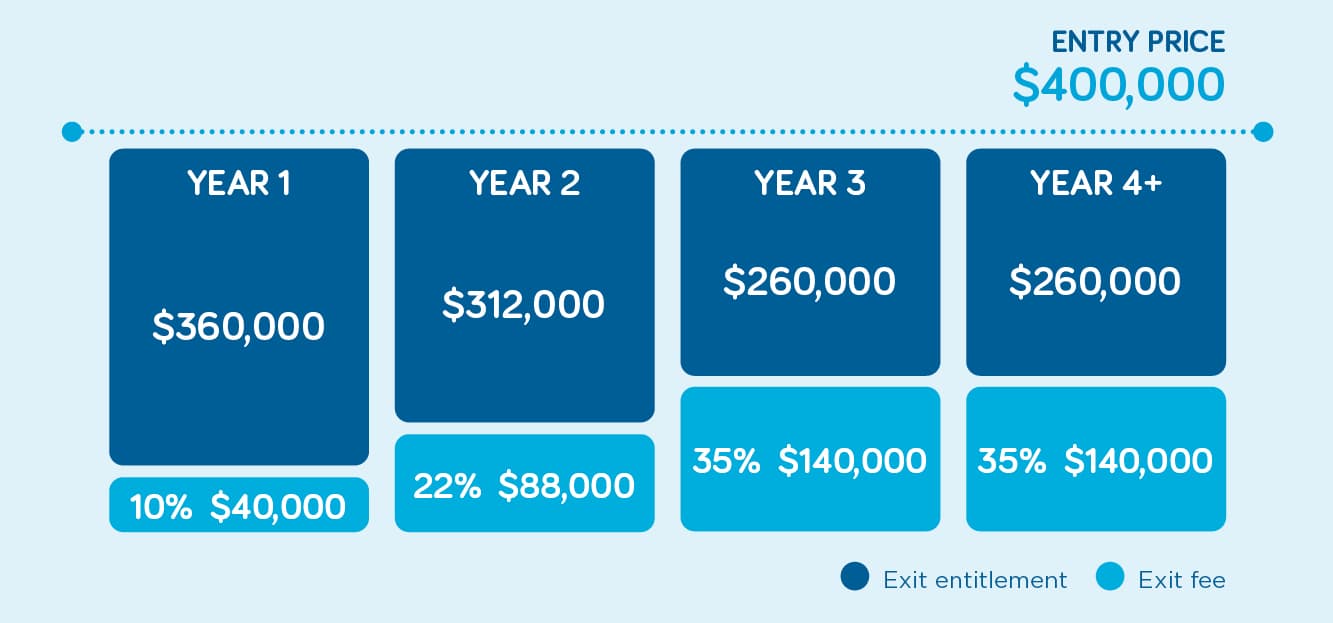
When it comes time to leave The Verge at Burleigh G.C., you’ll receive an exit entitlement, which is the purchase price minus the DMF. This fee is capped at 35%of your entry price and is stepped during your first five years in the village. There are no further increases after this period, no matter how long you stay.
From the day you move in, you’ll be able to calculate how much you will receive when you exit the village – making your future budgeting clear and predictable.
DMF example
#If you exit the village during the first 6 months (that is, during the Settling-In Period), you will not pay an exit fee.
Note: If you occupy your apartment for less than a whole year, your exit fee will be calculated on a daily basis.
What do I get for my money?
Our residents tell us that choosing to move into a retirement village is about far more than bricks and mortar. In reality, it’s an investment in you. You’ll be moving into a friendly community filled with people at the same stage of life, and you’ll have access to a range of amenities.
At The Verge at Burleigh G.C., this includes things like:
Café
BBQ areas
Indoor and outdoor meeting places
Gardens
Residents’ bar
Library
Community Hub Wellness hub with gym equipment and fitness classes
Treatment rooms for visiting health professionals
You can also get involved in a range of interest groups, social activities and events from happy hour to mini-golf and more – it’s really up to you and the community.
What’s more, when you don’t need to worry about maintaining your house and garden, you’ll actually have time to explore new interests!
These intangible benefits are an important consideration, and should be weighed up alongside the financials. Moving into a retirement village is about so much more than the property. Residents tell us that the lifestyle, health and wellbeing benefits enhance their quality of life immeasurably.
What if I change my mind?
We want you to feel secure and confident in your decision, so we have extended the statutory 14-day cooling off period for buying an apartment in a retirement village to 21 days. We’ll return your deposit in full if you change your mind during the 21-day cooling off period.
Further to this, if you decide The Verge at Burleigh G.C. isn’t right for you within 6 months of moving in, we’ll repay your entry price (less any fees and costs*) within 30 days so you can focus on your next move.
*Additional fees and costs when you buy and when you leave may include legal, registration or other applicable fees as well as reinstatement costs.
What if my care needs change?
If your needs change, you can rest easy knowing you can access care and support if you need it. At The Verge, you will be able to receive flexible care and support in your home from RetireAustralia’s Home Care team or a provider of your choice.
Our Home Care service makes life a little easier and gives you peace of mind that, should your needs change, you can continue to stay safely in your own home for longer. Our care team can help with household chores, meal preparation, showering, dressing, and medication support, to name a few.
Care is tailored to your individual needs and funded privately or through access to an approved government funded Home Care Package (HCP). We can even help you navigate HCP approval through My Aged Care, the government assistance platform.
How can I compare the cost of living in a retirement village with other options?
A true cost of living comparison can only be obtained by spending time with a sales consultant in a village, talking through your circumstances and needs, and understanding the fees and inclusions in your chosen village. You also need to do your own homework and make sure you have an accurate picture of your current living expenses to make the comparison valid.
In a general sense, retirement villages offer great cost of living value but trying to put a specific dollar figure to this comparison can easily become misleading. Your own cost of living and those applicable to villages can vary substantially, so it’s best to check with your village of choice directly.
On top of the hard costs listed above which village fees cover, the costs associated with living in a retirement village also provide residents with a sense of community and belonging, support from friends and staff, and numerous opportunities to lead a happy, active and healthy life.
Placing a value on these intangible benefits is very personal to each individual. To get more of an insight into what it is like to live in one of our retirement villages, take a look at our retirement stories and insights.
Many people put off moving into a retirement village because they’re concerned about downsizing. But is this concern justified?
Often, the biggest concern with moving into a retirement village is downsizing – what does it entail, is it worth it, and do residents miss their old house or neighbourhood? Everyone’s experience is unique, but the comment we hear most often from residents is, ‘I wish I’d made the move sooner’. Here, we break down what’s involved in downsizing, the pros and cons, and how you can tackle the process.
1. Make a plan
First things first, make a plan. Look at the floor plan and dimensions of your new home and decide how much of your furniture will fit the space. If it feels hard to let things go, consider putting furniture or larger pieces in storage while your house is on the market. You might be surprised by how little you miss them during this process.
2. Clear the clutter
It’s amazing how much we accumulate over the years, and the prospect of sorting through a lifetime of possessions and memories might seem overwhelming. That’s why we’ve put together a list of handy tips to make the de-cluttering process easier:
Start early. By making decisions well in advance of your actual move date, you’ll have time to sort out what’s most important to you and what you can let go.
Set yourself up for success.Start with items you’re not emotionally attached to, like outdated paperwork, kitchen utensils, stationery supplies, clothes and linen. Once you’ve done this, you can work your way up to photos, books, and sentimental memorabilia.
Prioritise. Write a list of non-negotiables – items you absolutely can’t live without – and try to assess the rest of your possessions with a critical eye.
Keep your focus narrow. Don’t tackle the whole house at once, but deal with one room, cupboard or zone at a time.
Break it into bite-sized chunks. It’s far more effective to consistently set aside 15 minutes a day than attempt to sort through years of memories in one weekend.
Be honest. Ask yourself “do I need it, use it or love it?” Be honest with yourself and remember objects don’t have feelings.
Take photos. Consider taking photographs or videos of things that can’t go to your new home. It will preserve the memory without taking up any space.
Swap old for new. It’s still OK to buy new items but try adopting ‘the one in / one out’ rule. For example, if you buy a new set of wine glasses, donate the existing ones.
Remember why you’re doing this. Research shows that clutter can affect mental wellbeing and add to feelings of stress. On the flipside, clearing out things you no longer want or need can be intensely liberating.
3. Find a new home for what you don’t need
Once you’ve de-cluttered, you might be wondering what to do with all the belongings you’re not taking with you to your new apartment or villa. You could consider selling big-ticket items like a lawnmower, and giving other pieces to family or charity. Knowing that a much-loved item will have a new lease of life in someone else’s home might help you let it go – and emotionally prepare for the move.
4. Enlist help
This is likely to be one of the most important moves you make, and it’s far easier to tackle if you can share the load among many. Ask professionals, family or neighbours to lend a hand – either with de-cluttering, packing, moving or cleaning.
5. Look to the future
If the magnitude of the project feels overwhelming, focus on what you’re gaining, rather than what you’re leaving behind. If you’re unsure if this is the right decision, weigh up the pros and cons:
The process of de-cluttering can take an emotional toll, but it will also simplify your life. What’s more, it can make the process of moving house much more manageable. Less clutter means less packing, physical effort and expense.
Sorting through all your possessions is time-consuming, but could benefit you financially. Your real estate agent is more likely to get a great price for your house if it’s streamlined and clutter-free. If you’d like to know more about the process of selling a house, we’ve got you covered.
It might be hard to emotionally let go of your house and possessions, but think about what life in a retirement village will be like – no more gardening to worry about, or the need to maintain a property you’ve outgrown. There will also be a welcoming community, ample opportunities for social connection, and a raft of activities on offer.
If you have questions about downsizing, speak to the sales consultant at the retirement community you’re most interested in. After all, they’ve seen hundreds of people go through the exact same process, and will be able to give you advice and point you in the right direction. They might even be able to connect you with residents who’ve recently made the move.
The decision to sell your house isn’t always straightforward. Here, we go through the sales process, costs involved, and tips to maximise the sale price.
If you’ve lived in your house for years or even decades, it can be hard to move on. Your home can be linked to cherished memories of family, milestones and celebrations, and evoke feelings of security and comfort. To prepare for selling your house and taking the next step in retirement, it can help to have an idea of what to expect from the sales process.
Do your homework
Before you choose an agent, start by researching local real estate agencies. If you have friends or family close by, it’s great to ask for personal recommendations. After all, this will be the biggest sale you’re likely to make, and having trust and respect for the agent is crucial.
You might like to check out listings and sales prices in your area, to get a gauge for what similar properties are worth. You could even visit properties for sale and see how the agent treats prospective buyers and answers questions – consider asking about whether the vendors are willing to negotiate the sale price, how long the property has been on the market and why they’re selling.
Then, create a shortlist of at least three agents you would like to meet face-to-face and don’t be afraid to ask questions when you meet them. Here are some for consideration:
Would they recommend a private sale or auction? Why?
How much are their agents’ fees, and how do they calculate this figure? Is it a fixed fee or a percentage of the sale price? This is also known as commission and is generally between 1.5% and 3.5% of the agreed price. Most agents’ fees don’t include advertising, so be clear on how much the recommended campaign would cost.
How would they go about marketing your home? This could involve web listings, sign boards outside your house, photography, floor plans and copywriting, as well as social media and email campaigns.
What work (if any) would they recommend you do to make your home more attractive to buyers?
How would they value your home? Can they provide you with a property profile that includes information about sales of comparable properties in your area? Would they recommend specifying an asking price (if not going to auction), or a broader price guide?
Choose an agent
If you take time to do your research and meet with several agents, you’ll have a good idea of what your property is worth. You’ll also have a good sense of which agent is best suited to you. Keep in mind that some agents could be tempted to overvalue your property to increase the likelihood of getting your business, so base your decision on many factors – not just who has the lowest commission or says they could obtain the highest sale price.
Prepare your home for sale
To maximise its potential value, look at your home with a critical eye and decide whether a small upfront investment could have a big impact. There are several ways you could make your home more attractive to prospective buyers:
Assess the frontage of your home, as some buyers will drive past before they commit to attending an open house. Would the garden benefit from some tidying or weeding, or can you add a splash of colour with new plants or pots?
Keep things as open, airy and uncluttered as possible. This might mean putting some furniture in storage during the sale process.
Neutral colours are best. Consider painting over any obvious marks, or even re-painting if the paint job is tired or the colours are dated.
Fix anything in need of obvious repair, and attend to small maintenance jobs, like missing light globes or loose door handles.
Have your carpets professionally cleaned.
Tidy up your cupboards. It’s easy to think ‘out of sight, out of mind’, but buyers are sure to open cupboards and drawers to get a good idea of storage space.
Clear the clutter. This will help your home look bigger and more spacious. Think big – taking away unnecessary furniture – as well as small – clearing any flat surface, having tidy kitchen bench tops and removing fridge magnets.
Help prospective buyers see themselves living in your house, by removing any bold furniture or artwork, as well as personal touches like photographs.
Inspection day.
Make sure your house is spotless on inspection day, with no laundry or washing up in sight. Turn on all the lights, open the windows and doors, and show your house at its best. Keep your home as comfortable as possible, with fans or air conditioning on in summer, and a fire or heater in the cooler months. It helps to have a bright bunch of flowers in the kitchen to add a splash of colour. Finally, make sure you leave the house during inspections to help put prospective buyers at ease. This includes any pets who live with you!
Other costs to keep in mind
As well as covering your agents’ fees and marketing campaign, keep in mind that you’ll need some money set aside for conveyancing. This simply means the legal transfer of ownership from you to the buyer. If you have a mortgage on the house you’re selling, you may also need to pay your bank or lender an early exit fee. The cost of selling your home varies by state, but you can find a comprehensive breakdown of likely real estate agent commission, marketing and conveyancing fees here.
Need advice?
For more advice about buying and selling a property in your state, go to:
Retirement villages are residential communities designed for people who are generally over the age of 65 and retired from full-time work. However, plenty of residents continue to work or volunteer part-time while enjoying village life.
How do retirement villages differ from aged care?
While retirement villages are designed for active and independent retirees, aged care facilities cater for those who need full-time care and can no longer live independently. Most aged care facilities focus on clinical-based care for older Australians who are unable to live independently in their own homes. People in retirement villages still enjoy the benefits and privacy of having their own home, without the worry of day-to-day property maintenance or gardening which are taken care of by village staff.
Residents in retirement villages also have access to a range of village facilities and are surrounded by like-minded people who engage in a wide range of social activities and events.
Moving into aged care is rarely a choice: it often occurs following a significant health incident or when it’s considered necessary for one’s health and safety. In contrast, moving into a retirement village should be a choice at a time in an individual’s life where they can benefit from all that retirement village living has offers.
Are retirement villages the same as land lease communities?
Also known as ‘over 55s lifestyle communities’, ‘manufactured home estates’ and ‘resort communities’, land lease communities are residential communities for older residents and offer many of the same benefits. They may look similar from the outside, but there are fundamental differences. For instance, land lease communities are legislated under the same laws as manufactured homes parks and caravan parks, so if the operator ceases to exist, your right to remain in your home isn’t protected. On the flipside, your right to live in your home is protected in a retirement village, which operates under the Retirement Villages Act. For more information, see our article: Retirement village or land lease community?
What’s it like to live in a retirement village?
Good question! Retirement villages are hubs of activity with ample opportunity for social connection. Facilities will vary by village, but you could have access to amenities like a swimming pool, community centre, library and hairdresser. You can read what some of our residents think about village life.
Will I own my house?
The Verge at Burleigh G.C., our brand new retirement community on the Gold Coast, will operate on a leasehold ownership agreement, which means RetireAustralia owns the land and the units, while you acquire the right to reside in your home for the duration of a long-term lease, generally 99 years. Your tenancy is secure for as long as you want to stay. The upshot of this is that you won’t need to pay stamp duty, which is generally one of the biggest upfront costs when buying a property.
How much will it cost?
To increase financial certainty, we’ve made our contracts as clear and transparent as possible. We specify, upfront, which costs you’ll need to pay, and what they cover. Here’s a quick breakdown of the fees you’ll need to pay over the duration of your stay in our leasehold retirement village on the Gold Coast – The Verge at Burleigh G.C.
Entry payment
Your entry payment gives you the right to reside in your new home and is typically less than the local median housing price.
You will not have to pay stamp duty on your unit, leaving you with extra money in your pocket to enjoy while you’re settling in.
Monthly service fees
These cover our operating costs, as well as council and water rates, building insurance, home and garden maintenance, upkeep of shared facilities, and support staff such as your Village Manager. By law, retirement village operators cannot profit from services charges, and these fees are regulated by the Queensland Retirement Villages Act.
Management fee*
When it comes time to leave The Verge at Burleigh G.C., you’ll receive an exit entitlement, which is the purchase price minus the management fee. This fee is capped at 35%of your entry price and is stepped during your first five years in the village. There are no further increases after this period, no matter how long you stay.
By charging this on exit – rather than incorporating it into the purchase price – you’ll not only free up your cashflow but find that your move into the village is much more affordable.
What age do I have to be?
RetireAustralia villages are designed for people over the age of 65.
Can I live in a retirement village on a pension?
Absolutely. Many of our residents receive an age pension. Your eligibility largely depends on the size of the entry payment you make when you move into the village – also known as an entry contribution (EC), compared to the extra allowable amount (EAA). The government compares these figures to determine if you’re considered a home owner. If the entry payment is less than the EAA, you may be eligible for rent assistance. See the federal government’s ‘Social Security Guide’ for more information.
Can I rent in a retirement village?
We don’t currently offer the option to rent, but if affordability is a concern for you, please give us a call. We can talk you through our most cost-effective communities and see if we can find a home that suits your budget.
What happens if my care needs change?
If your needs change, you can rest easy knowing you can access care and support if you need it. At The Verge, you will be able to receive flexible care and support in your home from RetireAustralia’s Support at Home team or a provider of your choice.
Our Support at Home service makes life a little easier and gives you peace of mind that, should your needs change, you can continue to stay safely in your own home for longer. Our care team can help with household chores, meal preparation, showering, dressing, and medication support, to name a few. Support is tailored to your individual needs and funded privately or through access to an approved government funding.
Can visitors stay with me?
Absolutely! This is your home and we want you to treat it as such. We encourage family and friends to visit and stay overnight if that suits. It varies by village, but guests can stay between two weeks and 30 days without requiring approval. Simply let your Village Manager know so we can keep an eye out for your guest(s) and treat them as part of the RetireAustralia family.
Can my pet live with me?
Many RetireAustralia communities are pet friendly. Search here to find out if your furry friend could join you in your ideal community.
Why live with Retire Australia?
You’ll be looked after by an experienced team We know retirement living, and we understand the needs of older Australians.
Your wellbeing is at the heart of everything we do We are passionate about providing an exceptional standard of living for our residents.
You’ll love the service you receive We’re always striving to better serve the people who reside in our communities.
You’ll feel at home We create welcoming communities through homelike design that make your experience comfortable and inviting.
Find out what you’re missing out on at The Verge at Burleigh G.C.– visit us, meet our team and tour our sales suite.
Retirement villages are residential communities designed for people who are generally over the age of 65 and retired from full-time work. However, plenty of residents continue to work or volunteer part-time while enjoying village life.
How do retirement villages differ from aged care?
While retirement villages are designed for active and independent retirees, aged care facilities cater for those who need full-time care and can no longer live independently. Most aged care facilities focus on clinical-based care for older Australians who are unable to live independently in their own homes. People in retirement villages still enjoy the benefits and privacy of having their own home, without the worry of day-to-day property maintenance or gardening which are taken care of by village staff.
Residents in retirement villages also have access to a range of village facilities and are surrounded by like-minded people who engage in a wide range of social activities and events.
Moving into aged care is rarely a choice: it often occurs following a significant health incident or when it’s considered necessary for one’s health and safety. In contrast, moving into a retirement village should be a choice at a time in an individual’s life where they can benefit from all that retirement village living has offers.
Are retirement villages the same as land lease communities?
Also known as ‘over 55s lifestyle communities’, ‘manufactured home estates’ and ‘resort communities’, land lease communities are residential communities for older residents and offer many of the same benefits. They may look similar from the outside, but there are fundamental differences. For instance, land lease communities are legislated under the same laws as manufactured homes parks and caravan parks, so if the operator ceases to exist, your right to remain in your home isn’t protected. On the flipside, your right to live in your home is protected in a retirement village, which operates under the Retirement Villages Act. For more information, see our article: Retirement villages or land lease community?
What’s it like to live in a retirement village?
Good question! Retirement villages are hubs of activity with ample opportunity for social connection. They also have plenty of space allowing for privacy and living life on your own terms. Facilities will vary by village, but you could have access to amenities like a swimming pool, community centre, library and hairdresser. You can read what some residents think about village life, or find out more about retirement living by checking out some real stories about village life.
Will I own my house?
Most of our villages operate on a leasehold ownership agreement, which means RetireAustralia owns the land and the unit, while you acquire the right to reside in your home for the duration of a long-term lease, generally 99 years. Your tenancy is secure for as long as you want to stay. The upshot of this is that you won’t need to pay stamp duty, which is generally one of the biggest upfront costs when buying a property.
We have villages* that offer a freehold strata title agreement, in which you own your home and share ownership of common facilities and land with your fellow residents. Under this ownership model, you’re required to pay the costs associated with this ownership – including stamp duty and ongoing strata fees.
To increase financial certainty, we’ve made our contracts as clear and transparent as possible. We specify, upfront, which costs you’ll need to pay, and what they cover. Here’s a quick breakdown of the fees you’ll need to pay over the duration of your stay in one of our leasehold villages:
Entry payment
Your entry payment gives you the right to reside in your new home and is typically 70-80% of the local median housing price.
You will not have to pay stamp duty on your unit, leaving you with extra money in your pocket to enjoy while you’re settling in.
Monthly service fees
These cover our operating costs, as well as council and water rates, building insurance, home and garden maintenance, upkeep of shared facilities, and support staff such as your Village Manager. By law, retirement village operators cannot profit from services charges, and these fees are regulated by the Retirement Village Act for each state.
Management fee*
When it comes time to leave one of our leasehold title villages, you’ll receive an exit entitlement, which is the purchase price minus the management fee. This fee is capped at 35%of your entry price and is stepped during your first three years in a village. There are no further increases after this period, no matter how long you stay.
By charging this on exit – rather than incorporating it into the purchase price – you’ll not only free up your cashflow but find that your move into the village is much more affordable.
RetireAustralia villages are designed for people over the age of 65, but most people are older.
Can I live in a retirement village on a pension?
Absolutely. Many of our residents receive an age pension. Your eligibility largely depends on the size of the entry payment you make when you move into the village – also known as an entry contribution (EC), compared to the extra allowable amount (EAA). The government compares these figures to determine if you’re considered a home owner. If the entry payment is less than the EAA, you may be eligible for rent assistance. See the federal government’s ‘Social Security Guide’ for more information.
Can I rent in a retirement village?
We don’t currently offer the option to rent, but if affordability is a concern for you, please give us a call. We can talk you through our most cost-effective communities and see if we can find a home that suits your budget.
What happens if my care needs change?
RetireAustralia promotes a ‘village for life’ philosophy, and at many of our villages we provide a range of living and care options to suit people at different stages of life. This means you can stay in the village you’ve come to know and love, even as your needs change.
Can visitors stay with me?
Absolutely! This is your home and we want you to treat it as such. We encourage family and friends to visit and stay overnight if that suits. It varies by village, but guests can stay between two weeks and 30 days without requiring approval. Simply let your Village Manager know so we can keep an eye out for your guest(s) and treat them as part of the RetireAustralia family.
Can my pet live with me?
Many RetireAustralia communities are pet friendly. Search here to find out if your furry friend could join you in your ideal community.
Why live with Retire Australia?
You’ll be looked after by an experienced team We know retirement living, and we understand the needs of older Australians.
Your wellbeing is at the heart of everything we do We are passionate about providing an exceptional standard of living for our residents.
You’ll love the service you receive We’re always striving to better serve the people who reside in our communities.
You’ll feel at home We create welcoming communities through homelike design that make your experience comfortable and inviting.