HomeStories & InsightsThank you the Green Clone Test

Your top retirement living questions answered

What would you like to know about living in a retirement village? Here, we answer the most commonly asked questions.

What is a retirement village?

Retirement villages are residential communities designed for people who are generally over the age of 65 and retired from full-time work. However, plenty of residents continue to work or volunteer part-time while enjoying village life.

How do retirement villages differ from aged care?

While retirement villages are designed for active and independent retirees, aged care facilities cater for those who need full-time care and can no longer live independently. Most aged care facilities focus on clinical-based care for older Australians who are unable to live independently in their own homes. People in retirement villages still enjoy the benefits and privacy of having their own home, without the worry of day-to-day property maintenance or gardening which are taken care of by village staff.

Residents in retirement villages also have access to a range of village facilities and are surrounded by like-minded people who engage in a wide range of social activities and events.

Moving into aged care is rarely a choice: it often occurs following a significant health incident or when it’s considered necessary for one’s health and safety. In contrast, moving into a retirement village should be a choice at a time in an individual’s life where they can benefit from all that retirement village living has offers.

Are retirement villages the same as land lease communities?

Also known as ‘over 55s lifestyle communities’, ‘manufactured home estates’ and ‘resort communities’, land lease communities are residential communities for older residents and offer many of the same benefits. They may look similar from the outside, but there are fundamental differences. For instance, land lease communities are legislated under the same laws as manufactured homes parks and caravan parks, so if the operator ceases to exist, your right to remain in your home isn’t protected. On the flipside, your right to live in your home is protected in a retirement village, which operates under the Retirement Villages Act. For more information, see our article: Retirement villlage or land lease community?

What’s it like to live in a retirement village?

Good question! Retirement villages are hubs of activity with ample opportunity for social connection. They also have plenty of space allowing for privacy and living life on your own terms. Facilities will vary by village, but you could have access to amenities like a swimming pool, community centre, library and hairdresser. You can read what some residents think about village life, or find out more about retirement living by checking out some real stories about village life.

Will I own my house?

RetireAustralia has villages in Sydney, New South Wales and in Logan, Queensland that offer a strata title agreement, in which you own your home and share ownership of common facilities and land with your fellow residents. These villages are Belrose Country Club and Bramblewood in Sydney and Noyea Riverside in Logan. Under this ownership model, you’re required to pay the costs associated with this ownership – including stamp duty and ongoing strata fees.

Most of our villages operate on a leasehold ownership agreement, which means RetireAustralia owns the land and the unit, while you acquire the right to reside in your home for the duration of a long-term lease, generally 99 years. Your tenancy is secure for as long as you want to stay. The upshot of this is that you won’t need to pay stamp duty, which is generally one of the biggest upfront costs when buying a property.

How much will it cost?

To increase financial certainty, we’ve made our contracts as clear and transparent as possible. We specify, upfront, which costs you’ll need to pay, and what they cover. Here’s a quick breakdown of the fees you’ll need to pay over the duration of your stay in one of our four strata title villages in Sydney:

Service fees

By law, operators can’t profit from recurrent charges which cover the costs of operating village services like the emergency call system, restaurant and activities. Fees generally increase annually with inflation.

Strata levies

A quarterly strata levy covers the exterior maintenance of your unit, building insurance, and the maintenance of common areas such as gardens and swimming pools. This is subject to inflation and is at the discretion of the body corporate.

Management fee*

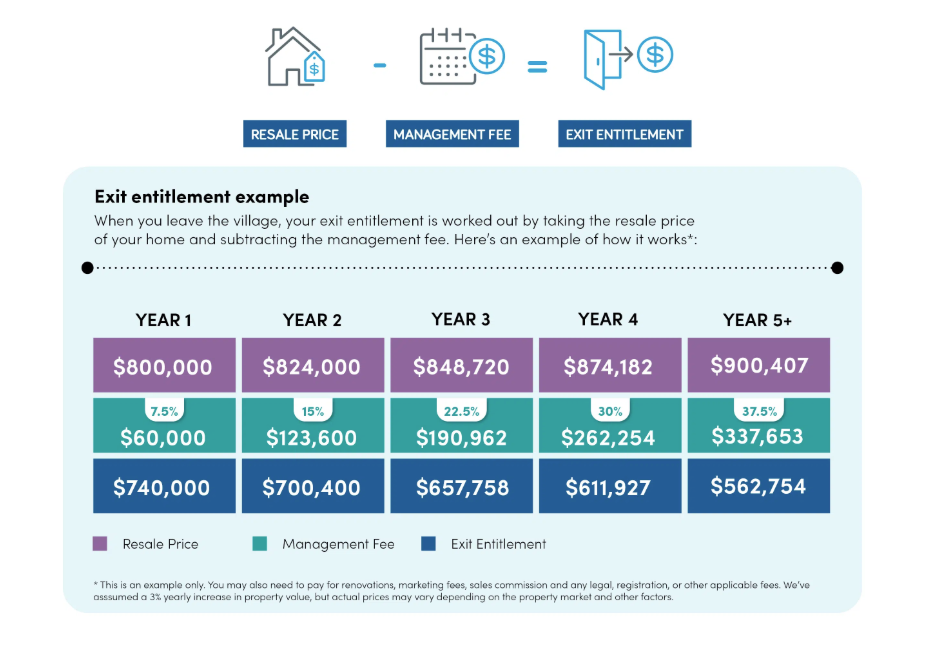
When it comes time to leave one of our strata title villages in Sydney, you’ll receive an exit entitlement, which is the resale price minus the management fee. This fee is capped at 37.5% of your resale price and is stepped during your first 5 years in a village. There are no further increases after this period, no matter how long you stay.

By charging this on exit – rather than incorporating it into the purchase price – you’ll not only free up your cashflow but find that your move into the village is much more affordable.

* Please note, the management fee structure is a little different for our licence and leasehold villages

What age do I have to be?

RetireAustralia villages are designed for people over the age of 65, but most are older.

Can I live in a retirement village on a pension?

Absolutely. Many of our residents receive an age pension. Your eligibility largely depends on the size of the entry payment you make when you move into the village – also known as an entry contribution (EC), compared to the extra allowable amount (EAA). The government compares these figures to determine if you’re considered a home owner. If the entry payment is less than the EAA, you may be eligible for rent assistance. See the federal government’s ‘Social Security Guide’ for more information.

Can I rent in a retirement village?

We don’t currently offer the option to rent, but if affordability is a concern for you, please give us a call. We can talk you through our most cost-effective communities and see if we can find a home that suits your budget.

What happens if my care needs change?

RetireAustralia promotes a ‘village for life’ philosophy, and at selected villages across New South Wales and South Australia, as well as our new communities, we provide a range of living and care options to suit people at different stages of life. You can also access flexible care and support delivered in your home by our Support at Home team or a provider of your choice. This means you can stay in the village you’ve come to know and love, even as your needs change.

Can visitors stay with me?

Absolutely! This is your home and we want you to treat it as such. We encourage family and friends to visit and stay overnight if that suits. It varies by village, but guests can stay between two weeks and 30 days without requiring approval. Simply let your Village Manager know so we can keep an eye out for your guest(s) and treat them as part of the RetireAustralia family.

Can my pet live with me?

Many RetireAustralia communities are pet friendly. Search here to find out if your furry friend could join you in your ideal community.

Why live with Retire Australia?

You’ll be looked after by an experienced team
We know retirement living, and we understand the needs of older Australians.

Your wellbeing is at the heart of everything we do
We are passionate about providing an exceptional standard of living for our residents.

You’ll love the service you receive
We’re always striving to better serve the people who reside in our communities.

You’ll feel at home
We create welcoming communities through homelike design that make your experience comfortable and inviting.

 

Your top retirement living questions answered

What would you like to know about living in a retirement village? Here, we answer the most commonly asked questions.

What is a retirement village?

Retirement villages are residential communities designed for people who are generally over the age of 65 and retired from full-time work. However, plenty of residents continue to work or volunteer part-time while enjoying village life.

How do retirement villages differ from aged care?

While retirement villages are designed for active and independent retirees, aged care facilities cater for those who need full-time care and can no longer live independently.

Most aged care facilities focus on clinical-based care for older Australians who are unable to live independently in their own homes. People in retirement villages still enjoy the benefits and privacy of having their own home, without the worry of day-to-day property maintenance or gardening which are taken care of by village staff.

Residents in retirement villages also have access to a range of village facilities and are surrounded by like-minded people who engage in a wide range of social activities and events.

Moving into aged care is rarely a choice: it often occurs following a significant health incident or when it’s considered necessary for one’s health and safety. In contrast, moving into a retirement village should be a choice at a time in an individual’s life where they can benefit from all that retirement village living has offers.

Are retirement villages the same as land lease communities?

Also known as ‘over 55s lifestyle communities’, ‘manufactured home estates’ and ‘resort communities’, land lease communities are residential communities for older residents. They may look similar from the outside, but there are fundamental differences. For instance, land lease communities are legislated under the same laws as manufactured homes parks and caravan parks, so if the operator ceases to exist, your right to remain in your home isn’t protected. On the flipside, your right to live in your home is protected in a retirement village, which operates under the Retirement Villages Act. For more information, see our article: Retirement village or land lease community?

What’s it like to live in a retirement village?

Good question! Retirement villages are hubs of activity with ample opportunity for social connection. They also have plenty of space allowing for privacy and living life on your own terms. Facilities will vary by village, but you could have access to amenities like a swimming pool, community centre, library and hairdresser. You can read what some residents think about village life, or find out more about retirement living by checking out some real stories about village life.

Will I own my house?

Our retirement villages in Logan, Queensland and in Sydney, New South Wales offer a strata title agreement, in which you own your home and share ownership of common facilities and land with your fellow residents. These villages are Noyea Riverside in Logan, and Belrose Country Club, Bramblewood and Queen’s Park in Sydney. Under this ownership model, you’re required to pay the costs associated with this ownership – including stamp duty and ongoing strata fees.

Most of our villages operate on a leasehold ownership agreement, which means RetireAustralia owns the land and the unit, while you acquire the right to reside in your home for the duration of a long-term lease, generally 99 years. Your tenancy is secure for as long as you want to stay. The upshot of this is that you won’t need to pay stamp duty, which is generally one of the biggest upfront costs when buying a property.

How much will it cost?

To increase financial certainty, we’ve made our contracts as clear and transparent as possible. We specify, upfront, which costs you’ll need to pay, and what they cover.

Here’s a quick breakdown of the fees you’ll need to pay over the duration of your stay in one of our strata title village in Logan:

Service fees

By law, operators can’t profit from recurrent charges which cover the costs of operating village services like the emergency call system, restaurant and activities. Fees generally increase annually with inflation.

Strata levies

A quarterly strata levy covers the exterior maintenance of your unit, building insurance, and the maintenance of common areas such as gardens and swimming pools. This is subject to inflation and is at the discretion of the body corporate.

Management fee*

When it comes time to leave Noyea Riverside, a strata title village, you’ll receive an exit entitlement, which is the resale price minus the management. This fee is capped at 35% of your resale price and is stepped during your first 5 years in the village. There are no further increases after this period, no matter how long you stay.

By charging this on exit – rather than incorporating it into the purchase price – you’ll not only free up your cashflow but find that your move into the village is much more affordable.

* Please note, the management fee structure is a little different for our licence and leasehold villages

What age do I have to be?

RetireAustralia villages are designed for people over the age of 65, but most residents are older.

Can I live in a retirement village on a pension?

Absolutely. Many of our residents receive an age pension. Your eligibility largely depends on the size of the entry payment you make when you move into the village – also known as an entry contribution (EC), compared to the extra allowable amount (EAA). The government compares these figures to determine if you’re considered a home owner. If the entry payment is less than the EAA, you may be eligible for rent assistance. See the federal government’s ‘Social Security Guide’ for more information.

Can I rent in a retirement village?

We don’t currently offer the option to rent, but if affordability is a concern for you, please give us a call. We can talk you through our most cost-effective communities and see if we can find a home that suits your budget.

What happens if my care needs change?

RetireAustralia promotes a ‘village for life’ philosophy, and at selected villages across New South Wales and South Australia, we provide a range of living and care options to suit people at different stages of life.  You can also access flexible care and support delivered in your home by our Support at Home team or a provider of your choice. This means you can stay in the village you’ve come to know and love, even as your needs change.

Can visitors stay with me?

Absolutely! This is your home and we want you to treat it as such. We encourage family and friends to visit and stay overnight if that suits. It varies by village, but guests can stay between two weeks and 30 days without requiring approval. Simply let your Village Manager know so we can keep an eye out for your guest(s) and treat them as part of the RetireAustralia family.

Can my pet join me in a retirement village?

Pets are welcome in most of our communities. Chat to us about your furry family member joining you in retirement living.

Why live with Retire Australia?

You’ll be looked after by an experienced team
We know retirement living, and we understand the needs of older Australians.

Your wellbeing is at the heart of everything we do
We are passionate about providing an exceptional standard of living for our residents.

You’ll love the service you receive
We’re always striving to better serve the people who reside in our communities.

You’ll feel at home
We create welcoming communities through homelike design that make your experience comfortable and inviting.



Different retirement living options explained

Whether for yourself or a loved one, planning where to live in retirement is a major financial and lifestyle decision.

Like any big decision, it is best made when you have all the information. To help you with your research we’ve summarised the 5 most popular types of retirement living in Australia to take some of the guesswork out of where to call home both now and in the future.

1. Staying in the family home

Staying in your family home ensures you stay in the neighbourhood you’re familiar with, close to the social networks you’ve built over many years.

It suits people who value their independence, love their surroundings and enjoy their established routines. It works best for those with strong family and social networks as loneliness and isolation is a higher risk for those ageing in their own home.

Considerations

  • Repairs and maintenance: You will still need to coordinate your own home repairs and house and garden maintenance, so it’s worth thinking about how you’ll feel about this in the years to come. By the time Australians retire, many of them have lived in their homes for over 20 years, if this sounds like you, you should consider that the costs of maintaining older homes can be significant.
  • Accessibility and safety: How well will you be able to navigate your home if your mobility is compromised? Being open-minded about home modifications is important to ensure that your home continues to be a safe place for you as you age.

A home can be full of fall hazards as well as other potential safety problems. Getting a home safety assessment for aging in place will give you peace of mind about this. It will also help you make an informed decision about what changes are needed to ensure your home is safe.

  • Isolation: You could become lonely and isolated living alone if your mobility or activity is ever limited.
  • Care and support: As the years go by, you may find you need help managing daily tasks and at some point, you may even need some level of nursing care. A great resource for understanding what options are available to you is the My Aged Care website.

2. Downsizing into an apartment or townhouse

Downsizing, or rightsizing as it is now popularly called, has many positives in retirement, not least having less space to maintain which frees up more time to do the things you enjoy most.

Moving into an apartment or townhouse generally offers as much security as a detached house, but they have smaller yards and lower upkeep costs, while still giving you privacy in balconies, courtyards and perhaps even a small garden.

Considerations

  • Home modifications: Before moving in, consider making some minor modifications in preparation for the future. For example, installing hand rails in critical locations and making sure the hallways are wide enough to accommodate someone walking with a cane or a wheelchair user. Most townhouses are designed with stairs to maximise land use, so it pays to think about how long you’ll be happy with going up and down the stairs.
  • Ownership: The titles for some units and townhouses may be different, and you will want to understand the term ‘strata title’. This title is a certificate of title for a lot, and a share of common property. It is worth the investment to get legal advice to assist you in reviewing the ‘strata scheme’ to ensure that you will own what you think you will own.
  • Downsizing: With less space comes the task of deciding what to do with all the possessions that you’ve spent years accumulating. The prospect of sorting through a lifetime of possessions and memories can be overwhelming and can take on a negative connotation. This has a lot to do with how emotionally attached we can get to our possessions and the memories associated with those items. We’ve put together a list of handy downsizing tips to make the process a little easier. But there’s no denying it is a big task and it could take you a lot longer than you think, so tackling it early on and giving yourself plenty of time is key.

3. Retirement villages

Retirement villages are the most common and well-known retirement living option in Australia. A major feature of this style of retirement living is the sense of community, with residents creating an informal support network and social groups.

Retirement villages are especially popular with both singles and couples aged over 65 years who want more security and support while living independently.  You can have an active social life and go travelling without worrying about day-to-day property maintenance or gardening needs that are taken care of by village staff.

Designed to provide safe and secure homes as we age, retirement villages should have no, or very few steps in the home (or the village), corridors and doorways are wider, bathrooms are adapted for mobility devices and each home is fitted out with a 24-hour emergency call button.

Considerations

  • Choice: There are several different types of retirement village, and each offers a different range of accommodation choices from single family homes, townhouses, villas, and apartments.

Retirement villages also have a range of lifestyle facilities similar to resorts. Facilities range from gyms, heated indoor swimming pools and billiards rooms through to tennis courts, bowling greens, bocce courts and more. Many offer services such as cleaning and laundry services, and transportation as well as a diversity of sporting and social activities.

In many villages small pets are welcome and residents love inviting family and friends to visit.

With so much choice, it is important to educate yourself on what each village offers. Be sure to visit a number of them before making a decision.

  • Costs and ownership: The vast majority of village homes are leased, meaning you do not own them, so just like buying an apartment or townhouse, it is important that you read your contract and seek independent advice to review the contract before you sign on the dotted line.

Having a complete understanding of upfront, ongoing and outgoing village costs is also important. One of the attributes of RetireAustralia retirement villages that many people find attractive is the certainty it offers. From the day you move in, you will know the outgoing payment you will receive. In uncertain times, you may find it comforting to know where you stand financially. If that is you, a retirement village could be for you.

  • Care and support: It’s important to consider how your care needs will be supported as you get older. Many retirement villages offer some form of onsite care, while others are co-located with an aged care home. While you may not need care now, you may in the future and the type of care and support provided in your retirement village will determine if you can remain living in your home or if you will need to move to a residential aged care facility.

4. Land lease communities

Also known as ‘over 55s lifestyle communities’, ‘manufactured home estates’ and ‘resort communities’, this living arrangement grew out of the caravan park industry and offers a gated estate were you buy the physical structure of your home and rent the land it sits on. In most estates, because of the caravan park heritage, your home is required to be manufactured off site, usually in a factory, and trucked in to its final location.

Land lease communities are targeted at younger retirees (50+) who are looking for affordable housing and want to spend their retirement surrounded by like-minded people.

Considerations:

  • Contract: Each operator is free to develop their own contract for the rent and rental agreement contract covering the land. You should get legal advice as you will be placing your valuable home on their land with few options if you wish to depart.
  • Costs and ownership: Most homes are ‘affordable’ and in nearly all cases you will buy a new home from the operator. However, the weekly fees are controlled by the operator and they can vary the fees as they wish – there are minimal controls.

Also, while the manufactured home will be your own, you don’t own the land your home is positioned on and will be required to pay rent for this land. This rent can be increased by the park owner and there is no guarantee that the park owner will operate the park indefinitely which may require you to remove your home and vacate the land.

  • Care needs and aging in place: Unlike retirement villages and residential aged care, there is no requirement for land lease communities to be age friendly, so you need to consider your accessibility and mobility if things change later in life. Land lease communities also do not offer any care, but you can arrange for home care services to be delivered into your home.

5. Aged care

Deciding whether to go into, or put a loved one into, residential aged care is one of the toughest decisions a person could make. If you find yourself facing this choice, consider the following pros and cons of nursing homes:

Residential aged care facilities, also known as aged care or nursing homes, are a live-in option for people requiring full-time care. Most aged care facilities focus on clinical-based care for older Australians who are unable to live independently in their own homes.

Considerations:

  • Quality of care: Nursing homes are evaluated and these reports are available through Medicare. Do your homework and read the reports about the homes you are considering so you can be sure that you or your loved one will be staying in a safe home that delivers high quality care.
  • Proximity of partner/ family: You may have to travel lengthy distances to visit your loved one if there isn’t a nursing facility near your home. And, unlike other retirement living options, partners don’t get to share apartments or rooms in an aged care facility.
  • Social activities and community: Residential aged care facilities provide differing levels of social activities and social connection. A sense of community is important at all ages and stages of retirement, so finding out what’s on offer and getting a sense of the community will be important.

Every person’s situation is unique and you will know what is right for you. The key is to think about your preferences and set a plan that suits you and takes into account what is important to you. Don’t shy away from factoring in the unknown by building in contingencies and share your plan with loved ones that might be responsible for your care in later life.


Retirement villages: What are the costs?

If you’re thinking of moving into a retirement village, there are lots of things to weigh up and money is one of the biggest considerations.

You’ll likely have lots of questions, not just about how much it will cost to move in but how much it will cost on an ongoing basis, and when it comes time to leave.

We understand you need certainty about your financial future, and that you might feel concerned about affordability and hidden costs. Let’s walk through each step of the process so you know exactly what to expect.

Payments – how much, when, and will they change over time?

In RetireAustralia’s three freehold (strata title) villages in Sydney, you own your home plus a portion of the community facilities and pay stamp duty and ongoing strata fees.

To increase financial certainty, we’ve made our contracts as clear and transparent as possible. We specify, upfront, which costs you’ll need to pay, and what they cover. Here’s a quick breakdown of the fees you’ll need to pay over the duration of your stay in one of our strata title villages in Sydney.

* Please note, the costs are a little different for our licence and leasehold villages in South Australia and Queensland. It is also a little different for our community The Verge at Burleigh on the Gold Coast.

Entry payment

Your entry payment gives you the right to reside in your new home. The good news is that this is typically less than the local median housing price, making your move into a village more affordable and allowing you to maintain a healthy cash flow after the sale of your home.

Service fees

These monthly fees keep the village running and cover services that make life easier and more enjoyable — things like maintaining shared spaces, security, activities, and community amenities. By law, all fees are charged at cost — we make no profit. They only increase in line with actual costs, and village finances are independently audited each year.

Strata levies

Paid quarterly to the Owners Corporation (NSW) these cover the upkeep of common property, building insurance, and shared facilities.

Management fee

The management fee explained

When you leave, you’ll pay a management fee which is capped at 37.5% of the resale price in our strata title villages in New South Wales and is accrued during your first 5 years in the village. This fee gives you access to your preferred lifestyle and contributes to quality social and recreational amenities. This is our form of income and can contribute to village improvements and support staff.


Our strata management fee explained


Capital gains

When you leave the village, you’re entitled to keep any capital gains your unit has accrued. So, if you purchase a unit for $500,000 and sell it for $650,000, there is a capital gain entitlement of $150,000. You will have to share up to 37.5% of the capital gains received with the operator as part of the management fee but you keep the rest. What’s more, you won’t need to pay capital gains tax on it either, given your home has been your main residence.

* Please note, the management structure is a little different for our licence and leasehold villages

What do I get for my money?

Our residents tell us that choosing to move into a retirement village is about far more than bricks and mortar. In reality, it’s an investment in you. You’ll be moving into a friendly community filled with people at the same stage of life, and you’ll have access to a range of amenities.

These vary depending on the village you choose but can include things like:

  • Swimming pool
  • Gymnasium
  • Tennis court
  • Bowling green
  • Hair salon
  • Community centre
  • BBQ areas
  • Residents’ bar
  • Billiards room
  • Library

You can also get involved in a range of interest groups, social activities and events from happy hour to mini-golf and more – it’s really up to you and the community.

What’s more, when you don’t need to worry about maintaining your house and garden, you’ll actually have time to explore new interests!

These intangible benefits are an important consideration, and should be weighed up alongside the financials. Moving into a retirement village is about so much more than the property. Residents tell us that the lifestyle, health and wellbeing benefits enhance their quality of life immeasurably.

What if my care needs change?

If your needs change, you can rest easy knowing you can access care and support if you need it. In RetireAustralia villages, you have a range of care and support services to choose from, whether that means ongoing daily support in a serviced apartment (available in many of our villages in New South Wales  and South Australia), or flexible care and support delivered in your home by our Support at home team. Support is tailored to your individual needs and you can pay privately for services or use government funding.

How can I compare the cost of living in a retirement village with other options?

A true cost of living comparison can only be obtained by spending time with a sales consultant in a village, talking through your circumstances and needs, and understanding the fees and inclusions in your chosen village. You also need to do your own homework and make sure you have an accurate picture of your current living expenses to make the comparison valid.

In a general sense, retirement villages offer great cost of living value but trying to put a specific dollar figure to this comparison can easily become misleading. Your own cost of living and those applicable to villages can vary substantially, so it’s best to check with your village of choice directly.

On top of the hard costs listed above which village fees cover, the costs associated with living in a retirement village also provide residents with a sense of community and belonging, support from friends and staff, and numerous opportunities to lead a happy, active and healthy life.

Placing a value on these intangible benefits is very personal to each individual. To get more of an insight into what it is like to live in one of our retirement villages, take a look at our retirement living stories and resources.


Downsizing: is it worth it?

Many people put off moving into a retirement village because they’re concerned about downsizing. But is this concern justified?


Often, the biggest concern with moving into a retirement village is downsizing – what does it entail, is it worth it, and do residents miss their old house or neighbourhood? Everyone’s experience is unique, but the comment we hear most often from residents is, ‘I wish I’d made the move sooner’. Here, we break down what’s involved in downsizing, the pros and cons, and how you can tackle the process.

1. Make a plan

First things first, make a plan. Look at the floor plan and dimensions of your new home and decide how much of your furniture will fit the space. If it feels hard to let things go, consider putting furniture or larger pieces in storage while your house is on the market. You might be surprised by how little you miss them during this process.

2. Clear the clutter

It’s amazing how much we accumulate over the years, and the prospect of sorting through a lifetime of possessions and memories might seem overwhelming. That’s why we’ve put together a list of handy tips to make the de-cluttering process easier:

  • Start early. By making decisions well in advance of your actual move date, you’ll have time to sort out what’s most important to you and what you can let go.
  • Set yourself up for success. Start with items you’re not emotionally attached to, like outdated paperwork, kitchen utensils, stationery supplies, clothes and linen. Once you’ve done this, you can work your way up to photos, books, and sentimental memorabilia.
  • Prioritise. Write a list of non-negotiables – items you absolutely can’t live without – and try to assess the rest of your possessions with a critical eye.
  • Keep your focus narrow. Don’t tackle the whole house at once, but deal with one room, cupboard or zone at a time.
  • Break it into bite-sized chunks. It’s far more effective to consistently set aside 15 minutes a day than attempt to sort through years of memories in one weekend.
  • Be honest. Ask yourself “do I need it, use it or love it?” Be honest with yourself and remember objects don’t have feelings.
  • Take photos. Consider taking photographs or videos of things that can’t go to your new home. It will preserve the memory without taking up any space.
  • Swap old for new. It’s still OK to buy new items but try adopting ‘the one in / one out’ rule. For example, if you buy a new set of wine glasses, donate the existing ones.
  • Remember why you’re doing this. Research shows that clutter can affect mental wellbeing and add to feelings of stress. On the flipside, clearing out things you no longer want or need can be intensely liberating.

3. Find a new home for what you don’t need

Once you’ve de-cluttered, you might be wondering what to do with all the belongings you’re not taking with you to your new apartment or villa. You could consider selling big-ticket items like a lawnmower, and giving other pieces to family or charity. Knowing that a much-loved item will have a new lease of life in someone else’s home might help you let it go – and emotionally prepare for the move.

4. Enlist help

This is likely to be one of the most important moves you make, and it’s far easier to tackle if you can share the load among many. Ask professionals, family or neighbours to lend a hand – either with de-cluttering, packing, moving or cleaning.

5. Look to the future

If the magnitude of the project feels overwhelming, focus on what you’re gaining, rather than what you’re leaving behind. If you’re unsure if this is the right decision, weigh up the pros and cons:

  • The process of de-cluttering can take an emotional toll, but it will also simplify your life. What’s more, it can make the process of moving house much more manageable. Less clutter means less packing, physical effort and expense.
  • Sorting through all your possessions is time-consuming, but could benefit you financially. Your real estate agent is more likely to get a great price for your house if it’s streamlined and clutter-free. If you’d like to know more about the process of selling a house, we’ve got you covered.
  • It might be hard to emotionally let go of your house and possessions, but think about what life in a retirement village will be like – no more gardening to worry about, or the need to maintain a property you’ve outgrown. There will also be a welcoming community, ample opportunities for social connection, and a raft of activities on offer.

If you have questions about downsizing, speak to the sales consultant at the retirement community you’re most interested in. After all, they’ve seen hundreds of people go through the exact same process, and will be able to give you advice and point you in the right direction. They might even be able to connect you with residents who’ve recently made the move.


Selling your home? Here’s where to start

The decision to sell your house isn’t always straightforward. Here, we go through the sales process, costs involved, and tips to maximise the sale price.


If you’ve lived in your house for years or even decades, it can be hard to move on. Your home can be linked to cherished memories of family, milestones and celebrations, and evoke feelings of security and comfort. To prepare for selling your house and taking the next step in retirement, it can help to have an idea of what to expect from the sales process.

Do your homework

Before you choose an agent, start by researching local real estate agencies. If you have friends or family close by, it’s great to ask for personal recommendations. After all, this will be the biggest sale you’re likely to make, and having trust and respect for the agent is crucial.

You might like to check out listings and sales prices in your area, to get a gauge for what similar properties are worth. You could even visit properties for sale and see how the agent treats prospective buyers and answers questions – consider asking about whether the vendors are willing to negotiate the sale price, how long the property has been on the market and why they’re selling.

Then, create a shortlist of at least three agents you would like to meet face-to-face and don’t be afraid to ask questions when you meet them. Here are some for consideration:

  • Would they recommend a private sale or auction? Why?
  • How much are their agents’ fees, and how do they calculate this figure? Is it a fixed fee or a percentage of the sale price? This is also known as commission and is generally between 1.5% and 3.5% of the agreed price. Most agents’ fees don’t include advertising, so be clear on how much the recommended campaign would cost.
  • How would they go about marketing your home? This could involve web listings, sign boards outside your house, photography, floor plans and copywriting, as well as social media and email campaigns.
  • What work (if any) would they recommend you do to make your home more attractive to buyers?
  • How would they value your home? Can they provide you with a property profile that includes information about sales of comparable properties in your area? Would they recommend specifying an asking price (if not going to auction), or a broader price guide?

Choose an agent

If you take time to do your research and meet with several agents, you’ll have a good idea of what your property is worth. You’ll also have a good sense of which agent is best suited to you. Keep in mind that some agents could be tempted to overvalue your property to increase the likelihood of getting your business, so base your decision on many factors – not just who has the lowest commission or says they could obtain the highest sale price.

Prepare your home for sale

To maximise its potential value, look at your home with a critical eye and decide whether a small upfront investment could have a big impact. There are several ways you could make your home more attractive to prospective buyers:

  • Assess the frontage of your home, as some buyers will drive past before they commit to attending an open house. Would the garden benefit from some tidying or weeding, or can you add a splash of colour with new plants or pots?
  • Keep things as open, airy and uncluttered as possible. This might mean putting some furniture in storage during the sale process.
  • Neutral colours are best. Consider painting over any obvious marks, or even re-painting if the paint job is tired or the colours are dated.
  • Fix anything in need of obvious repair, and attend to small maintenance jobs, like missing light globes or loose door handles.
  • Have your carpets professionally cleaned.
  • Tidy up your cupboards. It’s easy to think ‘out of sight, out of mind’, but buyers are sure to open cupboards and drawers to get a good idea of storage space.
  • Clear the clutter. This will help your home look bigger and more spacious. Think big – taking away unnecessary furniture – as well as small – clearing any flat surface, having tidy kitchen bench tops and removing fridge magnets.
  • Help prospective buyers see themselves living in your house, by removing any bold furniture or artwork, as well as personal touches like photographs.

Inspection day.

Make sure your house is spotless on inspection day, with no laundry or washing up in sight. Turn on all the lights, open the windows and doors, and show your house at its best. Keep your home as comfortable as possible, with fans or air conditioning on in summer, and a fire or heater in the cooler months. It helps to have a bright bunch of flowers in the kitchen to add a splash of colour. Finally, make sure you leave the house during inspections to help put prospective buyers at ease. This includes any pets who live with you!

Other costs to keep in mind

As well as covering your agents’ fees and marketing campaign, keep in mind that you’ll need some money set aside for conveyancing. This simply means the legal transfer of ownership from you to the buyer. If you have a mortgage on the house you’re selling, you may also need to pay your bank or lender an early exit fee. The cost of selling your home varies by state, but you can find a comprehensive breakdown of likely real estate agent commission, marketing and conveyancing fees here.

Need advice?

For more advice about buying and selling a property in your state, go to:

NSW:

Queensland:

South Australia:

Other information you may also be interested in


Downsizing: is it worth it?

Many people put off moving into a retirement village because they’re concerned about downsizing. But is this concern justified?

Often, the biggest concern with moving into a retirement village is downsizing – what does it entail, is it worth it, and do residents miss their old house or neighbourhood? Everyone’s experience is unique, but the comment we hear most often from residents is, ‘I wish I’d made the move sooner’. Here, we break down what’s involved in downsizing, the pros and cons, and how you can tackle the process.

1. Make a plan

First things first, make a plan. Look at the floor plan and dimensions of your new home and decide how much of your furniture will fit the space. If it feels hard to let things go, consider putting furniture or larger pieces in storage while your house is on the market. You might be surprised by how little you miss them during this process.

2. Clear the clutter

It’s amazing how much we accumulate over the years, and the prospect of sorting through a lifetime of possessions and memories might seem overwhelming. That’s why we’ve put together a list of handy tips to make the de-cluttering process easier:

  • Start early. By making decisions well in advance of your actual move date, you’ll have time to sort out what’s most important to you and what you can let go.
  • Set yourself up for success. Start with items you’re not emotionally attached to, like outdated paperwork, kitchen utensils, stationery supplies, clothes and linen. Once you’ve done this, you can work your way up to photos, books, and sentimental memorabilia.
  • Prioritise. Write a list of non-negotiables – items you absolutely can’t live without – and try to assess the rest of your possessions with a critical eye.
  • Keep your focus narrow. Don’t tackle the whole house at once, but deal with one room, cupboard or zone at a time.
  • Break it into bite-sized chunks. It’s far more effective to consistently set aside 15 minutes a day than attempt to sort through years of memories in one weekend.
  • Be honest. Ask yourself “do I need it, use it or love it?” Be honest with yourself and remember objects don’t have feelings.
  • Take photos. Consider taking photographs or videos of things that can’t go to your new home. It will preserve the memory without taking up any space.
  • Swap old for new. It’s still OK to buy new items but try adopting ‘the one in / one out’ rule. For example, if you buy a new set of wine glasses, donate the existing ones.
  • Remember why you’re doing this. Research shows that clutter can affect mental wellbeing and add to feelings of stress. On the flipside, clearing out things you no longer want or need can be intensely liberating.

3. Find a new home for what you don’t need

Once you’ve de-cluttered, you might be wondering what to do with all the belongings you’re not taking with you to your new apartment or villa. You could consider selling big-ticket items like a lawnmower, and giving other pieces to family or charity. Knowing that a much-loved item will have a new lease of life in someone else’s home might help you let it go – and emotionally prepare for the move.

4. Enlist help

This is likely to be one of the most important moves you make, and it’s far easier to tackle if you can share the load among many. Ask professionals, family or neighbours to lend a hand – either with de-cluttering, packing, moving or cleaning.

5. Look to the future

If the magnitude of the project feels overwhelming, focus on what you’re gaining, rather than what you’re leaving behind. If you’re unsure if this is the right decision, weigh up the pros and cons:

  • The process of de-cluttering can take an emotional toll, but it will also simplify your life. What’s more, it can make the process of moving house much more manageable. Less clutter means less packing, physical effort and expense.
  • Sorting through all your possessions is time-consuming, but could benefit you financially. Your real estate agent is more likely to get a great price for your house if it’s streamlined and clutter-free. If you’d like to know more about the process of selling a house, we’ve got you covered.
  • It might be hard to emotionally let go of your house and possessions, but think about what life in a retirement village will be like – no more gardening to worry about, or the need to maintain a property you’ve outgrown. There will also be a welcoming community, ample opportunities for social connection, and a raft of activities on offer.

If you have questions about downsizing, speak to the sales consultant at the retirement community you’re most interested in. After all, they’ve seen hundreds of people go through the exact same process, and will be able to give you advice and point you in the right direction. They might even be able to connect you with residents who’ve recently made the move.


Selling your home? Here’s where to start

The decision to sell your house isn’t always straightforward. Here, we go through the sales process, costs involved, and tips to maximise the sale price.

If you’ve lived in your house for years or even decades, it can be hard to move on. Your home can be linked to cherished memories of family, milestones and celebrations, and evoke feelings of security and comfort. To prepare for selling your house and taking the next step in retirement, it can help to have an idea of what to expect from the sales process.

Do your homework

Before you choose an agent, start by researching local real estate agencies. If you have friends or family close by, it’s great to ask for personal recommendations. After all, this will be the biggest sale you’re likely to make, and having trust and respect for the agent is crucial.

You might like to check out listings and sales prices in your area, to get a gauge for what similar properties are worth. You could even visit properties for sale and see how the agent treats prospective buyers and answers questions – consider asking about whether the vendors are willing to negotiate the sale price, how long the property has been on the market and why they’re selling.

Then, create a shortlist of at least three agents you would like to meet face-to-face and don’t be afraid to ask questions when you meet them. Here are some for consideration:

  • Would they recommend a private sale or auction? Why?
  • How much are their agents’ fees, and how do they calculate this figure? Is it a fixed fee or a percentage of the sale price? This is also known as commission and is generally between 1.5% and 3.5% of the agreed price. Most agents’ fees don’t include advertising, so be clear on how much the recommended campaign would cost.
  • How would they go about marketing your home? This could involve web listings, sign boards outside your house, photography, floor plans and copywriting, as well as social media and email campaigns.
  • What work (if any) would they recommend you do to make your home more attractive to buyers?
  • How would they value your home? Can they provide you with a property profile that includes information about sales of comparable properties in your area? Would they recommend specifying an asking price (if not going to auction), or a broader price guide?

Choose an agent

If you take time to do your research and meet with several agents, you’ll have a good idea of what your property is worth. You’ll also have a good sense of which agent is best suited to you. Keep in mind that some agents could be tempted to overvalue your property to increase the likelihood of getting your business, so base your decision on many factors – not just who has the lowest commission or says they could obtain the highest sale price.

Prepare your home for sale

To maximise its potential value, look at your home with a critical eye and decide whether a small upfront investment could have a big impact. There are several ways you could make your home more attractive to prospective buyers:

  • Assess the frontage of your home, as some buyers will drive past before they commit to attending an open house. Would the garden benefit from some tidying or weeding, or can you add a splash of colour with new plants or pots?
  • Keep things as open, airy and uncluttered as possible. This might mean putting some furniture in storage during the sale process.
  • Neutral colours are best. Consider painting over any obvious marks, or even re-painting if the paint job is tired or the colours are dated.
  • Fix anything in need of obvious repair, and attend to small maintenance jobs, like missing light globes or loose door handles.
  • Have your carpets professionally cleaned.
  • Tidy up your cupboards. It’s easy to think ‘out of sight, out of mind’, but buyers are sure to open cupboards and drawers to get a good idea of storage space.
  • Clear the clutter. This will help your home look bigger and more spacious. Think big – taking away unnecessary furniture – as well as small – clearing any flat surface, having tidy kitchen bench tops and removing fridge magnets.
  • Help prospective buyers see themselves living in your house, by removing any bold furniture or artwork, as well as personal touches like photographs.

Inspection day.

Make sure your house is spotless on inspection day, with no laundry or washing up in sight. Turn on all the lights, open the windows and doors, and show your house at its best. Keep your home as comfortable as possible, with fans or air conditioning on in summer, and a fire or heater in the cooler months. It helps to have a bright bunch of flowers in the kitchen to add a splash of colour. Finally, make sure you leave the house during inspections to help put prospective buyers at ease. This includes any pets who live with you!

Other costs to keep in mind

As well as covering your agents’ fees and marketing campaign, keep in mind that you’ll need some money set aside for conveyancing. This simply means the legal transfer of ownership from you to the buyer. If you have a mortgage on the house you’re selling, you may also need to pay your bank or lender an early exit fee.

Need advice?

For more advice about buying and selling a property in your state, go to:

NSW:

Queensland:

South Australia:


Retirement villages: what are the costs? Freehold QLD

If you’re thinking of moving into a retirement village, there are lots of things to weigh up and money is one of the biggest considerations. Discover what's involved at Noyea Riverside Retirement Village.

You’ll likely have lots of questions, not just about how much it will cost to move in but how much it will cost on an ongoing basis, and when it comes time to leave.

We understand you need certainty about your financial future, and that you might feel concerned about affordability and hidden costs. Let’s walk through each step of the process so you know exactly what to expect.

Payments – how much, when, and will they change over time?

In RetireAustralia’s freehold (strata title) village in Logan, you own your home plus a portion of the community facilities and pay stamp duty and ongoing strata fees.

To increase financial certainty, we’ve made our contracts as clear and transparent as possible. We specify, upfront, which costs you’ll need to pay, and what they cover. Here’s a quick breakdown of the fees you’ll need to pay for the duration of your stay in our freehold village in Logan.

* Please note, the costs are a little different for our licence and leasehold villages

Entry payment

Your entry payment gives you the right to reside in your new home. The good news is that this is typically 70-80% of the local median housing price, making your move into a village more affordable and allowing you to maintain a healthy cash flow after the sale of your home.

Service fees

By law, operators can’t profit from recurrent charges which cover the costs of operating village services like the emergency call system, restaurant and activities. Fees generally increase annually with inflation.

Strata levies

A quarterly strata levy covers the building insurance, and the maintenance of common areas such as gardens. The exterior maintenance of the unit is covered by the owner. This is subject to inflation and is at the discretion of the body corporate.

Management fee

What is the management fee?

The management fee is payable when you leave the village and allows us to keep our entry prices as competitive as possible, leaving you with more cash in your pocket to enjoy life in the village after you move in.

The management fee covers RetireAustralia’s initial investment in the village and helps to ensure that all residents have access to quality facilities and amenities while they’re living in the village.

How is the management calculated?

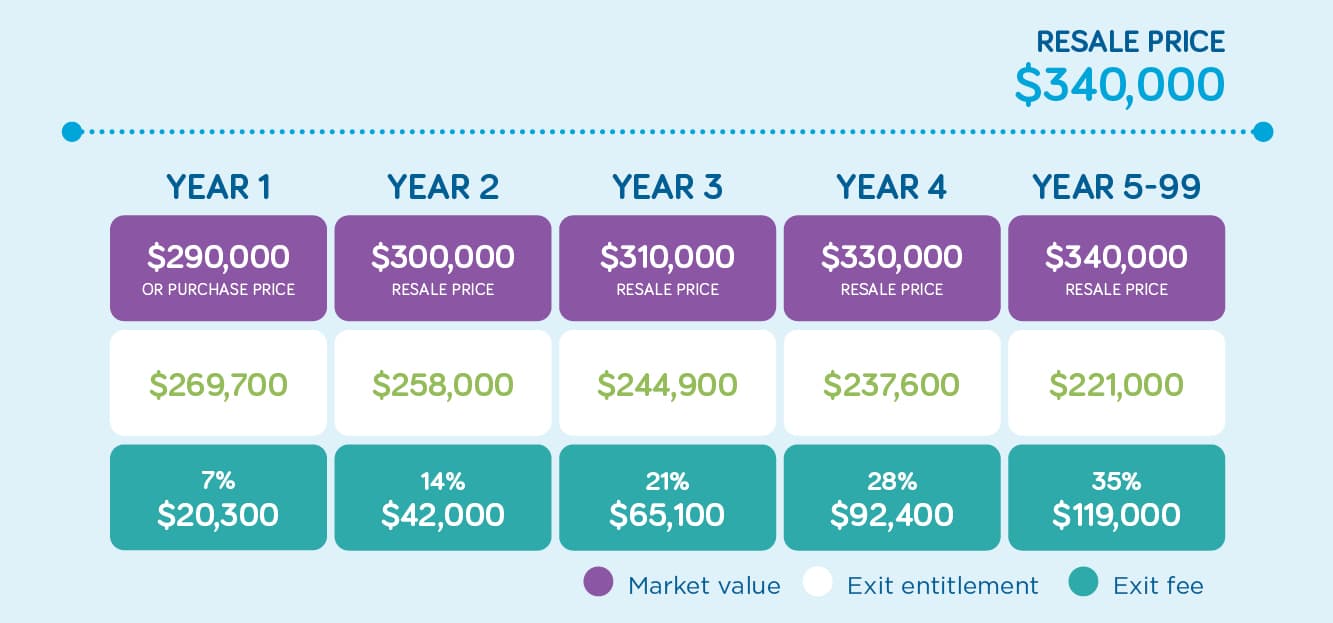
When it comes time to leave Noyea Riverside, our freehold village in Logan, you’ll receive an exit entitlement, which is the resale price minus the management. This fee is capped at 35% of your resale price and is stepped during your first 5 years in the village. There are no further increases after this period, no matter how long you stay.

You will pay the managment fee when you leave the village. This is charged and deducted from the gross sale proceeds. This way, it’s easy to calculate exactly how much money you’ll receive after you leave.

Management fee example

To calculate your exit entitlement when leaving the village one would have to use the resale price less the deferred management fee.*

*This is an example only. Additional charges may also be payable for any legal, registration or other applicable fees. In this example real estate growth averages 3.2% per annum – this is dependent on the property market climate and various other factors which might impact property prices at the time of sale.

Capital gains

When you leave the village, you’re entitled to keep any capital gains your unit has accrued. So, if you purchase a unit for $500,000 and sell it for $650,000, there is a capital gain entitlement of $150,000. You will have to share up to 35% of the capital gains received with the operator as part of the departure fee but you keep the rest. What’s more, you won’t need to pay capital gains tax on it either, given your home has been your main residence.

Please note, the management fee structure is a little different for our licence and leasehold villages

What do I get for my money?

Our residents tell us that choosing to move into a retirement village is about far more than bricks and mortar. In reality, it’s an investment in you. You’ll be moving into a friendly community filled with people at the same stage of life, and you’ll have access to a range of amenities.

These vary depending on the village you choose but can include things like:

  • Swimming pool
  • Gymnasium
  • Tennis court
  • Bowling green
  • Hair salon
  • Community centre
  • BBQ areas
  • Residents’ bar
  • Billiards room
  • Library

You can also get involved in a range of interest groups, social activities and events from happy hour to mini-golf and more – it’s really up to you and the community.

What’s more, when you don’t need to worry about maintaining your house and garden, you’ll actually have time to explore new interests!

These intangible benefits are an important consideration, and should be weighed up alongside the financials. Moving into a retirement village is about so much more than the property. Residents tell us that the lifestyle, health and wellbeing benefits enhance their quality of life immeasurably.

What if my care needs change?

If your needs change, you can rest easy knowing you can access care and support if you need it. In RetireAustralia villages, you have a range of care and support services to choose from, whether that means ongoing daily support in a serviced apartment (available in many of our villages in New South Wales, South Australia), or flexible care and support delivered in your home by our Support at Home team . Support is tailored to your individual needs and funded privately or through access to government funding.

How can I compare the cost of living in a retirement village with other options?

A true cost of living comparison can only be obtained by spending time with a sales consultant in a village, talking through your circumstances and needs, and understanding the fees and inclusions in your chosen village. You also need to do your own homework and make sure you have an accurate picture of your current living expenses to make the comparison valid.

In a general sense, retirement villages offer great cost of living value but trying to put a specific dollar figure to this comparison can easily become misleading. Your own cost of living and those applicable to villages can vary substantially, so it’s best to check with your village of choice directly.

On top of the hard costs listed above which village fees cover, the costs associated with living in a retirement village also provide residents with a sense of community and belonging, support from friends and staff, and numerous opportunities to lead a happy, active and healthy life.

Placing a value on these intangible benefits is very personal to each individual. To get more of an insight into what it is like to live in one of our retirement villages, take a look at our retirement stories and insights.


Retirement living myths busted

Think retirement village living isn’t for you?  Before you make a decision about your next move, make sure you know what living in a village is really like.

There are lots of myths about living in a retirement village that don’t reflect what life is really like.  So let’s separate the fact from the fiction!

Myth #1: Being surrounded by people my age will encourage me to slow down and lose my independence

On the contrary, we find that residents revel in being part of a new social circle and making new connections, and continue to lead full and rich lives. As resident Ros explains, “If you hang around people who are really good at being retired, you get really good at being retired.”

She and her husband John moved into Wood Glen Retirement Village on the Central Coast, but life hasn’t slowed down since they sold their bed and breakfast in Port Macquarie.

Now, they live close enough to Sydney to connect regularly with family, and both volunteer and work in the local community. They also keep busy with sport, with Ros cycling, doing pilates, and going to an outside gym, while John makes use of Wood Glen’s proximity to golf, tennis, and surfing.

“We’re only a 10-15 pushbike ride from Terrigal,” says Ros. “Wood Glen has got absolutely everything. We love it.”

Closer to home, they’ve joined the village’s weekly line dancing classes, and John also plays table tennis and teaches Kelly pool. As Ros points out, “If you’re making a choice to make a change, you might as well make it as rich as you possibly can. That’s what I’m doing.”


Myth #2: My health and wellbeing will suffer

Not true! In fact, multiple research studies have shown that your health can actually improve in a retirement village, by reducing isolation and improving mental wellbeing.

Social isolation is a big problem for older Australians, with one in five estimated to suffer from the condition, which can lead to decreased mental health.

Retirement living is specifically designed to counter social isolation, and instead foster a sense of belonging and community. Indeed, a report from the Property Council of Australia showed that 41% of residents said their happiness had increased since entering a retirement village.

That’s true for Tarragal Glen resident Gordon , who says, “Some people look at retirement village living and downsizing as though you’re giving up something, but for us we really feel like it’s given us a better life than we had before. After two years in the village we have a new circle of friends and a very full life both inside and outside of the village.”

It’s a similar story for Carlyle Gardens residents Noel and Judy . When asked about his favourite memory from living in the village, Noel doesn’t hesitate. “Friendships,” he says. “This is one of the best moves we’ve ever made.”

As for Judy, she says “all the entertainment has been absolutely first class. It’s the balance. I am happier here and couldn’t recommend it more.”

There are countless ways in which retirement living is good for your health – if you’d like to know more, here’s just are ways in which your wellbeing could flourish.

Myth #3: I’ll be encouraged to cut ties with the broader community

When asked to describe their village community, the word we most often hear from residents is “family”. As Anne at Boambee Gardens describes it, “[the community] is like a family, it’s fabulous. You feel part of a family not only with residents but with the staff.”

But while there’s lots to keep you busy within the village itself, residents also have active and full lives in the broader community, with many volunteering or working part-time. Take our Wood Glen residents, John and Ros. John volunteers at Integrity Living as a bus attendant, while Ros does face-to-face counselling at Lifeline one day a week as well as volunteer administration work at a police office.

Meanwhile, Neville at Cleveland Manor volunteers as a lollipop man at the local school and mans the bar at twice-weekly village happy hours.

But no matter how fulfilling and rewarding life is in the broader community, it’s always nice to have a place to call home. As Cleveland Manor resident Nick puts it, “There’s a feeling of belonging. You can’t put a price on it.”

The best way to find out more about village life is to visit one of our communities, meet a few residents and get to know the social and activity calendar.