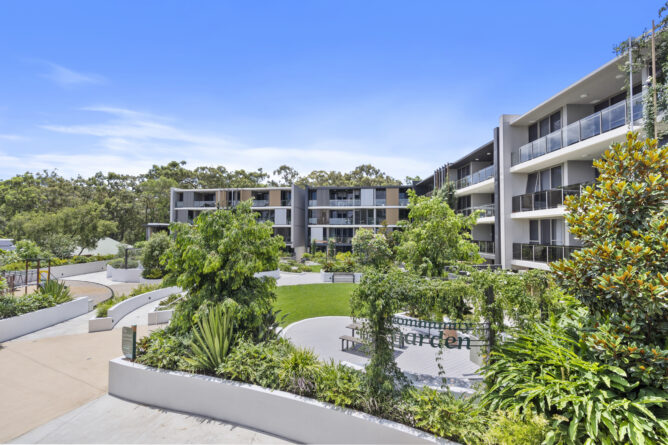
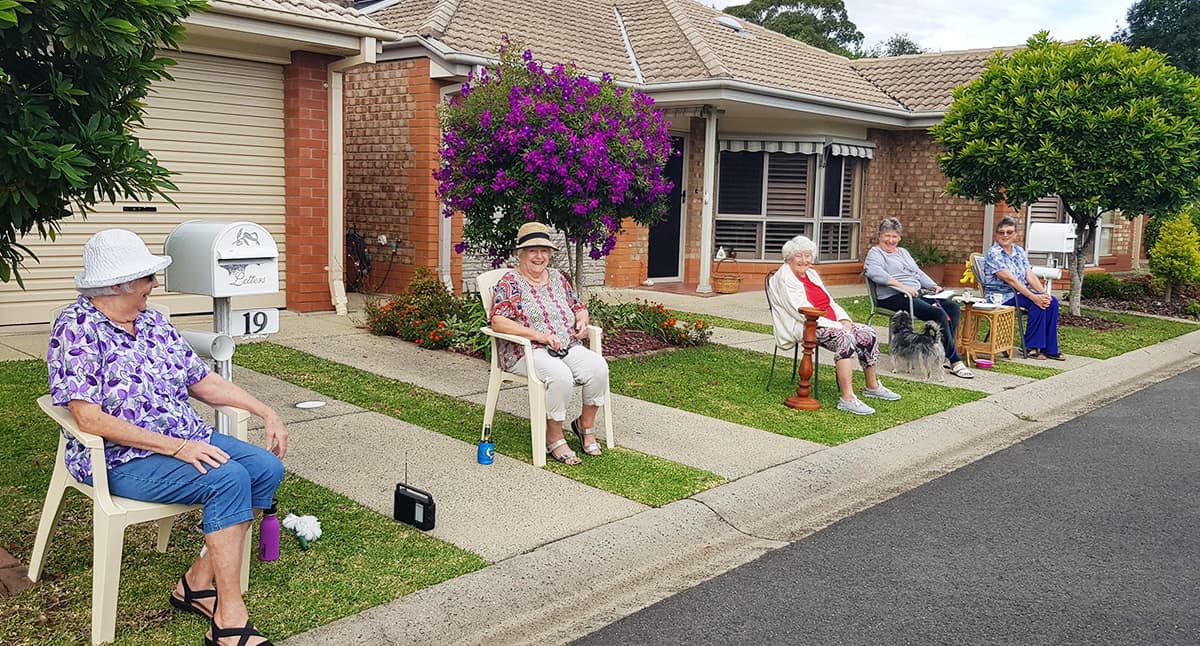
Over the past few months, residents and the village team at Tarragal Glen have been working with local organisations to help fire-affected communities get back on their feet.
Convoy Missions Australia (CMA) is one such organisation. Their ‘Operation True Blue’ initiative builds permanent and semi-permanent housing for locals to live in while they rebuild their homes.
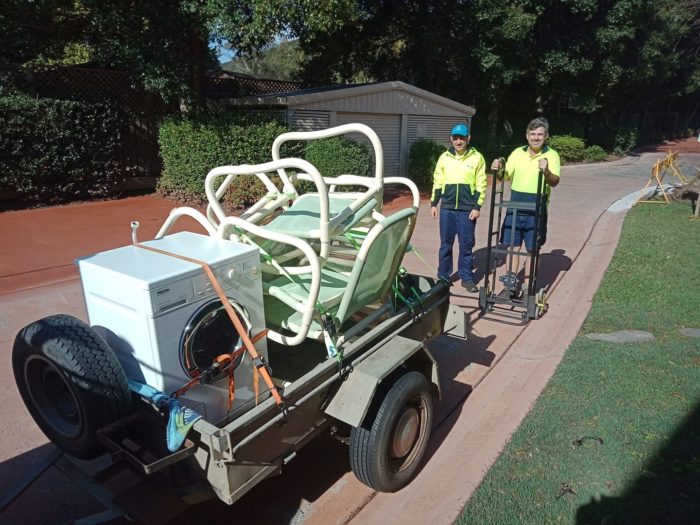
The whole Tarragal Glen community pitched in to help. Residents have donated furniture, non-perishable foods, clothing, Bunnings gift cards and other goods. Meanwhile, village staff rounded up items from refurbished apartments that would usually be considered waste, giving them new life in the hands of CMA. Materials like old ovens, tapware, door handles, used kitchen appliances, sinks and even a patio roof were able to be re-purposed to help families settle into their short-term homes.
The team has also worked with Tinonee Outreach Incorporated, donating three more trailer loads of goods for families near Taree on the weekend. While the 2019/20 bushfire season was the worst in NSW history – and the re-building process is just starting for many – the efforts of the Tarragal Glen community have gone some way in helping those who lost everything.
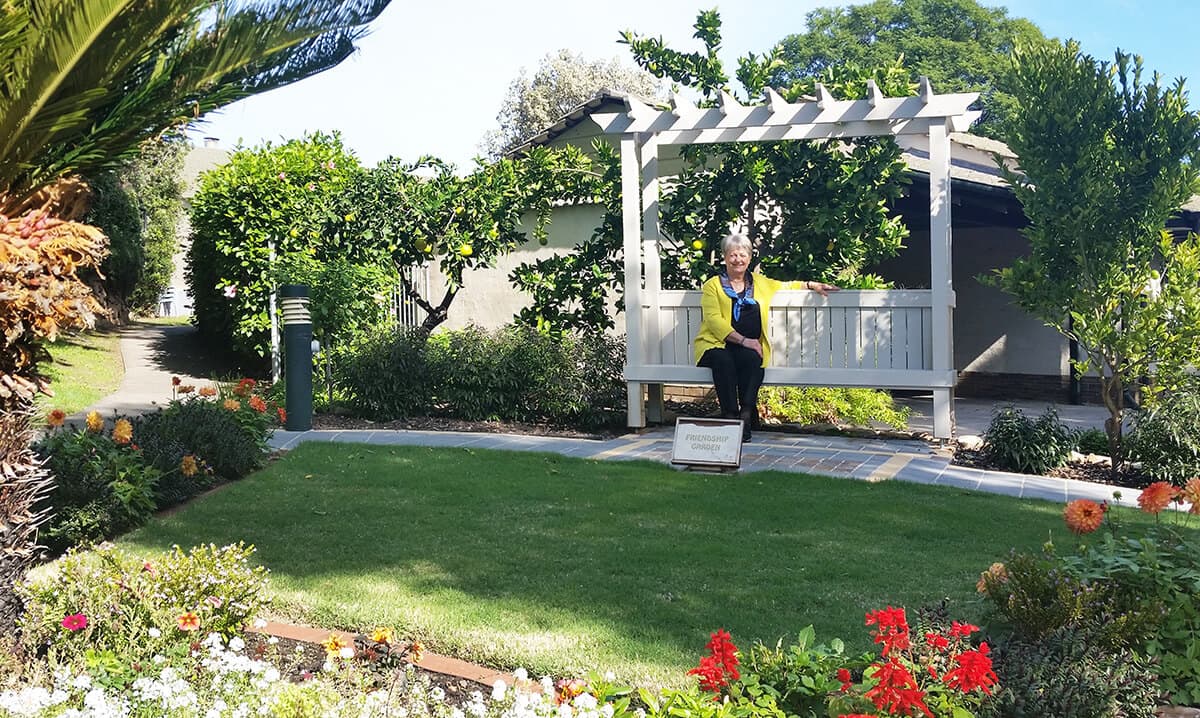
Under the direction of retired florist, designer and garden centre owner Yvonne Schultz, volunteer gardeners at RetireAustralia’s Bartonvale Gardens Retirement Village have established a rose garden and a friendship garden. They have been so inspired that they have also recently set up a free flower delivery service.
A sweetly scented posy from the garden is presented to residents throughout the popular North Adelaide village on their birthday, in addition to a beautiful handmade card featuring a pressed flower.
Ms Schultz said the garden, which has grown substantially since officially opening three months ago, had helped her rediscover her creative passions.
“Retirement is meant to be about spending time following your passions and spending time with like-minded people,’’ she said.
“I’m happy, I feel loved and I have a sense of purpose. I do what brings me joy and if that brings joy to my community, that makes me enormously satisfied.”
Village Manager Robyn Bennett says Ms Schultz’s initiatives are bringing residents together to share new interests and form friendships.
“Strong ties with friends and the community provides residents with happiness, security, support and a sense of purpose,” Mrs Bennett said.
“So when I found out about Yvonne’s background in floristry and horticulture and love of nature I was thrilled and I dropped a hint about a rose garden.
“Yvonne took up the challenge with glee, bringing together a group of volunteers to establish the Bartonvale Village Garden Group.’’
The group of retirees spend many hours together nurturing seedlings and tending the beautiful gardens as well as participating in activities all things creative and natural.
“Generous donations from the village community made the gardens possible, with 48 residents contributing standard roses, feature trees, plants and gardening materials,’’ Mrs Bennett said. “It’s testimony to how one idea can inspire a community.
“In the affectionately named friendship garden and the sensory rose garden you will often find residents sitting in the arbour to gaze at the flowers or quite literally stopping and smelling the roses.”
RetireAustralia CEO Dr Brett Robinson said resident-led initiatives were not uncommon across the group’s 27 villages.
“The fact that we’ve got so many resident led initiatives in our villages is testament to who we are as an organisation,” Dr Robinson said.
“We really are one big family ourselves and I think it’s that genuine community spirit, support and connection that our residents are attracted to.”
You can find out more about retirement villages where community spirit is blooming here.
You’ll likely have lots of questions, not just about how much it will cost to move in but how much it will cost on an ongoing basis, and when it comes time to leave.
We understand you need certainty about your financial future, and that you might feel concerned about affordability and hidden costs. Let’s walk through each step of the process so you know exactly what to expect.
Payments – how much, when, and will they change over time?*
The most common types of agreement in RetireAustralia villages are leasehold and licence, where you purchase a long-term lease to live in your home. Here we break down the costs for leasehold and licence villages.
To increase financial certainty, we’ve made our contracts as clear and transparent as possible. We specify, upfront, which costs you’ll need to pay, and what they cover. Here’s a quick breakdown of the fees you’ll need to pay for the duration of your stay in one of our licence or leasehold villages:
Your entry payment gives you the right to reside in your new home on a long-term lease (usually 99 years). Unlike most property transactions, you will not have to pay stamp duty on your apartment. This equates to a significant cost saving on entry.
This payment is relative to the locally property market and demand for homes in the retirement village.
Monthly service fees
By law, RetireAustralia makes no profit from village fees, which are charged on a cost-recovery basis and only increase in line with village costs.
Fees cover village operating costs including:
Council rates
Water rates
Building insurance
Building and garden maintenance
24-hour emergency call system
Access to and upkeep of communal village facilities
You can also rest assured that it can’t be increased greater than the Consumer Price Index without the approval of village residents. For further peace of mind, these fees are audited by an independent party each year.
Management fee*
What is the management fee
The management fee, (sometimes referred to as deferred management fee, exit fee or departure fee) is payable when you leave the village and allows us to keep our entry prices as competitive as possible, leaving you with more cash in your pocket to enjoy life in the village after you move in.
The management fee is the only fee that allows RetireAustralia to reinvest back into your village, through capital replacement works, maintenance of communal facilities, and village upgrades. It also covers the refurbishment, sales and marketing costs of homes and the remainder is profit. This not only benefits you during your time in the village but also helps maintain the value of your home, which is important when it comes time to sell.
How is the management fee calculated?
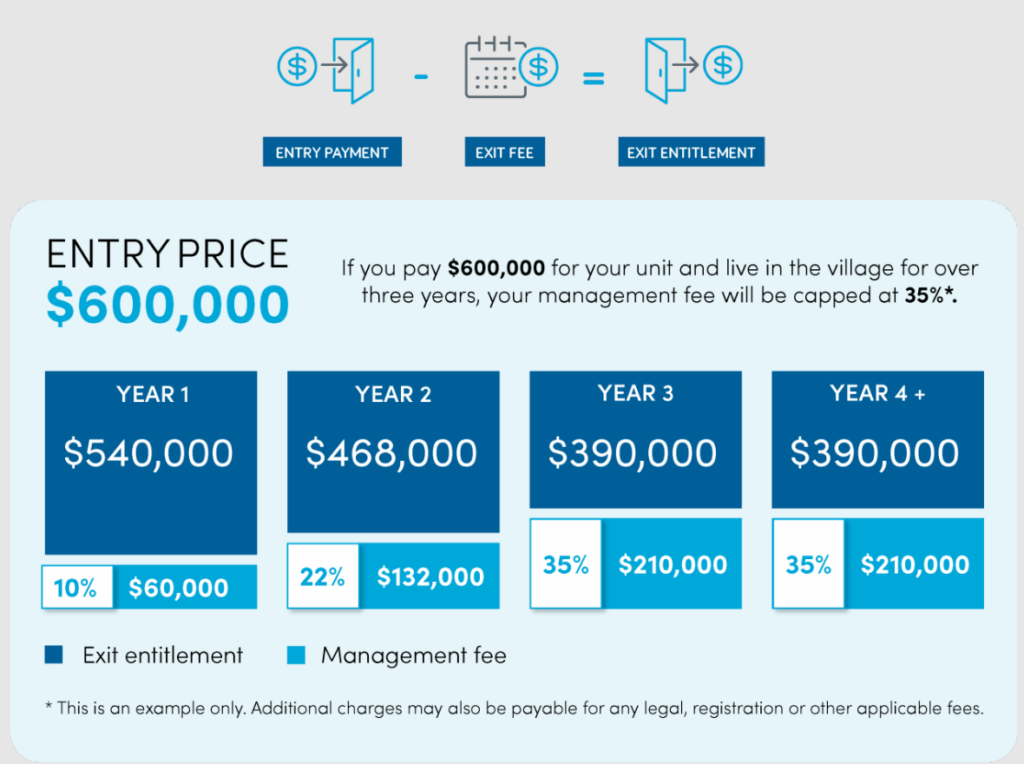
When it comes time to leave the village, you’ll receive an exit entitlement, which is the purchase price minus the management fee. This fee is capped at 35%of your entry price and is stepped during your first three years in a village. There are no further increases after this period, no matter how long you stay.
From the day you move in, you’ll be able to calculate how much you will receive when you exit the village – making your future budgeting clear and predictable.
Management fee example
To calculate your exit entitlement when leaving the village one would have to use the purchase price less the exit fee.*
Our residents tell us that choosing to move into a retirement village is about far more than bricks and mortar. In reality, it’s an investment in you. You’ll be moving into a friendly community filled with people at the same stage of life, and you’ll have access to a range of amenities.
These vary depending on the village you choose but can include things like:
Swimming pool
Gymnasium
Tennis court
Bowling green
Hair salon
Community centre
BBQ areas
Residents’ bar
Billiards room
Library
You can also get involved in a range of interest groups, social activities and events from happy hour to mini-golf and more – it’s really up to you and the community.
What’s more, when you can enjoy a low-maintainence lifetstyle as we take care garden and building maintainence, so you’ll actually have time to explore new interests!
These intangible benefits are an important consideration, and should be weighed up alongside the financials. Moving into a retirement village is about so much more than the property. Residents tell us that the lifestyle, health and wellbeing benefits enhance their quality of life immeasurably.
What if my care needs change?
If your needs change, you can rest easy knowing you can access care and support if you need it. In RetireAustralia villages, you have a range of care and support services to choose from, whether that means ongoing daily support in a serviced apartment in many of our villages in New South Wales, or South Australia, or flexible care and support delivered in your home by our Support at Home team. Care is tailored to your individual needs and funded privately or through government funding.
How can I compare the cost of living in a retirement village with other options?
A true cost of living comparison can only be obtained by spending time with a sales consultant in a village, talking through your circumstances and needs, and understanding the fees and inclusions in your chosen village. You also need to do your own homework and make sure you have an accurate picture of your current living expenses to make the comparison valid.
In a general sense, retirement villages offer great cost of living value but trying to put a specific dollar figure to this comparison can easily become misleading. Your own cost of living and those applicable to villages can vary substantially, so it’s best to check with your village of choice directly.
On top of the hard costs listed above which village fees cover, the costs associated with living in a retirement village also provide residents with a sense of community and belonging, support from friends and staff, and numerous opportunities to lead a happy, active and healthy life.
Placing a value on these intangible benefits is very personal to each individual. To get more of an insight into what it is like to live in one of our retirement villages, take a look at our retirement stories and insights.
The decision to sell your house isn’t always straightforward. Here, we go through the sales process, costs involved, and tips to maximise the sale price.
If you’ve lived in your house for years or even decades, it can be hard to move on. Your home can be linked to cherished memories of family, milestones and celebrations, and evoke feelings of security and comfort. To prepare for selling your house and taking the next step in retirement, it can help to have an idea of what to expect from the sales process.
Do your homework
Before you choose an agent, start by researching local real estate agencies. If you have friends or family close by, it’s great to ask for personal recommendations. After all, this will be the biggest sale you’re likely to make, and having trust and respect for the agent is crucial.
You might like to check out listings and sales prices in your area, to get a gauge for what similar properties are worth. You could even visit properties for sale and see how the agent treats prospective buyers and answers questions – consider asking about whether the vendors are willing to negotiate the sale price, how long the property has been on the market and why they’re selling.
Then, create a shortlist of at least three agents you would like to meet face-to-face and don’t be afraid to ask questions when you meet them. Here are some for consideration:
Would they recommend a private sale or auction? Why?
How much are their agents’ fees, and how do they calculate this figure? Is it a fixed fee or a percentage of the sale price? This is also known as commission and is generally between 1.5% and 3.5% of the agreed price. Most agents’ fees don’t include advertising, so be clear on how much the recommended campaign would cost.
How would they go about marketing your home? This could involve web listings, sign boards outside your house, photography, floor plans and copywriting, as well as social media and email campaigns.
What work (if any) would they recommend you do to make your home more attractive to buyers?
How would they value your home? Can they provide you with a property profile that includes information about sales of comparable properties in your area? Would they recommend specifying an asking price (if not going to auction), or a broader price guide?
Choose an agent
If you take time to do your research and meet with several agents, you’ll have a good idea of what your property is worth. You’ll also have a good sense of which agent is best suited to you. Keep in mind that some agents could be tempted to overvalue your property to increase the likelihood of getting your business, so base your decision on many factors – not just who has the lowest commission or says they could obtain the highest sale price.
Prepare your home for sale
To maximise its potential value, look at your home with a critical eye and decide whether a small upfront investment could have a big impact. There are several ways you could make your home more attractive to prospective buyers:
Assess the frontage of your home, as some buyers will drive past before they commit to attending an open house. Would the garden benefit from some tidying or weeding, or can you add a splash of colour with new plants or pots?
Keep things as open, airy and uncluttered as possible. This might mean putting some furniture in storage during the sale process.
Neutral colours are best. Consider painting over any obvious marks, or even re-painting if the paint job is tired or the colours are dated.
Fix anything in need of obvious repair, and attend to small maintenance jobs, like missing light globes or loose door handles.
Have your carpets professionally cleaned.
Tidy up your cupboards. It’s easy to think ‘out of sight, out of mind’, but buyers are sure to open cupboards and drawers to get a good idea of storage space.
Clear the clutter. This will help your home look bigger and more spacious. Think big (taking away unnecessary furniture), as well as small (clearing any flat surface), having tidy kitchen bench tops and removing fridge magnets.
Help prospective buyers see themselves living in your house, by removing any bold furniture or artwork, as well as personal touches like photographs.
Inspection day.
Make sure your house is spotless on inspection day, with no laundry or washing up in sight. Turn on all the lights, open the windows and doors, and show your house at its best. Keep your home as comfortable as possible, with fans or air conditioning on in summer, and a fire or heater in the cooler months. It helps to have a bright bunch of flowers in the kitchen to add a splash of colour. Finally, make sure you leave the house during inspections to help put prospective buyers at ease. This includes any pets who live with you!
Other costs to keep in mind
As well as covering your agents’ fees and marketing campaign, keep in mind that you’ll need some money set aside for conveyancing. This simply means the legal transfer of ownership from you to the buyer. If you have a mortgage on the house you’re selling, you may also need to pay your bank or lender an early exit fee.
Need advice?
For more advice about buying and selling a property in your state, go to:
Often, the biggest concern with moving into a retirement village is downsizing – what does it entail, is it worth it, and do residents miss their old house or neighbourhood? Everyone’s experience is unique, but the comment we hear most often from residents is, ‘I wish I’d made the move sooner’. Here, we break down what’s involved in downsizing, the pros and cons, and how you can tackle the process.
1. Make a plan
First things first, make a plan. Look at the floor plan and dimensions of your new home and decide how much of your furniture will fit the space. If it feels hard to let things go, consider putting furniture or larger pieces in storage while your house is on the market. You might be surprised by how little you miss them during this process.
2. Clear the clutter
It’s amazing how much we accumulate over the years, and the prospect of sorting through a lifetime of possessions and memories might seem overwhelming. That’s why we’ve put together a list of handy tips to make the de-cluttering process easier:
Start early. By making decisions well in advance of your actual move date, you’ll have time to sort out what’s most important to you and what you can let go.
Set yourself up for success.Start with items you’re not emotionally attached to, like outdated paperwork, kitchen utensils, stationery supplies, clothes and linen. Once you’ve done this, you can work your way up to photos, books, and sentimental memorabilia.
Prioritise. Write a list of non-negotiables – items you absolutely can’t live without – and try to assess the rest of your possessions with a critical eye.
Keep your focus narrow. Don’t tackle the whole house at once, but deal with one room, cupboard or zone at a time.
Break it into bite-sized chunks. It’s far more effective to consistently set aside 15 minutes a day than attempt to sort through years of memories in one weekend.
Be honest. Ask yourself “do I need it, use it or love it?” Be honest with yourself and remember objects don’t have feelings.
Take photos. Consider taking photographs or videos of things that can’t go to your new home. It will preserve the memory without taking up any space.
Swap old for new. It’s still OK to buy new items but try adopting ‘the one in / one out’ rule. For example, if you buy a new set of wine glasses, donate the existing ones.
Remember why you’re doing this. Research shows that clutter can affect mental wellbeing and add to feelings of stress. On the flipside, clearing out things you no longer want or need can be intensely liberating.
3. Find a new home for what you don’t need
Once you’ve de-cluttered, you might be wondering what to do with all the belongings you’re not taking with you to your new apartment or villa. You could consider selling big-ticket items like a lawnmower, and giving other pieces to family or charity. Knowing that a much-loved item will have a new lease of life in someone else’s home might help you let it go – and emotionally prepare for the move.
4. Enlist help
This is likely to be one of the most important moves you make, and it’s far easier to tackle if you can share the load among many. Ask professionals, family or neighbours to lend a hand – either with de-cluttering, packing, moving or cleaning.
5. Look to the future
If the magnitude of the project feels overwhelming, focus on what you’re gaining, rather than what you’re leaving behind. If you’re unsure if this is the right decision, weigh up the pros and cons:
The process of de-cluttering can take an emotional toll, but it will also simplify your life. What’s more, it can make the process of moving house much more manageable. Less clutter means less packing, physical effort and expense.
Sorting through all your possessions is time-consuming, but could benefit you financially. Your real estate agent is more likely to get a great price for your house if it’s streamlined and clutter-free. If you’d like to know more about the process of selling a house, we’ve got you covered.
It might be hard to emotionally let go of your house and possessions, but think about what life in a retirement village will be like – no more gardening to worry about, or the need to maintain a property you’ve outgrown. There will also be a welcoming community, ample opportunities for social connection, and a raft of activities on offer.
If you have questions about downsizing, speak to the sales consultant at the retirement community you’re most interested in. After all, they’ve seen hundreds of people go through the exact same process, and will be able to give you advice and point you in the right direction. They might even be able to connect you with residents who’ve recently made the move.
7 reasons why retirement villages are good for you
Did you know that where you live can impact your health just as much as how you live? How having community connection makes a tangible difference to your quality of life? This is why living in a retirement village can positively impact your health, your connection with loved ones and your sense of community.
Here are just seven of the ways retirement village living is good for your health and wellbeing.
1. Reduce isolation and improve mental wellbeing
One in five older Australians [1] is estimated to suffer from social isolation, which can negatively impact one’s mental health [2]and even lead to depression. The recent COVID-19 pandemic and lockdowns created even further social isolation for older Australians.
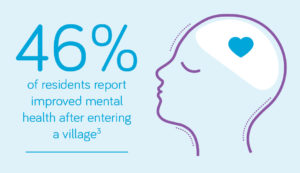
Life in a retirement village is specifically designed to counter social isolation, and instead foster a sense of belonging and community. Residents have many opportunities to connect with each other through a range of social activities and events, which has a positive effect on health and wellbeing. Indeed, research [3] shows that 46% report improved mental health after moving into a retirement village.
2. Boost longevity
Living better and healthier is great, but what about living longer? A Swedish study [5] has shown that being socially active can add up to five years to the life expectancy for women, and six years for men.
Researchers studied 1800 people over 18 years, and found that several factors impacted longevity, including having healthy lifestyle behaviours, a better social network, and participating in more leisure activities.
The research is in – a retirement village is the perfect place to boost your longevity through social connections and involvement in sporting and social activities and interests.
3. Reduce the risk of disability
Research conducted by Rush University Medical Center [6] has shown that people who are more socially active are less likely to become disabled. In other words, they’re less likely to need help with daily activities or mobility.
The good news is that researchers looked at a broad range of social activities, so whatever your interests, your social activities will have a positive impact. Researchers measured social activities like going to restaurants, playing bingo, volunteering, going on day or overnight trips, and visiting relatives and friends. With a busy social calendar on offer in all of our villages, you’ll be spoilt for choice in how you wish to stay active.
4. Fewer and shorter hospital stays
The Property Council of Australia [7] reports that retirement villages provide services that enable residents to have shorter hospital stays – and fewer of them. In fact, retirement village residents leave hospital a full two days earlier than non-residents. That’s because retirement village residents can be discharged into a safe environment that’s equipped with hand railings, ramps, an emergency call system and on-site support staff.
What’s more, the social connectedness that’s inherent in a retirement village helps counteract problems of social isolation and depression when you’re home after an operation. When you consider that falls and depression are two of the most common health conditions for older people [8], it’s no wonder that a safe, secure site and supported community can help keep retirement village residents out of hospital.
5. Visit the GP less often
In the Property Council of Australia report, it’s estimated that over 65s visit their local GP about 6-7 times a year. In contrast, residents in retirement villages make 1-3 fewer visits each year. They attribute this to the fact that many retirement villages have staff on-site who can assist with minor health concerns.
At RetireAustralia villages, residents can choose from a range of care and support services to meet their individual needs, whether that means ongoing, daily support in a serviced apartment or flexible services delivered right into their home through our Home Care team or other provider.
6. Lower the risk of dementia
Research shows that engaging in meaningful activities can reduce the risk of stress-related illnesses and dementia [9]. Specifically, activities with purpose – like music, drawing, meditation, reading, and arts and crafts – are particularly helpful in boosting health and wellbeing.
Our villages offer ample opportunities to take part in social and leisure activities, from MahJong to arts and crafts, dancing and painting classes. Many of our villages also have a library and a workshop on-site, so you’ll always have meaningful activities on hand if you wish to join in. And, if we don’t have what you’re looking for? Our Village Managers are always open to new ideas and would love to hear what you’re passionate about pursuing.
7. Delay the move to aged care
Would you like to hold off on moving into residential aged care? If the answer is yes, then living in a retirement village could be a good start.
Research cited in the Property Council of Australia report [10] found that residents of retirement villages enter aged care later than those moving from the family home. This isn’t a matter of weeks or months, but years – an average of five years to be exact. This also means you get to enjoy the village facilities and lifestyle benefits of retirement living for longer.
It seems the course is clear – life in a retirement village is likely to boost your health and wellbeing, but also your sense of fulfilment. And a life well lived is worth aspiring to!
The enormity of recent catastrophes across Australia is unprecedented and difficult to comprehend. After enduring a summer of destructive bushfires, people across the country have been impacted by a global pandemic. At such times, it can be priceless to have the physical and emotional support of a caring community. If you or your loved one is in a retirement village during a natural disaster or health crisis, it helps to know how that village will respond.
One of the most important things to remember is that all retirement villages have obligations under the Retirement Villages Act. This varies by state but, in short, it means that retirement villages have an obligation to protect their residents. It also means there will be plans in place outlining what needs to happen in an emergency. Retirement villages offer residents the best of both worlds – independent living with the assurance of a safety net and support in a crisis.
At our RetireAustralia villages across Queensland, New South Wales and South Australia, here’s what we’re doing – and will continue to do – to support residents during a health crisis.
Emergency response team
We have a dedicated emergency team that is focused on preventing COVID-19 from entering our communities, and preparing for the possibility that it might.
The health and wellbeing of our residents and staff is our top priority. We recognise that many of our residents will be vulnerable to the coronavirus and we’ve implemented a range of measures to help protect them.
For instance, we’ve added visitor checkpoints at each village, staffed by well-known members of the team. By establishing these stringent measures and ensuring all visitors are properly screened, we’re helping minimise exposure to the virus and providing extra protection for residents.
We also regularly communicate with our communities to raise awareness and understanding of COVID-19, and give advice about what residents can do to keep themselves safe.
We follow the news so you don’t have to
The situation is evolving quickly and it can be hard to stay on top of all the changes and localised advice. Our emergency response team closely monitors the situation and responds to directives and advice from both State and Federal Governments.
We stay abreast of changes and keep our residents informed. This means our residents can switch off and take a break from the relentless news coverage as needed.
Dedicated COVID-19 hotline
We understand this is a challenging time. Residents and their families might need extra support, advice, and reassurance around what we’re doing to protect our communities. That’s why we’ve set up a dedicated COVID-19 hotline, available on 1800 325 046.
Residents and their loved ones can call and ask questions around our response to the pandemic and what we’re doing to keep them safe.
Increased infection control
This is a new virus that is highly contagious – but the good news is that it’s stopped in its tracks by soap and water and physical distancing. These are our strongest weapons against the virus, and hygiene and cleanliness have never been more important.
To help stop the spread, all staff at RetireAustralia have completed mandatory refresher training on Infection Control policies and procedures – which were reviewed and enhanced early in 2020. We’ve also trained all staff on effective handwashing, and increased handwashing stations in village communal areas.
In addition, we have stocks of personal protective equipment (PPE), disinfectant and sanitiser on hand to maintain a clean and hygienic environment.
Keeping our villages safe
It’s impossible to guarantee that coronavirus will never enter one of our communities. But we’re doing everything we can to keep it out. These measures start at home, and our staff sign a health declaration each day before they start work.
We also have guidelines for visitors who must sign a health declaration before they enter the village.
Daily wellness check-ins
The current situation can feel lonely and overwhelming, but we’re in this together. In our communities, we’re offering independent living residents a daily wellness check-in phone call to see how they’re travelling and connect them with additional support if they need it.
Looking after body and mind.
We know that self-isolation and social distancing can take a toll on emotional and mental health, especially if we’re in this for the long haul. That’s why we’ve given advice to our residents about how to look after themselves physically and mentally. We’ve also shared tips to families and friends about how to support their loved ones, so isolation doesn’t have to be isolating.
Grocery support
Across our communities we’re helping residents access groceries, either going to the supermarket on their behalf or arranging regular deliveries of essential items. Each village is unique so the details of this support may vary. But at each of our communities, there are friendly team members available to help you get what you need.
Connected communities
Social networks are more important than ever – even if they look a little different from what we’re used to. Our village teams and residents are keeping our communities connected, even while social distancing. Take a look at some real stories about village life to get a sneak peek into what it is like to live in one of our retirement villages during a global pandemic.
Ultimately, the safety of our residents always comes first, and we’re doing all we can to keep residents healthy, connected, and informed. Living in a retirement village still comes with all the perks of independent living, but with an all-important safety net – ensuring you have support when you need it most.
If you’re interested in finding out more about our communities, you can even take a virtual tour of our villages from the comfort and safety of your own home!
There’s been a lot of talk about the pending economic downturn due to COVID-19, but data released by CoreLogic shows now could be the right time if you’ve been thinking about selling your home.
But a ray of hope for Australian homeowners is thatat least in the early stages of the pandemic, property values across the country have held firm.
Data released by CoreLogic showed their Hedonic Home Value Index increased by 0.7% in March. Not only that, property prices were already on a solid footing to begin with, after both Brisbane and Adelaide reached their peak price in March, and with Sydney just 2.7% off its peak.
We wait to see what the corresponding April report shows, but the indicators are that if there is to be a severe and prolonged downturn we’ll be given fair warning and have time to act before the worst hits.
RetireAustralia’s General Manager of Sales & Marketing, Paul McAlpine, has 15 years experience working in the property sector, both in residential land sales and retirement living. He’s optimistic a crash is not imminent.
“What we’re seeing is the number of properties being listed on the market has fallen amid concerns around whatthe full economic impact of the COVID-19 pandemic will be,” Paul said.
“The scarcity of homes available in the market could see a drop in property values delayed and prices staying strong for several months.
“With restrictions now being eased, and the real estate industry preparing to host property inspections again, sellers who move now will be ahead of the curve and stand a good chance of selling their property before any potential fall in prices does occur.”
So if you’ve been thinking about selling your home and making the move to a retirement village, now could be the right time.
“Timing is everything when deciding to downsize,” McAlpine continued. “The best case scenario is that you list your home when the market is high and you’re not in any rush to sell.
“Conversely, you can wait a little too long and have health or other limitations dictate when and how quickly you need to sell, which is not a situation you’d want to be in with the current uncertainty in the market.”
Anothergreat thing is that retirement living is all about certainty. Even as we live through these uncertain times, retirement village living is stable. You’ll know what you need to pay when you move in and what you’ll receive when you leave. No need to worry about future downturns or market instability.
If you are interested in taking another look at retirement living, get in touch with one of our friendly sales consultants to discuss how we can help you make the move.
No matter whether you want to honour your own motherhood journey, your adult children, your wife or your mum, we've put together some new and creative ideas to stay connected and mark the special occasion.
Virtual get-together. This is where technology comes in handy. If your family usually has a Mother’s Day brunch or picnic, you could re-create that experience using FaceTime, Skype or Zoom. You could even schedule a virtual cooking session, where you both cook the same dish – from different kitchens! – while on a video call. Share photos of your finished culinary creations afterwards and see how they differ. If you’re not familiar with making video calls, check out the government’s Be Connected website, which has free training videos to guide you through.
Pay it forward. There are many mums in the village who won’t be able to see their families on Mother’s Day, which could make for a fairly subdued experience. Perhaps you could celebrate your neighbours and lift their sprits with a small gift, cut flower from your garden, or homemade card – it doesn’t need to be elaborate, but the simple act of letting them know you’re thinking of them is sure to be treasured.
Inter-generational artwork. Some of the best pieces of art are home-made with love. Why not suggest that your loved ones make a colourful artwork from their handprints? There are lots of nifty and creative ways of doing this, including cutting out shapes, painting, and embroidering the prints onto a pillow.
Scrapbook it. Speaking of multiple generations, this might be a great time to reflect on your own mother and share those memories with your family. You could pull out some photo albums, scrapbook some ideas, or post a photo on Facebook to honour your mother. What makes (or made) her special? What are some of your favourite memories of growing up, and how did you celebrate Mother’s Day as a child, if you celebrated at all?
Game night. If you’re a board game aficionado, you could have a virtual family games night. There are plenty of games available on your phone’s App Store, like Words with Friends (a version of Scrabble), Monopoly and Cluedo, some of which charge a small fee to download. Tabletopia also has over 800 board games online, and you can create a virtual ‘room’ in which your family can play. There’s a monthly subscription fee if you want to play more than two games a month.
Travel the world. If you love art and travel, why not ‘visit’ some of the most inspiring galleries and museums from around the globe this Mother’s Day? Without leaving your living room, you can experience some of the world’s best art via the Google Arts and Culture app. Take virtual tours of the Museé d’Orsay in Paris, the Metropolitan Museum of Art in New York, and the Uffizi Gallery in Florence – along with 1,200 more! You can zoom in on iconic artworks, see collections curated by time and colour, or even immerse yourself in amazing gardens.
Plan for the future. When social distancing restrictions are lifted, what do you most want to do with your family? The coronavirus crisis has brought enormous tragedy, but it’s also crystallised what’s most important in life. Now could be a great time to focus on the experiences you want to have in the future, and the memories you want to create. After all, it’s our stories and experiences that will endure and see us through these trying times.
Drop a hint. If you have something a little more concrete in mind, like flowers, books or craft, we’ve got you covered. We’ve put together some ideas to inspire your family members this Mother’s Day! Be sure to let your family know if anything takes your fancy.
Attending a sales appointment during the COVID-19 crisis
We’ve made some adjustments to the way we conduct sales appointments within our communities to help protect the health and wellbeing of you, our residents and staff.
Your first appointment with one of our friendly sales consultants will be held on the phone. Once you’ve had a good chat and they understand what you’re looking for, they’ll talk you through our available properties and take you on a virtual tour of our community via a video conferencing tool like Zoom or FaceTime – and if you don’t have a device that supports this technology, let your sales consultant know and they’ll work with you to find another solution.
If you’ve found a property you’re interested in, your consultant will arrange a time for you to attend a viewing of the property at the village. To limit exposure around the village however, we’re only able to offer viewings of a maximum of two properties at any one time (and two people per viewing).
Before your on-site appointment
Your sales consultant will meet you at the village entry, where you’ll need to complete a health declaration form and agree to our village entry protocol.
You’ll then be asked to follow your sales consultant in your vehicle to the property. We ask that you drive to limit any incidental contact with residents or staff within our community.
During your on-site appointment
Your sales consultant will enter the property and ask you to wait at the door while they point out the key features of the property.
You’ll then be able to enter the property for a maximum of 10 minutes. During your viewing, we ask that you refrain from touching anything within the property. Your sales consultant will remain in the living area to answer any questions you may have while you take a look around.
Throughout your appointment, your sales consultant will ensure they maintain a minimum distance of 1.5 metres between you. We ask that you also respect these social distancing guidelines during your visit to our community.
After your on-site appointment
Once your viewing is complete, your sales consultant will have a brief discussion with you about the next steps in our appointment journey. They will also provide you with some additional information on the property that you can review together online.
In a few days, you’ll receive a follow-up call from your sales consultant to check-in and answer any further questions you may have.
Ready to call our community home?
If you’ve fallen in love with one of our properties and are ready to make a deposit, we can arrange for this to be handled at your house to avoid you having to make another trip out.
Before we hold this meeting, we’ll ask that you complete a health declaration form to confirm you’re feeling healthy and well on the day.
Keeping everyone safe throughout this process is paramount, and if at any point you have any questions or concerns, just ask us. We’re here to help!