







HomeStories & InsightsThank you the Green Clone Test

What is life like for men in a retirement village?

One of the biggest drawcards of moving into a retirement village is the sense of community it brings and being surrounded by like-minded people. Most villages offer a diverse range of activities and social events from crafts and sport to morning teas and happy hours. While they say there is something for everyone, there is a general perception that activities are focused on women or couples. We take a look at what is on offer at some of RetireAustralia’s retirement villages to see what’s available for the blokes.

A day out at Drayton Villas

When Village Manage Michael McMullen started working at Drayton Villas Retirement Village, he quickly noticed that the men seemed to have more difficulty connecting with others in the village. While the women were able to bond over a cup of tea, there was still a stigma that men don’t need to socialise. He and Brett Halley from the Drayon Villas’ team decided it was something they needed to tackle.

“So, we started a men’s day out,” says Michael. “Every couple of months we go somewhere. The first one was at a pub on the weekend and we had a feed, a beer and a good chat. We’ve done a sausage sizzle in the park and we’ve done one in the homestead [village community centre] as well.

“It’s helping them build relationships with the other guys. Now they will go and have a coffee and talk. Before they were tucked away until some family came and visited.”

Now the men are making these connections, Michael is noticing an improvement in their health and spirits – they seem brighter and more energetic. Having these friendships also helps to build a sense of community in the village.

“It gives them more purpose, it comes back again to wanting to be listened to. They want people to tell a story to. Drayton Villas is their life, so creating those friendships and relationships in the village is what makes it a good community,” explains Michael.

It’s not just outings that they focus on either, Brett, who looks after maintenance in the villages, helped set up a workshop where the men could gather and create things.

We started up a men’s shed here, for the men who don’t get out much, so they can start making a few things. They really enjoy that!
Brett Halley, maintenance person, Draytons Villas

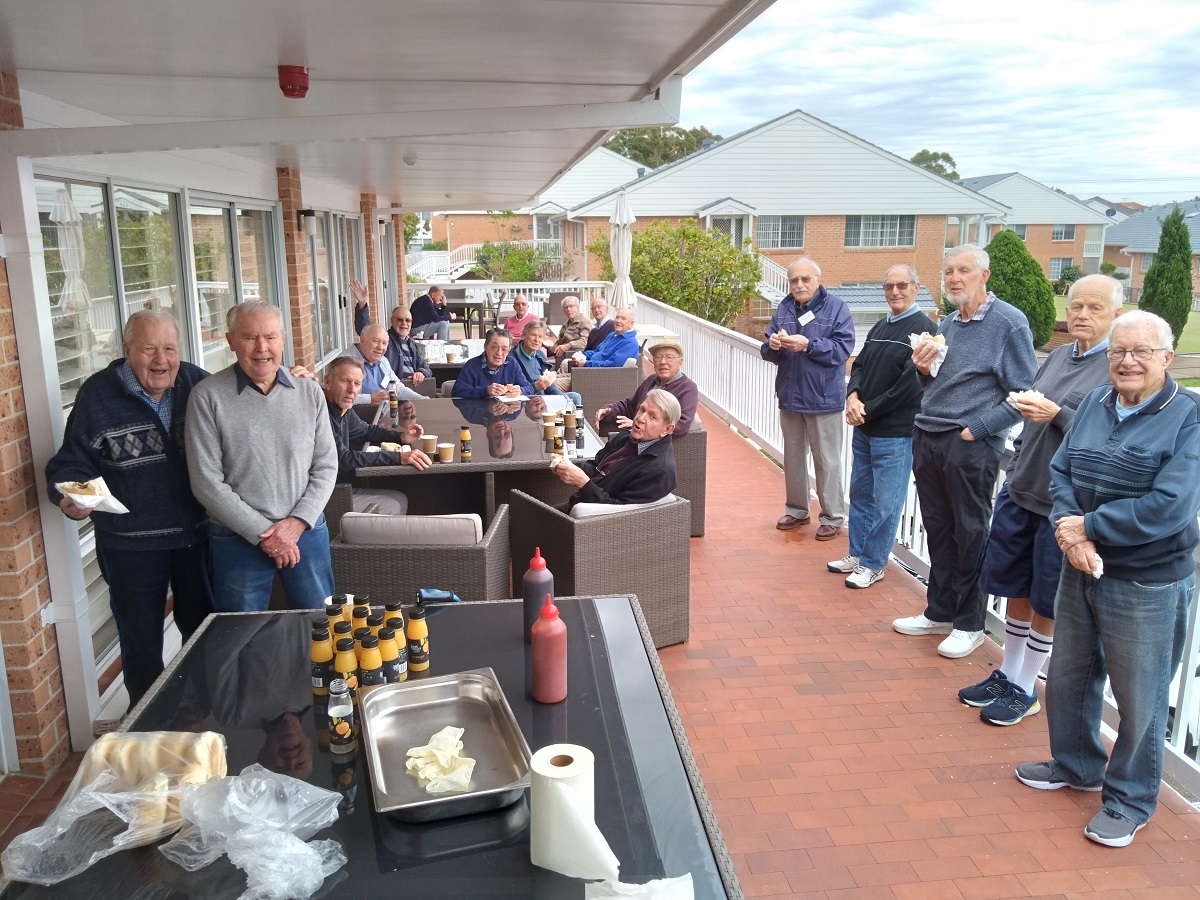
Boys’ BBQ brekkie at Belrose

For a long time, the team at Belrose Country Club Retirement Village were looking at ways to bring the men in their community together. When people could begin to gather again after the demise of COVID restrictions, the team at Belrose Country Club decided to hold a Father’s Day Breakfast.

“We have tried many things to get the lads together over the years – it is not easy to get them to come out! I have had a bee in my bonnet about getting the men involved since I started. I bought real draughts, and a chess set, and tried to entice them by offering biscuits. I advertised they were there for blokes to use, and then left biscuits out in the Clubhouse Lounge hoping they’d come,” says Caitlin Beyer, the village Lifestyle Activities Officer. “We came up with the idea of a Father’s Day Breakfast. The breakfast would be ‘our shout’. We advertised in our newsletter and they came along and loved it!”

The breakfast was so well attended, and the boys enjoyed it so much that the team ran it again the next month, and it has become a regular event and very much part of the culture in the village. The only difference from that first breakfast is that the men cook for themselves, but they still enjoy spending time and having a chat together over bacon and eggs.

The boys at Belrose Country Club have embraced their regular breakfasts as a time to catch up and connect.

Put to work at Tea Tree Gardens

When Colin Davies did a tour of Tea Tree Gardens Retirement Village he knew it was the place for him the moment he stepped foot in the village workshop. “I’m a tradesman and joiner by trade and nearly all the furniture in my house has been made by me, so that was a big attraction for me,” says Colin.

Many RetireAustralia retirement villages have a workshop where residents can do projects and share their skills with others. It’s a great way to meet like-minded people and become a part of the village community, but sometimes your skills can come in great demand as Colin discovered.

“I was in the workshop one day, I picked up the plane and noticed it hadn’t been sharpened for a while, so I went home and got my oilstone, by the time I got back to workshop word had gotten round and there was 17 chisels and three other planes waiting to be sharpened,” laughs Colin. “So, I spent the morning sharpening! It’s nice to have skills you can share.”

Colin and some of his friends spend their time in the workshop creating beautiful jigsaws for the residents to use in the Community Centre, they have made almost 100 of them!

“We spend time in the workshop having a bit of a laugh and a joke as well as a cup of coffee and a chocolate bikkie! We very rarely buy biscuits because people come in and pay us in biscuits for the work we do.

“It’s not exclusively for men, but when the women come in here we always say to them ‘mind your language’,” says Colin cheekily. “It’s all in good fun!”

You won’t just find Colin in the workshop, he plays snooker with friends at least four times a week too.

“I play snooker with a bunch of fellas and we all have a lot of laughs and take the mickey out of each. I’m usually doing a jigsaw puzzle in between shots,” says Colin.

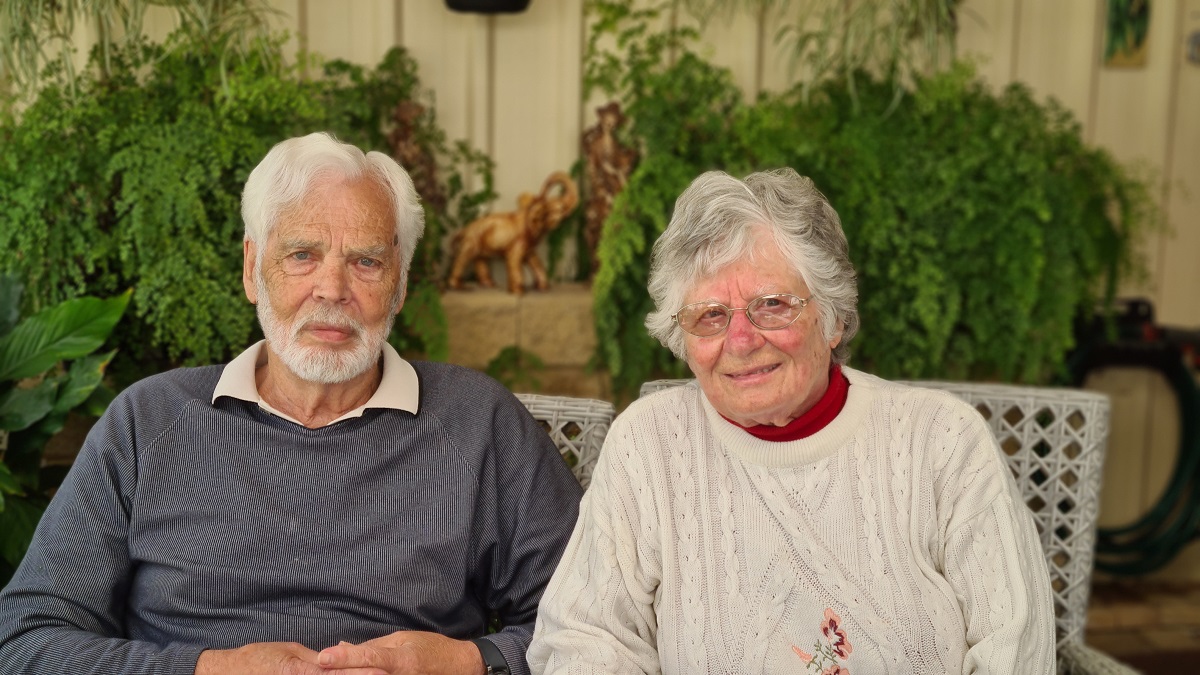
For Colin, pictured here with his wife Sylvia, the village workshop was the thing that sold him on moving to the village.
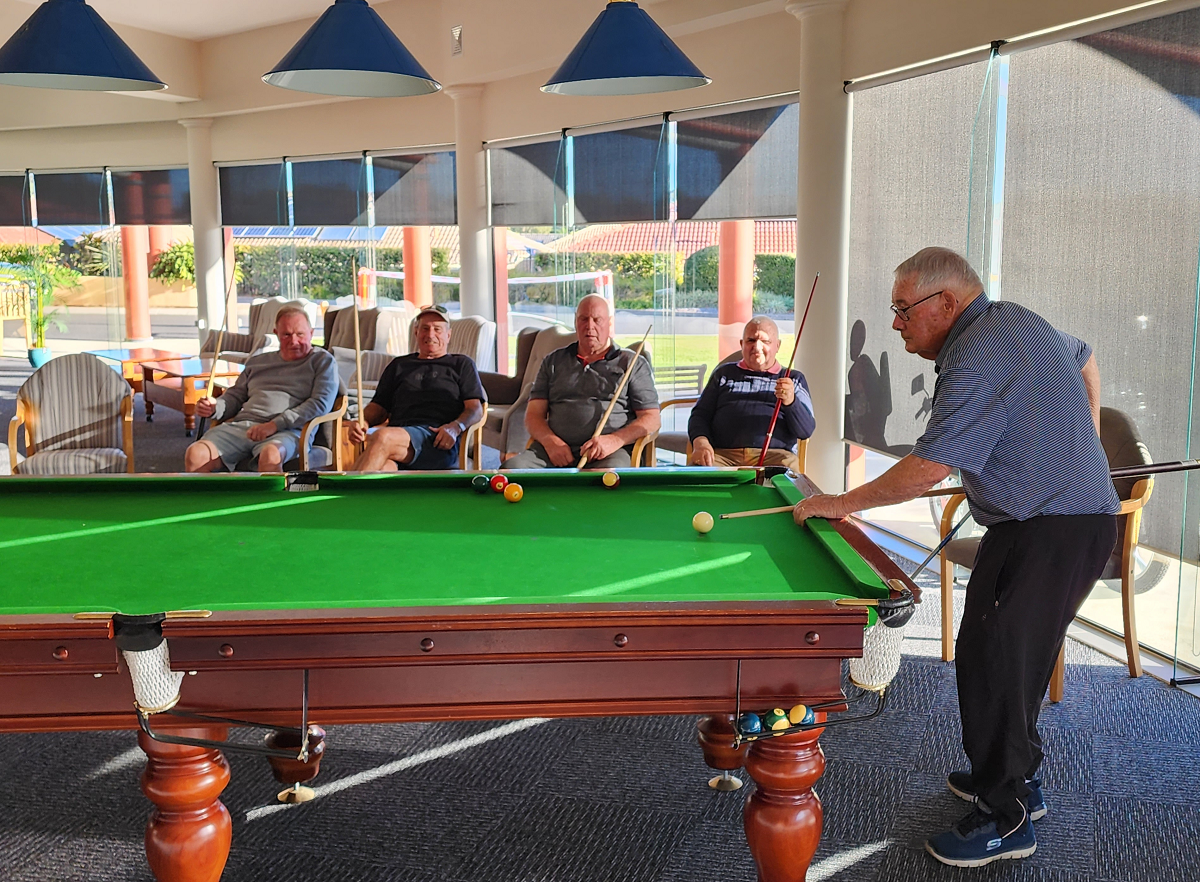
Kelly pool is very popular amongst the men at Boambee Gardens.

Scooping the pool at Boambee Gardens

For the residents at Boambee Gardens Retirement Village there are a lot of activities on offer for both men and women, but there are some that the men particularly enjoy. There is a snooker group and a Kelly pool (a variation on regular pool) group, as well as a Punter’s Club that all meet up regularly.

“Everyone is welcome to join in, but traditionally they are things that men enjoy,” says resident David Lee. “I enjoy playing snooker and Kelly pool is very popular – it’s a fun challenge. I’d also like to start a darts competition. I love that there is a big range of activities to do here.”

Resident Terry Kadwell is the driving force behind the popular Kelly pool, Jackpot Joker and Punter’s Club in the village.

“On a Friday afternoon the Punter’s Club get together when the Chook Raffle and the Jackpot Joker is also on, we put some money in and we all have a turn to bet on the Saturday,” says Terry. “There are three groups and the one I’m in bought a share in a racehorse from our winnings!”

The men’s business in a retirement village is not so secret now!

Want to discover if life in a retirement village is right for you? Get your FREE guide to retirement living.

Sign up for our monthly newsletter, Vitality!

Find a home that's right for you

RetireAustralia owns and operates retirement villages in 30 unique urban, seaside, tree-side and regional locations.

Queensland
Retirement Villages in QLD
View communities
New South Wales
Retirement Villages in NSW
View communities
South Australia
Retirement Villages in SA
View communities
Queensland
Retirement Villages in QLD
View communities
New South Wales
Retirement Villages in NSW
View communities
South Australia
Retirement Villages in SA
View communities

Ann’s safe and secure life

After the passing of her husband, Ann Symes sought a community of like-minded people. Relocating to a granny flat felt isolating, but exploring retirement villages with her daughter led her to find a true home at Magill Retirement Village.

Living on her own is something that Ann Symes had never considered, but after the passing of her dear husband and being ensconced in family life for so many years, she knew she needed to find a community of like-minded people.

“We lived in Pooraka [north Adelaide] until my husband got very ill, he was diagnosed with cancer. My daughter had a massive house with a huge garage, which she turned that into a granny flat. At my husband’s request, not mine!” says Ann. “I didn’t want to leave my home, but he felt that I wouldn’t manage on my own. He was always very protective. So, we moved to the granny flat and a year-and-a-half later my husband passed away.

“After he died, I felt very cut off from like-minded people, so I decided to look at villages because I felt it was the right thing for me.”

Ann and her daughter looked at many villages until they toured Magill Retirement Village and finally found home.


“I saw some beautiful retirement villages, very upmarket, but very cold. Magill was the last one I came to and when I came into the unit, I said to my daughter ‘I’m buying here’ and my daughter said: ‘Are you sure? Think about it.’ And I said ‘No, I have a nice feeling’. Honestly, I’m very happy here.

– Ann Symes

Village life is the life for Ann

Ann is known in the village as fun, friendly, generous, and always helping to other residents and with her warm laugh that’s easy to believe.

“I try to make friends and be helpful,” says Ann. “I think most of the people who come here are happy to be friends. We check on each other, all the residents interact in some way or another. I like people, I’m a people person.”

For Ann, life in the village is the perfect arrangement, she can live on her own and on her own terms, but she still has the comfort and security of living in a caring community.

“I’m not brave enough to live on my own now, so I like the security here,” says Ann. “I have the best of both worlds – I live on my own, but I have the community around me so I’m not alone. I’ve got my independence, I can close the door and I’m on my own, but outside I have everyone around. We all look out for each other.”

It’s not just the other residents who make life simple and stress-free for Ann, having the village team on hand when she needs help is priceless for her. She also has peace of mind knowing that care is available if she needs it in the future.

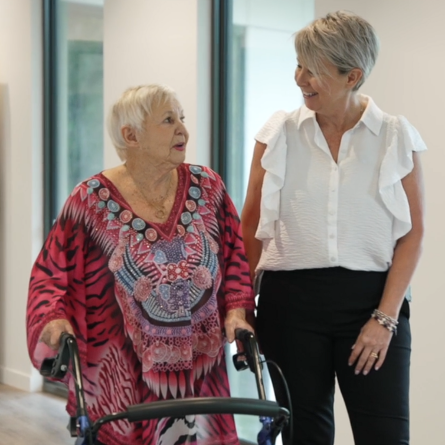
“I like the help, the handyman is very helpful,” says Ann. “The staff listen to you and try to do as much as they can. We’re very fortunate to have our Village Manager Kelly here [pictured above with Ann], she’s wonderful.”

Life wasn’t always this simple

Ann has certainly earned her retirement years, having moved to Australia over 40 years ago from India where she was a trained nurse.

“It took me five years to get back into nursing here, because they didn’t do the refresher courses at that time. So, I worked at Balfours packing pies and pasties, starting at 2am for five years,” Ann explains. “Then they started taking people back in for the refresher courses and I applied, and I got into the first course.

“I did midwifery in India so, when I came here, I’d had midwifery up to here!” laughs Ann. “So, I decided I would go into aged care, I was in my 40s and wanted a slower pace of nursing.”


“I thoroughly enjoyed working with the older people and hearing their stories and chatting with them. It was lovely, I did it for 15 years until I retired.” 

– Anne Symes

Family first

As well as taking part in the many social events in the village and playing Rummikub with friends on the weekend, you’ll often find cricket-mad Ann glued to a match on the TV.

“When we first came, my daughters and I would go to the cricket matches here at the oval. It was good fun! My daughters are just as mad about cricket as I am,” she says.

Her three living daughters are light of Ann’s life and while we’re speaking with her, she receives a call from her granddaughter.

“My granddaughter, at Harvard university in America, calls me every week! She is extremely clever,” says Ann. “I’ve got six grandchildren – five granddaughters and one grandson.”

When we remark that she seems very happy and has a good life at Magill and ask if she would recommend the village to her friends, she tell us: “Quite a few people have asked me about living here and I always tell people that I’m very happy here and I encourage them to move in. ‘Why don’t you try it? Because I’m happy here.’ I tell everybody!”

Find a community that you can call home.

Sign up for our monthly newsletter, Vitality!

Not receiving our Vitality monthly newsletter yet? Share your details below and we’ll send you monthly updates, helpful tips, and inspiring stories to support you on your retirement journey.

Having a pet in a retirement village

Can you bring your pet to a retirement village and will it benefit your life?

Pets can be an excellent addition to life in a retirement village, as well as providing numerous benefits for older Australians. While most of RetireAustralia’s communities are pet friendly, it’s essential to do your research to see if pets are welcome in your chosen retirement village and if there are any regulations for pet ownership. We take a look at what you need to consider when bringing a pet to a retirement village and what a pet can add to your life.

Four things to consider when bringing a pet to a retirement village

1. Check the guidelines

Many retirement villages welcome furry friends, but they may have some guidelines on what types of pets are suitable for village life. Before bringing a pet to the retirement village, it’s important to check in to ensure that your pet is allowed and also that you understand any regulations for pet ownership.

2. Consider the needs of the pet

When moving to a retirement village, it’s important to think about what your animal will need. For example, dogs may require regular exercise and outdoor time, while cats may be more low-maintenance. Will your home be suitable to house your pet? Small pets like birds or fish can be a good choice for those who don’t want the responsibility of a larger animal. It’s essential to choose a pet that fits with your lifestyle and needs.

3. Consider other residents

You should always be considerate of other residents in the village when bringing a pet. Some people may be allergic to certain animals or may be uncomfortable around them. It’s important to be respectful of others and keep your pet under control at all times.

4. Provide proper care and attention

Pets require proper care and attention to ensure their health and wellbeing. In a retirement village, it’s important to make sure that your pet is well-cared for and receives the attention they need. This includes regular vet visits, proper nutrition, and exercise. If you have a Home Care Package, you may be able to access support to help you look after your pet.

The benefits of owning a pet

Owning a pet can provide many benefits, these include: decreased loneliness, improved mood, boosting physical activity, and giving a sense of purpose. We delve into these benefits and explain why pets could improve your life in a retirement village.

Companionship

One of the most significant benefits of having a pet is the companionship they provide. Older people who live alone can feel lonely at times and a pet can help alleviate these feelings by providing companionship and unconditional love. A dog or cat can be a constant presence in the home, and they can offer comfort during times of stress or sadness. Even simple interactions like petting and playing with a pet can be incredibly comforting and reassuring.

Improved mood

Pets have been shown to improve the mood of their owners, and this is especially true for older people. Interacting with a pet can release endorphins in the brain, which can boost mood and reduce stress. Studies have also shown that people who own pets are less likely to experience depression and anxiety than those who don’t[1]. In fact, just the act of petting a dog or cat has been shown to lower blood pressure and reduce stress levels.

Increased physical activity

Pets can also encourage older people to be more physically active. For example, walking a dog is an excellent form of exercise that can help you stay active and healthy. Even playing with a cat or small dog can get you up and moving, which can have numerous health benefits. In addition, having a pet can provide older people with a reason to get out of the house and engage with the world around them.

Sense of purpose

Pets can provide a sense of purpose. Caring for a pet requires responsibility and commitment, which can be incredibly rewarding. People who own pets often feel a sense of purpose and meaning in their lives, as they are responsible for the wellbeing of their furry friend. This can be especially important for people who may have lost a sense of purpose after retiring or experiencing other life changes.


Find a pet friendly community you can call home

[1] https://www.ncbi.nlm.nih.gov/pmc/articles/PMC6826684/

Belinda’s door is always open at Carlyle Gardens

Listening to residents is what makes Belinda Hensler a strong force at Carlyle Gardens Retirement Village.

When Belinda Hensler became the Carlyle Gardens Retirement Village manager in June 2020, she was taken aback by some blunt and direct feedback from residents.

“But I shook it off and it’s probably the best thing that’s ever happened to me,” says Belinda.

After taking a few weeks to consider residents’ feedback, Belinda decided to adopt an open-door policy in the retirement village so she could be available to them for any issues they may have, at any time.

“Now the residents know they can come to me with issues and we will work through them together,” she says. “I feel like they’re helping me to do my job because they’re helping to improve the village.”

Walking the talk

Belinda, a former sales manager at Carlyle Gardens in Bargara, has gone out of her way to increase engagement among the coastal village’s almost 420 residents.

To increase communication both ways, she introduced a new feature to the village newsletter – a spreadsheet of issues that had been raised by residents, along with updates on progress, challenges, or other issues. This ensures that there’s transparency and residents know that Belinda is taking their needs seriously.

Belinda also launched a casual, monthly manager morning tea for residents once COVID restrictions eased. This gives her quality time to sit, chat and listen to the residents.

It started small, filling just one table in the village’s clubhouse, but now the morning tea fills five tables with residents bringing a plate, keen to discuss issues and opportunities in their village.

Residents at Carlyle Gardens are now so confident in Belinda’s management skills they eagerly approach her with any problems they are experiencing as they know she can help deliver positive changes.

“One of the impressive things about Belinda has been her openness to saying, ‘while we ask for respect, tell me what’s wrong.’ She’s willing to put herself out there and say, ‘please tell me how I can improve’,” says RetireAustralia operations manager Scott Burton. “It’s testament to her resilience and willingness to take feedback.”

Turning issues into opportunities

Belinda has transformed Carlyle Gardens into a thriving seaside village. The village is such a vibrant place to live that the residents are regularly recommending it to their friends. In recent years, many of the newest residents have come into the village at the urging of their friends.

While Belinda has faced challenges since taking on the role of manager, she has uncovered a solution for each hurdle in her path.

For example, when she recognised some residents in the village needed assistance to live independently, Belinda set up negotiations between a local care provider, Carinity and RetireAustralia. The resulting partnership gives residents access to personalised care packages.

“There are a lot of residents who are ageing and need assistance,” Belinda says. “There are also residents who, if they have a fall or a sudden illness, could need some help getting back on their feet or whose families don’t live close by.”

Belinda, pictured with RetireAustralia CEO Brett Robinson, was recently nominated for QLD Programmed Award for Village Manager of The Year in the National Retirement Living Awards.

Belinda also found a way to upgrade the village’s 30-year-old road network using a technique that saves money and minimises disruption.

Brighter days

Belinda makes the village not only a good place to live, but a nice place to work. After discovering 12 empty slabs of concrete around the village, Belinda proactively set out to make changes to the village’s outdoor seating.

“I realised years ago they’d had seats on them but they had been removed when they fell apart,” she said. “So, I did some investigating, and someone helped me source new chairs.”

The new seats are weather-resistant, created from recycled plastic, and coloured bright blue.

“They brighten my day now,” she said. “It would have cost a lot to remove the slabs but instead we have bold seating.”

These days when residents approach Belinda, their feedback is very different.

“They used to have a new village manager every couple of years, so I’d get asked, ‘how long are you going to stay?’ I tell them now, ‘I’m staying until I retire’,” she says.


Find a community you can call home

The importance of an advance care directive

No matter what age or stage of life you’re in, it’s important to consider your preferences for care and outline them in an advance care directive.

No one ever wants to consider a time where they will be unable to make a decision for themselves, but unfortunately we never know what the future may hold. No matter what age or stage of life you’re in, it’s important to consider your preferences for care and how you would like to live out your days. According to Advance Care Planning Australia, more than 50 percent of Australians will not be able to make their own medical decisions at end-of-life but only 15 percent of people have an advance care directive.

What is an advanced care directive?

An advanced care directive is a document that outlines your preferences when it comes to the type of care and treatment you’d like to receive. This document will also ensure that your values and beliefs are clear to those closest to you, as well as your health care providers. Simply put, it’s a way to give instructions about what you’d like to happen with your future care if you’re unable to do so.

It also allows you to formally appoint a substitute decision maker should a situation arise when you’re unable to make a decision for yourself.

Why do I need an advance care directive?

Having an advance care directive means that you will receive the care that you want. Having a directive that outlines your wishes means that your loved ones won’t have to guess and it will help ease the stress in what may be a very difficult time. It will assist family and health care providers to make necessary decisions.

Without a care directive, or if you haven’t appointed someone to make decisions on your behalf, and you become seriously ill or injured, doctors will make care decisions based on their assessment. This may include treatments that you would not want.

When should you create an advance care directive?

The best time to create an advance care directive is when you’re healthy and before a crisis, when there isn’t an urgent need for a directive.

It becomes more important to make an advance care directive as we get older, if we develop a chronic or terminal illness or are diagnosed with cognitive decline (such as Alzheimer’s disease).

An advance care directive versus an advance care plan

You may have heard both terms used, but is there a difference? Aren’t they just the same thing? In fact, they’re not. An advance care directive is a legally-binding document that outlines the directions around your preferred care and treatments as well as your values and beliefs. Your health care provider is legally bound to follow your directive.

An advance care plan is created on behalf of someone else who is unable to make their own decisions when it comes to their care. A plan can outline a person’s values and preferences and can assist substitute decision-makers and healthcare providers, but they are not legally bound to follow it.

How do I make an advance care directive?

To make an advance care directive, you must be over 18 and have decision making capacity. You don’t need a lawyer to make an advance care directive. Each state and territory have different processes and names of documents, to find out what is available in your state click here

Most states will have a specific form you need to complete:

New South Wales

Queensland

South Australia: Online or download a form


Want to discover whether life in a retirement village is right for you? Get your free guide to retirement village living.

Norm & Tina in control of their decisions

For Magill Retirement Village residents, Norm and Tina Morcombe, their goal in life is to stay busy, help people and be in control of their own decisions.

For Norm and Tina Morcombe their goal in life is to stay busy, help people and be in control of their own decisions. Which is exactly why life at Magill Retirement Village has suited them so well for the past 11 years.

Before moving to the village, the couple had lived nearby in Newton, a 10-minute drive away, for about 20 years. A combination of health issues, their experience of caring for Tina’s elderly parents and wanting to be in control of their future led Norm and Tina to make the move to the village. Although a little serendipity played a part as well.

“Tina’s only got about 10% eyesight, she’s legally blind, and I had a heart attack 20 years ago. So we thought ‘Hold on, we need to start thinking about these things before we get too old and the kids tell us: hey, you better start moving!’” says Norm.

Years earlier, Norm and Tina had spent a great deal of time looking after her elderly parents when Tina’s mum was paralysed by stroke and her father battled cancer.

“It got to the stage where I’d drop Tina off on my way to work and she was basically living with them. So we made the decision to sell up and buy another house, and we had them for 4-and-a-half years. It was OK for me, I could go to work, but Tina was looking after them seven days a week, 24 hours a day,” says Norm.

“I said to Norm, I don’t want to put our kids through what we went through. I wanted to do it for my parents, but we can’t live in the past, we have to live in the future and we’re going to make our own decisions,” explains Tina.

A serendipitous moment

With the thought of finding somewhere to live in retirement at the back on their minds, Tina spotted the village while they were out on a drive and suggested they take a look.

“So we came in and had a look. They showed us another unit and then this one and we basically fell in love with it there and then,” Norm explains.

This was just before Christmas, and in a matter of weeks they’d found someone to buy their home (including all of their furniture) and they had moved into Magill by the end of January. That was 11 years ago and they’ve never regretted their decision.

“The biggest thing is we’ve got no worries here,” says Norm. “We don’t have to worry about maintenance or anything like that.”

Keeping busy

While Tina has friends in the village and keeps busy with family who live nearby, Norm loves helping the village maintenance person, Rick, with odd jobs.

“I’m lucky that I’ve got Rick here who I can work with,” says Norm. “I can’t stand still, I’ve got to keep moving and the beauty of helping Rick it keeps me occupied, it keeps my brain going and I’ve got company. Working with Rick keeps me out of Tina’s hair.”

“That’s for sure!” laughs Tina in reply. “We keep ourselves busy, we’re not bored yet! Our goal is to keep busy and try to help someone if we can.”

Support when you need it

One of the main benefits of living in the village is the security of having trusted people around and knowing that support is there if they need it.

“I’m scared being on my own, so it’s peace of mind being here. I’m so relaxed and feel safe and secure,” says Tina.

“Tina gets nervous and my biggest concern is if anything happens to me, how is Tina going to handle it?” says Norm.

“Whatever happens we’re never going to be alone here,” Tina replies “The same goes for other people who live here, if anyone needs anything, they can knock on the door at any time, but we don’t live in each other’s pockets.”

To really ensure they’re never alone and that they have the support they need to continue the life they want in the village, the couple are on a Home Care Package.

“It’s also why we’ve each got a Home Care Package, I’m on level 1 and Tina is on level 3. To help ease our concerns of being looked after,” says Norm. “Getting the cleaning once a fortnight is the best thing we did.”

Come and enjoy village life

Tina says she loves life in the village so much that she’s regularly telling people they should come and live at Magill.

“Tina’s already organised two or three people to come and live in the village,” says Norm.

“Yes, come here is what I tell everyone,” Tina says.


Find a community you can call home



Surprising things you can get in a Home Care Package

Home Care Packages can improve your life in more ways than just cleaning, discover the surprising things they can fund.

The government-funded Home Care Packages provide support and assistance to eligible older Australians who wish to continue living independently in their homes. These packages offer funding for a range of services, such as personal care, domestic assistance, and transport services, as well as funding for home modifications and assistive technology. To access a Home Care Package, you need to be assessed by My Aged Care to see if you’re eligible and what you’re eligible for.

While the benefits of a Home Care Package are clear, many people may be surprised by some of the things that can be included. Here, we will explore some of the most surprising things you can receive under a Home Care Package.

Non-traditional pain relief or supplements

If you’re suffering with pain that can’t be treated with traditional medicine, you may like to try alternative therapies such as acupuncture. You can you use your Home Care Package to fund this. You may also wish to use supplements to boost your health and these can also be funded by your Home Care Package.

Pet care

Pets can help to improve the quality of our lives by decreasing loneliness and boosting mood. For this reason, a Home Care Package can be used to fund pet care services. This can include assistance with feeding and walking your furry friends, as well as grooming and veterinary appointments.

Social outings

While this isn’t common in our RetireAustralia villages, many older Australians may feel isolated and lonely, particularly if they have limited mobility or live alone. Home Care Packages can provide funding for social outings, such as trips to the cinema, museum, or a local park, as well as transport to and from these events.

For Bartonvale Lodge Retirement Village resident, Klaus, he was able to re-connect to his culture through social activities at the German Club paid for through his Home Care Package.

“I can now go shopping and for drives to the beach,” says Klaus. “I had forgotten how to speak German after my parents passed away, and now I can read it and understand what they are saying when I go to the German Club.”

Allied health services

To help keep you moving and pain free, a Home Care Package can give you access to allied health services such as physiotherapy, occupational therapy and podiatry.

Mobility equipment

It’s important to remain independent and social as we get older, to ensure this is possible you’re able to access mobility equipment on a Home Care Package. This could include walkers, crutches, wheelchairs, mobility scooters, ramps and lifts.

Home modifications

As we age, it can become more difficult to move around our homes safely. Home Care Packages can provide funding for home modifications, such as the installation of grab rails, ramps, and shower seats. This can help to reduce the risk of falls and increase independence and confidence in the home.

Language translation services

For older Australians who speak a language other than English, communication can be a barrier to accessing the support they need. Home Care Packages can provide funding for language translation services, so that you can communicate effectively with your care provider and other healthcare professionals.

Technology assistance

As technology becomes more integrated into our daily lives, it can be challenging for some older people to keep up. Home Care Packages can provide funding for technology assistance, such as setting up and using a computer or tablet, accessing online services, and using assistive technology devices.

Assistance with technology is just one of the things that could be funded by your Home Care Package. 

Music and art therapy

Music and art therapy have been shown to have a range of benefits, such as reducing stress and anxiety, improving mood, and promoting social interaction. Your Home Care Package can provide funding for music and art therapy sessions, so you can enjoy the therapeutic benefits of these activities from the comfort of your own home.

These are just some of the things that are available under your Home Care Package. Speak to the RetireAustralia Home Care team to find out what could be available specifically for you so that you can live independently in your home for as long as possible.

RetireAustralia Home Care

RetireAustralia Home Care is available in many of our villages and offers residents the same trust, familiarity, and feeling of ‘home’ that they already have about their village. Care is flexible and tailored to exactly what you need, when you need it. It can be funded privately or through an approved government-funded Home Care Package. We can even help you navigate Home Care Package approval through My Aged Care, the government assistance platform.


Want to discover whether life in a retirement village is right for you? Get your free guide to retirement village living.

9 top tips to help you downsize and declutter


It’s so easy to accumulate a lifetime of treasured trinkets and possessions. We often don’t realise how much ‘stuff’ we have until it’s time to move house. When you’re making the change to retirement living there is often an element of downsizing as you move from a family home to the next chapter of your life. It may seem overwhelming, but there are some simple things you can do to make clearing the clutter stress free. Before long, you will be relaxing in your new home at The Rise at Wood Glen.

We’ve supported many residents and their families over the years through this process and gathered their best tips and advice on how to make things as easy as possible.

1. Make a plan

Group your objects into categories and start culling less emotional items such as paperwork, kitchen utensils, stationery supplies, cleaning products, clothes, linen and plastic-ware. Once you’ve done these you can work your way up to photos, books, knick-knacks and other sentimental memorabilia.

2. Start early

Start to make decluttering decisions well in advance of your actual move date. This is important if you have a high level of attachment to your belongings and allows you to stay in control of decision making. Quite often you will underestimate just how much you need to de-clutter, so starting as soon as possible is your best bet says RetireAustralia resident Chris, “My top tip is start clearing the rubbish in the garage two years before you downsize!”

3. Take measurements and consider your new lifestyle

RetireAustralia’s sales staff will provide you with a floor plan of your low-maintenance apartment in The Rise at Glen Wood which will include the room measurements. Take advantage of this by taking measurements of all the spaces and storage areas and use this to help decide what to take.

Remember, you will have access to all the fabulous common areas and there will be no need to bring that lawn mower or hedge trimmer.

4. Keep sessions short

Even if it’s for only 15 minutes at a time, short sessions will soon add up to a lot of work. You don’t need to do it all at once, but slowly you’ll be able to work up to longer periods.

5. Be honest

To help make decisions on what to keep, ask yourself “do I need it, use it or love it?” Be honest with yourself and remember objects don’t have feelings. You can create piles or areas to sort into, such as ‘keep’, ‘toss’ and ‘sell/giveaway/donate’. Don’t create a ‘maybe’ pile as it is something you’re just going to have to sort out again later.

“Once we’d done it, we felt so good. We’d got rid of all this stuff we didn’t really need and living here feels like we’re on holiday every day,” says Del, a RetireAustralia resident from Wellington Manor.

6. Take photos

Consider taking photographs or video of things that can’t go to your new home. It will preserve the memory without taking up any space in your new home.

Speaking of photos, you may have boxes of old photos and many albums. Photos are treasured items and need to preserved, but they can also be heavy and bulky. Enlist some friends or family to help digitize them all and then frame the ones that are special to take pride of place in your new home.

7. Swap old for new

It’s OK to still buy new items but try adopting ‘the one in / one out’ rule. For example, if you buy a new set of wine glasses, donate the existing ones.

Moving into your new home can also be your chance to update some of those older items for some nice things you’ve had your eye on. Now’s the time to create your new home for the next exciting stage of your life.

The Rise kitchen

8. Gift or sell things

Firstly, ask your children if they want any of the items you don’t want, but be prepared for them to not want many of them, no matter how precious they are to you. Secondly, consider a private garage sale for people you know and trust and put coloured stickers on the items you no longer want. Thirdly, ask charities if they want your unwanted items but don’t just assume they will – charities often have limited room or too much stock already. Auction houses can also be a destination for selling your unwanted items but they can be very fussy about what they’ll accept.

“We had friends help, we donated stuff to charity, we gave to family and friends, we sold on Facebook Marketplace,” says Chris.

9. Be kind to yourself

Downsizing and decluttering can be tough as we form emotional attachments to our belongings and the memories they hold. By starting early, you give yourself time to reminisce over cherished memories and process the change that’s occurring. Don’t be hard on yourself for being sentimental, but do remind yourself that a fantastic new life awaits you. The most common thing we hear at RetireAustralia is “I wish we’d made the move sooner!”.

Get some assistance

This is something you don’t have to tackle on your own, there are professionals available you can assist you. Some services that may be able to help include:

Transition Angels Ph: 1300 730 028

Need more?

If you require more information about your new apartment or The Rise at Glen Wood to help your downsizing process, you can always reach out to our sales team. We look forward to welcoming you soon to The Rise at Glen Wood.


Is retirement living good for you?


It might seem hard to believe, but where you live can impact your health just as much as how you live – and having community connection makes a tangible difference to your quality of life.
We’ve put together six ways retirement living is good for you.

1. Social connectedness

The Rise at Wood Glen offers genuine community, social connectedness, and a sense of belonging. This is important because humans are social creatures, even those who prefer their own company need a sense of connection to thrive.

You’ll have ample social activities to choose from, from happy hours to lawn bowls, movie nights to craft groups. There’s something for everyone but it’s entirely up to you how much, or how little, you take part in.

Either way, you’ll be part of a diverse and supportive community. And, as the Australian Unity Wellbeing Index reports, this has a positive impact on our wellbeing [1].

“Communities offer us collective support, a sense of belonging, and play a key role in combating loneliness as we age. [2]

2. Better physical health

Throughout our RetireAustralia villages, our teams have reported countless instances of residents’ health improving after moving into a retirement community. And now there’s research to back up this anecdotal evidence. In a survey of Australian retirement village residents, 27% reported their physical health improved after moving in [3].

This could be for countless reasons, including more social interaction, feeling safe and secure, and better nutrition*.

Research shows that loneliness can have an adverse effect on physical health, and is linked with impaired immune functioning, unhealthy behaviours, and physical inactivity [4].

On the flipside, retirement living is good for you because villages have been specifically designed to improve health and wellbeing. In other words, our communities are purpose-built to counter social isolation and foster a sense of belonging and connectedness. Our vibrant activity calendars also offer whatever it is that sparks your interest and keeps your body and mind active.

3. Improved mental wellbeing

This brings us to improved mental wellbeing. In many ways, it’s hard to separate physical and mental health because they’re so inter-linked.
It’s also important to be aware that older people are more susceptible to common triggers for anxiety and depression  [5]. Beyond Blue reports that these triggers include physical illness, chronic pain, and personal loss.

The good news is that having strong community connections can not only provide people happiness, support and a sense of purpose, but it can help stave off anxiety and depression.

“Research shows that being connected to others is important for mental wellbeing and can be a protective factor against anxiety and depression.” Beyond Blue: Connections Matter  [5].

4. Safety and security

Many residents tell us that safety and security is at the top of their list, and one of the key motivators behind moving into a retirement village.

Residents feel safer in a retirement village for lots of different reasons, but we most often hear that people feel more secure because they:

  • Are in a community of like-minded neighbours where everyone looks out for each other.
  • Have a 24-hour emergency call system, this offers peace of mind in the event of a fall or a health incident.
  • Feel supported in the midst of challenging external events, such as natural disasters and COVID-19
  • Can visit family and friends knowing their mail will be collected, lawns mowed, and home secure in their absence.

Retirement village living also gives extra assurance to family members who may not live close by.

5. Future care needs

We’ve already touched on physical health, but it’s important to think about your future care needs, even if you’re currently fit and active. One of the main benefits of retirement living is having a safety net if your health changes down the track. You can rest easy, knowing we have you covered if you fall ill, get injured, or need extra care and support:

  • Home Care: Home Care provides residents with the same trust, familiarity, and feeling of ‘home’ that they already have about their village. Our reliable and experienced team can help with household chores, meal preparation, showering, dressing and medication support, to name a few. Depending on the community you choose, you can access home care from RetireAustralia and/ or another reputable provider.
  • Priority access: Alternatively, if your care needs are increasing and you need consistent day-to-day support, in most cases you also have priority access to one of our care or serviced apartments in your village or a nearby RetireAustralia village. Our trusted team will take care of housekeeping, maintenance and delicious meals every day.

6. Ditch the lawnmower

This brings us to our final point – a low-maintenance lifestyle. This is especially important if you have a large family home that’s become a burden to maintain.

At The Rise, you don’t have to worry about maintenance or gardening. If you have a leaking tap or your light bulb blows let our village team know and we will take care of it**. This means you can kick back in the community centre overlooking lush green gardens – without having to fire up the lawnmower. Having gardening and maintenance taken care of allows you the time and space to spend more time on what you love, whether that’s playing with your grandkids, golfing or reading.


* Better nutrition applies to care and serviced apartment residents, who receive delicious and nutritious meals every day.
** Examples only. Before moving into a RetireAustralia village we provide clarity on what maintenance the village service charges cover, giving you peace of mind and financial certainty for the future.
1] Australian Unity. “How community affects wellbeing.” (2020), online: https://www.australianunity.com.au/wellbeing/What-is-real-wellbeing/How-community-affects-wellbeing
[2] As above
[3] Retirement Living Council. “The book of wise moves.” (2020), online: https://www.awisemove.com.au/village-life/
[4] Van Orden et al. “Strategies to promote social connections among older adults during ‘social distancing’ restrictions.” (2020), online: https://www.ncbi.nlm.nih.gov/pmc/articles/PMC7233208/
[5] Beyond Blue. “Risk factors for older people” (2022), online: https://www.beyondblue.org.au/who-does-it-affect/older-people/risk-factors-for-older-people

Simple steps to selling your home


The decision to sell your house isn’t always straightforward. If you’re unsure of what the sales process involves and you’re looking for advice, we have some tips and suggestions that we’ve gathered over the years from our residents to help you get the best outcome.

If you’ve lived in your house for years or even decades, it can sometimes be hard to move on. The process of selling your home can also feel daunting. While change can be uncomfortable, it is also an exciting step forward to your new home at The Green, where you will discover a great community and embark on a wonderful stage in life. Before you dive into retirement living you will need to prepare your home for sale. To get the best result it can help to have an idea of what to expect from the sales process.

Do your homework

Most people use a real estate agent to sell their home to help make the process easier and get the best price possible. Before you choose an agent, start by researching local real estate agencies. If you have friends or family close by, it’s great to ask for personal recommendations. After all, this will be the biggest sale you’re likely to make, and having trust and respect for the agent is crucial.

To get a gauge for what similar properties are worth, check out listings and recent sales prices in your area. It can be a good idea to visit local open homes and see how the agent treats prospective buyers and answers questions. Some things you could ask include: whether the vendors are willing to negotiate the sale price, how long the property has been on the market and why they’re selling. Don’t mention that you’re selling and see who calls you back, as this can be a good indicator of a hard-working agent.

Then, create a shortlist of at least three agents you would like to meet face-to-face and don’t be afraid to ask questions when you meet them. Here are some for consideration:

  • Would they recommend a private sale or auction? Why?
  • How much are their agents’ fees, and how do they calculate this figure? Is it a fixed fee or a percentage of the sale price? This is also known as commission and is generally between 1.5% and 3.5% of the agreed price. Most agents’ fees don’t include marketing and advertising, so be clear on how much the recommended campaign would cost.
  • How would they go about marketing your home? This could involve web listings, sign boards outside your house, photography, floor plans and copywriting, as well as social media and email campaigns.
  • What work (if any) would they recommend you do to make your home more attractive to buyers?
  • How would they value your home? Can they provide you with a property profile that includes information about sales of comparable properties in your area? Would they recommend specifying an asking price (if not going to auction), or a broader price guide?
  • Are there other agents in the agency who will be showing the property?

Choose an agent

Residents tell us that doing your research and meeting with several agents will give you a good idea of what your property is worth. You’ll also have a good sense of which agent is best suited to you. Keep in mind that some agents could be tempted to overvalue your property to increase the likelihood of getting your business. So base your decision on many factors – not just who has the lowest commission or says they could obtain the highest sale price.

When RetireAustralia resident, Gordon Crawford put his home on the market to move into Tarragal Glen Retirement Village, he found: “By researching and finding a good agent and with the housing market on a high, the sale process was very fast and we had a decent level of free cash to set up our new home”.

Prepare your home for sale

To maximise its potential value, look at your home with a critical eye and decide whether a small upfront investment could have a big impact. There are several ways you could make your home more attractive to prospective buyers:

  • Assess the frontage of your home, as some buyers will drive past before they commit to attending an open house. Would the garden benefit from some tidying or weeding, or can you add a splash of colour with new plants or pots?
  • Keep things as open, airy and uncluttered as possible. This might mean putting some furniture in storage during the sale process.
  • Neutral colours are best. Consider painting over any obvious marks, or even re-painting if the paint job is tired or the colours are dated.
  • Fix anything in need of obvious repair, and attend to small maintenance jobs, like missing light globes or loose door handles.
  • Have your carpets professionally cleaned.
  • Tidy up your cupboards. It’s easy to think ‘out of sight, out of mind’, but buyers are sure to open cupboards and drawers to get a good idea of storage space.
  • Clear the clutter. This will help your home look bigger and more spacious. Think big – taking away unnecessary furniture. As well as small – clearing any flat surface, having tidy kitchen bench tops and removing fridge magnets.
  • Help prospective buyers see themselves living in your house, by removing any bold furniture or artwork, as well as personal touches like photographs.

Inspection day

You already know that your house should be spotless on inspection day, with no laundry or washing up in sight. There are some other small things you can do that make a big difference, such as turn on all the lights  and, open the windows and doors, as this will show your house at its best. Keep your home as comfortable as possible, with fans or air conditioning on in summer, and a fire or heater in the cooler months. It helps to have a bright bunch of flowers in the kitchen to add a splash of colour. Finally, make sure you leave the house during inspections to help put prospective buyers at ease. This includes any pets who live with you!

Other costs

As well as covering your agents’ fees and marketing campaign, keep in mind that you’ll need some money set aside for conveyancing. This simply means the legal transfer of ownership from you to the buyer. If you have a mortgage on the house you’re selling, you may also need to pay your bank or lender an early exit fee. The cost of selling your home varies by state, but you can find a comprehensive breakdown of likely real estate agent commission, marketing and conveyancing fees. 

Need advice? 

For more advice about buying and selling a property in New South Wales, go to Fair Trading: advice on on selling a property.