
HomeStories & InsightsThank you the Green Clone Test

Life in a retirement village – what are the costs?

Is living in a retirement village expensive? We take a look at the cost of living in a leasehold or licence retirement village.

Retirement villages

Deciding where you’d like to spend your later years is a big decision. Retirement villages offer many benefits for older people, including living in a supportive environment surrounded by like-minded people and they can be a cost-effective retirement living option too.

The cost of living in a retirement is an important consideration and, in many cases, a deciding factor of where people choose to spend their later years. Here we outline what the costs are for buying into, living in and leaving a leasehold retirement village (the most common RetireAustralia village), so that you’re able to make an informed decision and have certainty about your financial future.

When you buy 

When it comes to retirement villages there are three types of ownership agreements. These are:

  • Leasehold
  • Licence
  • Strata Title

Leasehold and licence

The most common types are lease and licence, this is where you purchase a long-term lease to live in your home.

For lease and licence there is an entry payment, the amount will depend on the size, style and location of your home. Unlike most property transactions, you will not have to pay stamp duty on your new home, so this equates to a significant cost saving on entry.

At RetireAustralia, we have an independent living residence contract that we provide in our leasehold and licence villages, which includes disclosure, cooling-off and settling-in periods. This provides peace of mind should you change your mind within the cooling-off period – you’ll get your deposit back in full. If you move in and you decide the village isn’t right for you within 90 days, we’ll reimburse your entry payment minus accrued service charges, any reasonable costs incurred for renovations made at your request, and a pro rata rental fee for your time in the village.

While you live there

Many residents in our retirement villages describe life as relaxed, secure and stress-free, as the facilities along with garden and maintenance are looked after by a dedicated team. To cover these costs, there is a regular service charge. By law, village operators cannot profit from service charges, so they are only charged on a cost recovery basis.

The service charge covers things such as:

  • Council and water rates
  • Building insurance
  • Building and garden maintenance
  • 24-hour emergency call system
  • Village staff
  • Access to and upkeep of communal village facilities

When you leave

No hidden costs

RetireAustralia will prepare, market and sell your home for you, in most cases at no extra cost, except in the event of exceptional wear and tear, damage, or alterations or additions to your home.

Financial certainty while on the market

Under our independent living residence contract, offered in our leasehold and licence villages, we will buy back your retirement home if not sold within 6 months (New South Wales) or 18 months (Queensland and South Australia) to give you the certainty to plan your next move

Departure/exit fee

Like the majority of retirement village operators, RetireAustralia retains a portion of the funds from the sale of your home as a deferred payment fee.

The fee is effectively an ‘enjoy now, pay later’ scheme, which helps reduce the cost of moving into a retirement village. It covers RetireAustralia’s initial investment in the village and helps to ensure that all residents have access to quality facilities and amenities while they’re living in the village. It funds capital replacement works and village upgrades.

Repayment protection

Our independent living residence contract, offered in our leasehold and licence villages, allows you to calculate exactly how much you’ll get back based on your entry payment. So from the day you move in, you’ll be able to calculate how much you will receive when you leave the village – making your future budgeting clear and predictable. The deferred payment fee will not exceed 35%, no matter how long you stay in the retirement village. Many of our residents feel secure armed with this knowledge, especially in times when house prices are volatile. You can calculate your deferred payment fee here.

Cost of living in a retirement village

The best way to really understand the true cost of living is to spend time with a sales consultant in a village. They will be able to talk you through your individual circumstances and needs, and help you understand the fees and inclusions in your chosen village. It’s also important that you do your own homework and make sure you have an accurate picture of your current living expenses.
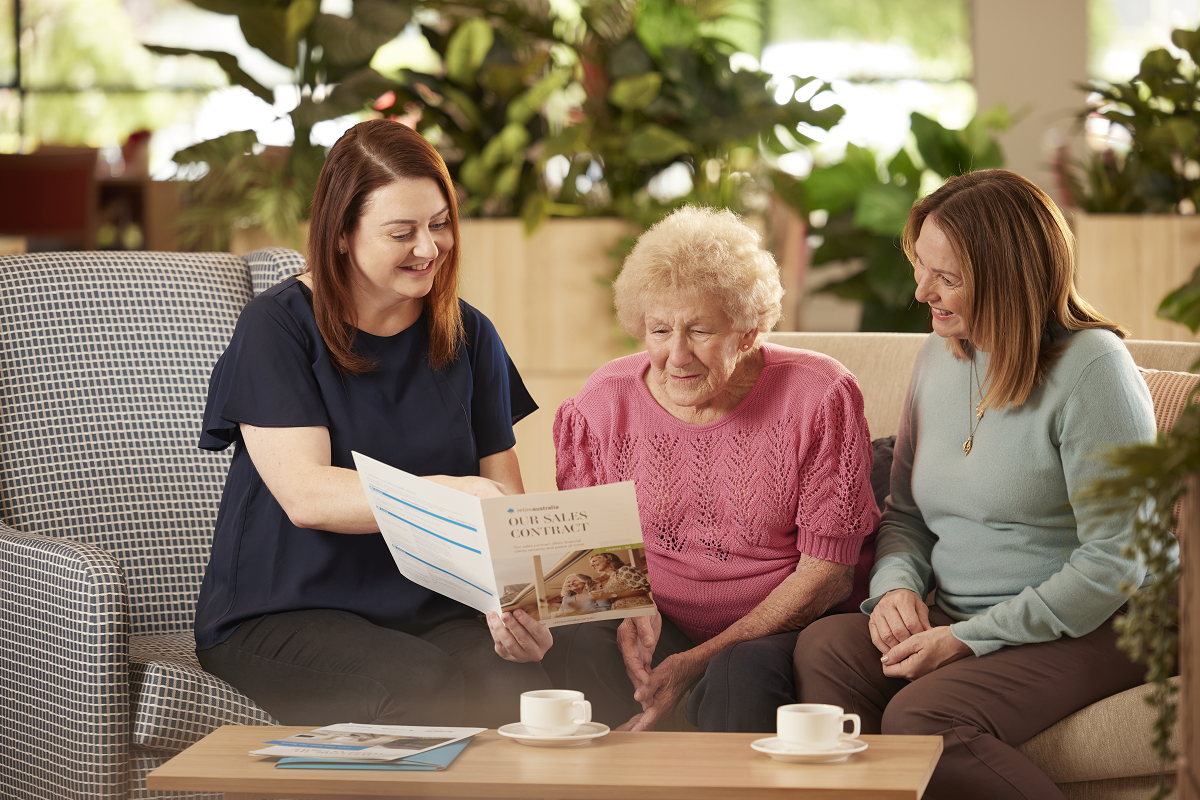
A sales consultant can give you the best idea of specific costs for your circumstances.

In a general sense, retirement villages offer great cost of living value but trying to put a specific dollar figure to this comparison can easily become misleading. Your own cost of living and those applicable to villages can vary substantially, so it’s best to check with your village of choice directly.

On top of the hard costs listed above, which village fees cover, the costs associated with living in a retirement village also provide residents with a sense of community and belonging, support from friends and staff, and numerous opportunities to lead a happy, active and healthy life. Life in a retirement village can also give you peace of mind knowing that care and support is available should you ever need it. Best of all you will never feel alone or isolated.

Tarragal Glen Retirement Village resident Gordon Crawford did a lot of research into the costs and financial elements of living in a retirement village before making the move, but found he couldn’t put a price on the community he moved into.

“Having settled into our new home, we discovered a sense of community we hadn’t expected,” Gordon says. “We enjoy social events such as BBQ night (where occasionally we have live music), Coffee Corner, Lunch Box, Drinks at 4 and the Village Manager’s morning tea. Through this we now consider many of the residents friends. Friends who care about each other and keep an eye out for anyone having difficulties.”

Placing a value on these intangible benefits is very personal to each individual. To get more of an insight into what it is like to live in one of our retirement villages, take a look at some of our other resident stories.


Want to discover whether life in a retirement village is right for you? Get your free guide to retirement village living.




Signs an ageing loved one may need support

It's important to spot the signs that an ageing parent may need extra support to stay independent and, most crucially, safe.

We all want to live independently and on our own terms, so recognising and accepting that you need assistance can be difficult at any stage of life. As we get older, we naturally start to struggle with things we could once do with ease. Often this can gradually creep up on us and those around us. It’s also easy to downplay or ignore issues, which can make it tough to know when an ageing loved one may need some extra support, but there are some signs to look out for.

“Sometimes it can be a combination of little things, and they may be happening slowly, so over time we don’t really see or acknowledge them, or take appropriate notice,” says RetireAustralia NSW Regional Care Manager Josh Campbell.

With a decade of experience in aged care, Josh understands the difficulties families can face and shares some tips on what to look for and how to approach what can be a difficult conversation.

Changing ways

You know your relative best, so most often you will be able to recognise when something may be amiss or not quite right during your regular catch-ups. If your dad is someone who likes to dress ‘just so’ or is always on time, it may be that you notice a scruffier appearance or that he is running late for a scheduled date. Or maybe your mum was an avid bowler or passionate theatre-goer and all of a sudden loses interest. These could be signs of something being not quite right. Noticing these kind of changes are, for a lot of people, the first indicators that an ageing loved one may need a little extra help. It can be upsetting to see people change in this way too.

“It can be a tough time, not only for ageing people, but it can also be a stressful time for anyone making decisions for their family,” Josh said.

Physical signs

Below is a list of some of the most common physical signs that could indicate an ageing loved one needs help.

  • Change in weight: a sudden and unintentional change in weight could be a sign that they’re not eating or preparing the right meals, skipping meals or relying on fast foods.
  • Bruises, scrapes or burns: wounds could indicate that there have been a change in mobility, falls or troubles with cooking. As we age, we often struggle with balance due to a loss in muscle mass and falls can become an issue.
  • Poor hygiene or body odour: a result of not bathing regularly and a decrease in grooming habits. Sometimes there may be a fear of falling in the bathroom that’s preventing showering.
  • Dirty or inappropriate clothing: wearing clothes that are stained or may not be suited to the weather could signal a struggle with dressing.

Financial signs

Being unable to handle finances and money can be another indicator that help is required. Here are some signs:

  • Unopened letters or unpaid bills: a pile of unopened letters or bills could indicate someone is struggling to manage their finances.
  • Utilities or internet being disconnected: this could be a sign that bills are not being paid.

Home maintenance signs

Changes around the home are another common way that people recognise a decline in their ageing loved ones. They include:

  • A sudden change in housekeeping: a house that is ordinarily kept neat and tidy, or there are signs of clutter or hoarding.
  • Appliances or cookware with burn marks: this could indicate a pot has been left unattended on the stove.
  • Spoiled food in the fridge or pantry: food that is being neglected and not thrown away.
  • Lack of food in the fridge or pantry: not enough food in the home could be a sign that grocery shopping in being forgotten or too hard to do.
  • Rubbish not being cleared or taken out.

Cognitive and memory changes

Unfortunately, the risk of dementia increases as we age and while people can live independently for some time, some form of care and assistance will often be required. Some things you may notice include:

  • Repeating questions and statements
  • Forgetting to take medications or missing appointments
  • Confusion: Being confused telling a story or unable to follow a group conversation.
  • Getting lost while driving or walking
  • Being unable to recall familiar names of people, things and places.
  • Change in mood or personality: for example, if someone becomes depressed or is quick to anger, when they normally aren’t.


It’s important to choose the right time and place to have a conversation about care.

Having the care conversation

If you recognise some warning signs with an older relative, it can be difficult to sit down and broach the subject of care. It can be tempting to put it off, but the worst outcomes happen when the conversation is missed and a crisis occurs. If your loved one has a fall or becomes ill, you may have to make decisions on the go, which means they may not be what your relative or you really want.

Pick a time and place where you’re both comfortable. “Gently and informally start to discuss if they would be open to looking at additional care or assistance,” recommends Josh. “Ask them how they feel, what help they might need, and listen carefully to the answers, and remember to listen to what they might not be saying.

“Make sure you don’t approach them in a confrontational way or start blaming or shaming your loved ones. Ensure your visits and discussions aren’t interrogations or cause conflict. Start this conversation respectfully, with love, and sooner rather than later.”

For more ways to approach this important conversation, take a read of this blog.

Next steps

If your loved one is open to receiving some care, you could arrange an appointment to visit  their GP with them for a chat. Here you can discuss organising a case conference to investigate what support your ageing relatives may need and what is available.

The website My Aged Care outlines the range of care and assistance available through the government.

For more information, you can also read about the care and support offered in our retirement communities  including our very own alternative to aged care, Glengara Care.


To discover more about retirement living, get your free guide now.

Kelly is a cut above at Magill

Magill Retirement Village Manager Kelly Reading has celebrated many professional and personal milestones over the years

Working across two villages in Adelaide has provided Magill Retirement Village manager Kelly Reading with many memorable moments including a wedding and a career move that changed her life. Kelly moved to Adelaide from the UK in 2006, she had been a hairdresser since she had left school and was working as one when she saw a job ad for the hair dressing salon at Tea Tree Gardens Retirement Village.

“The hairdresser had been there for 15 years and had decided to retire, so luckily I got it,” says Kelly.

“I think, as a hairdresser, I’ve always been a people person and I never really knew how much I loved older people until I started working at the salon at Tea Tree Gardens.”

Married to the job

Getting married at Tea Tree Gardens has been the most memorable part of Kelly’s time at RetireAustralia. Kelly couldn’t work out where she wanted to hold her wedding in early 2020, she only wanted to have a small, private affair, when Tea Tree Gardens Village manager Lucy Mulvany came up with the perfect solution.

Kelly and Lucy on the wedding day.

“Lucy said to me: ‘If you want to get married here, you can.’ And I thought, ‘Yeah, we can get married down near the creek’. So I had a very small, private group of friends and then the whole of Tea Tree Gardens,” Kelly says with a laugh.

The nuptials became a whole village affair, with everyone banding together to make the day one to remember. Kelly was married under an arbour that was built by some of the residents in the village workshop, then it was decorated by some of the other residents, who also did all the flowers.

Kelly arrives to cheering residents at her wedding.

“One of the residents had a two-seater car, so he picked me up and we went to the creek in that,” Kelly says. “It was so overwhelming because as we pulled up into the creek, my two boys were waiting to give me away and all the residents were standing there and they were all clapping and cheering. It was so beautiful.

“No matter what happens in my life, RetireAustralia will always be in my heart for that reason.” 

Styling for a new career

After many years as the hairdresser at Tea Tree Gardens, Kelly was ready for a change. When the COVID-19 pandemic hit, Kelly started working casually in the office.

“That was really cool because I just tried to keep everyone’s spirits up. I used to drive around in the buggy and play music, get the residents all dancing on the croquet lawn and all that kind of stuff.

“I’d always known that I couldn’t do hairdressing until I retired and as I was getting older, my body was starting to hurt that bit more,” Kelly explains. “I never really knew what I wanted to do, until I went into the office and thought ‘Oh this is quite fun!’ After that I decided whatever I did, it was going to have to be within retirement living.”

This time in the office spurred Kelly on and she studied for her Certificate III in Business in her spare time

“Just as I became qualified with that, the position for Admin between Tea Tree Gardens and Magill Retirement Village came up,” Kelly explains. “As I had been at Tea Tree for so long, I didn’t want to just leave it all behind. So, I got that role but then the next minute I’m here at Magill full-time. I feel like all the cards fell at the right time and place.”

A new chapter

For Kelly, being Village Manager at Magill Retirement Village is exactly where she wants to be. “I gave up hairdressing and I haven’t missed it for one minute. I don’t like routine, as such, so I like the fact that every day is different,” she explains. “I like being around the older people and I like the fact I’m surrounded by beautiful people all the time.”

Kelly’s enthusiasm and energy shines through when you listen to her talk about helping the village become an even more vibrant place filled with happy residents.

Kelly is loved by the residents at Magill.

“I looking forward to growing as a manager,” she says “My main aim is for the residents to be happy. I want to come to work every day and see them happy in their own environment. I want them to have something to look forward to, to be able to get up and have activities to go to. I want to make this place to really vibrant. I have a great team who back me up.”

We can’t wait to see where Kelly takes Magill in the future.


Find a community you can call home


A day in the life of a retirement village resident

Active retiree Jenny Klinkby shows us what a day in her life as a resident at Boambee Gardens Retirement Village is like.

Staying active and social is key to a happy life for Jenny Klinkby. Each Tuesday is an especially action-packed day for Jenny, who has lived at Boambee Gardens Retirement Village with her husband Alf for the past 14 and a half years. Jenny has kindly shared what an average day in her life as a resident in the village looks like for her.

A day in Jenny’s life

9-10am: On a Tuesday, it’s exercise to start off the morning. There is an exercise group called Heart Moves which Jenny likes to go to.

10.15-11.15am: It’s Tai Chi. “I don’t always go to these groups,” says Jenny. “But I try to get along when I can. Otherwise, there could be doctor’s appointments, dentist appointments, crazy things going on around here.”

Lunchtime: “After Tai Chi, I have a husband that needs lunch, so we take a break to eat,” says Jenny.

1.30-2.30pm: It’s time to get moving again with some line dancing.

2.30pm: Craft club. “When I finish line dancing, I usually go down to the craft club for about half an hour,” Jenny explains. “Here, I do a bit of crocheting, if I’ve got some to do. Crocheting the tops of hand towels, because we have a little shop every so often and so I’m lucky enough to be the only one doing the hand towels. Then we’ve got squares to make blankets, more so for the winter. I also help out with whatever else is going.”

While this is an average Tuesday that Jenny enjoys she says that her busy life means that she doesn’t always get to all the groups the village offers.

“I don’t always do it every Tuesday, but I try and do it as much as I can,” says Jenny “I like to do it as it keeps me upright, otherwise I shall sit down all day. The line dancing gives us plenty of exercise, as does the Heart Moves in the morning. The tai chi is good as it’s slower and more of a movement exercise.”

Couples that play together, stay together

retirement village resident couple
Jenny and her husband Alf love to do things together.

Over the more than 14 years that Jenny and her husband Alf have lived in the village, they’ve taken part in lots of different social activities and groups. Staying active and busy is how the couple like to live their lives and Boambee Gardens has lots on offer for them.

“We used to do rock’n’roll dancing together, which was great fun,” says Jenny. “But we’re getting a bit too old to do that now. We always like to do something, I don’t know how to live with nothing to do.”

While Jenny has her day packed full of groups on a Tuesday, her husband Alf has his own interests to keep him busy.

“Alf doesn’t join the classes, he has a few things to do himself,” Jenny explains. “He’s a member of the bonsai club, so he plays with his bonsais quite a bit. He does a little bit of gardening.

“He used to be a member of the chess club, he took chess to the schools around here. He introduced the schools to chess along with an older man, many years ago. Now the schools have competitions and the teachers have taken over, so that is still going I believe.”

Something for everyone

It’s not just Jenny and Alf who like to keep busy, a lot of the residents at Boambee Gardens like to get out and about and take part in things happening inside the village, as well as life outside.

“Some of the residents are very busy, there are those who get involved, others who like to get into the gardens,” says Jenny. “There’s a lot of activity going on here, they’ve got painting groups, yoga groups (I haven’t joined the yoga group) there’s bingo and table tennis, there’s quite a bit going on.

“There are quite a few goers in the village. There are others who go and do things outside of the village too. It’s fantastic this way of living. We’re so handy to shops, airport, the train stations, the hospital, we’re 15 minutes from everything.”

Living the quiet life

While the village can be a hive of activity for those who don’t want to sit around, there are plenty of residents who prefer to live a quieter existence or spend time away from the village.

“There are residents who keep to themselves and you won’t see from one year to the next. They often have outside interests or they may just like to keep to themselves,” says Jenny.

“Others will come to the bar each evening for a quick drink before they go to dinner, have a little chat. You can’t see everybody, in 14-and-a-half years there are some people I’ve not seen yet,” says Jenny “Everyone’s different, so you have a great big mix of people here, which makes it good. The ones who are happy to do the social things and the others who are happy to do their own things.”

Working for her residents

Leading the helm at Boambee Gardens is 2021 NSW Village Manager of the Year Lexi Connor. Lexi is much-loved by the residents not only for her dedication, but for the fun that she brings.

“Lexi is fantastic, she’s the best person we’ve got! We hope she never leaves! We want to keep her for ourselves,” says Jenny.


Find a community you can call home

9 top tips to help you downsize & declutter


It’s so easy to accumulate a lifetime of treasured trinkets and possessions. We often don’t realise how much ‘stuff’ we have until it’s time to move house. When you’re making the change to retirement living there is often an element of downsizing as you move from a family home to the next chapter of your life. It may seem overwhelming, but there are some simple things you can do to make clearing the clutter stress free. Before long, you will be relaxing in your new home at The Verge.

We’ve supported many residents and their families over the years through this process and gathered their best tips and advice on how to make things as easy as possible.

1. Make a plan

Group your objects into categories and start culling less emotional items such as paperwork, kitchen utensils, stationery supplies, cleaning products, clothes, linen and plastic-ware. Once you’ve done these you can work your way up to photos, books, knick-knacks and other sentimental memorabilia.

2. Start early

Start to make decluttering decisions well in advance of your actual move date. This is important if you have a high level of attachment to your belongings and allows you to stay in control of decision making. Quite often you will underestimate just how much you need to de-clutter, so starting as soon as possible is your best bet says The Verge at Burleigh G.C. resident Chris, “My top tip is start clearing the rubbish in the garage two years before you downsize!”

3. Take measurements and consider your new lifestyle

RetireAustralia’s sales staff will provide you with a floor plan of your low-maintenance apartment in The Verge at Burleigh G.C. which will include the room measurements. Take advantage of this by taking measurements of all the spaces and storage areas and use this to help decide what to take.

Remember, you will have access to all the fabulous common areas and there will be no need to bring that lawn mower or hedge trimmer.

4. Keep sessions short

Even if it’s for only 15 minutes at a time, short sessions will soon add up to a lot of work. You don’t need to do it all at once, but slowly you’ll be able to work up to longer periods.

5. Be honest

To help make decisions on what to keep, ask yourself “do I need it, use it or love it?” Be honest with yourself and remember objects don’t have feelings. You can create piles or areas to sort into, such as ‘keep’, ‘toss’ and ‘sell/giveaway/donate’. Don’t create a ‘maybe’ pile as it is something you’re just going to have to sort out again later.

As Judy from The Verge says: “Throughout your life you’re at the shops and see a tablecloth and think ‘that’s a nice tablecloth’ and suddenly you have 17 tablecloths, five doona covers and six sets of sheets! Why?”

6. Take photos

Consider taking photographs or video of things that can’t go to your new home. It will preserve the memory without taking up any space in your new home.

Speaking of photos, you may have boxes of old photos and many albums. Photos are treasured items and need to preserved, but they can also be heavy and bulky. Enlist some friends or family to help digitize them all and then frame the ones that are special to take pride of place in your new home.

7. Swap old for new

It’s OK to still buy new items but try adopting ‘the one in / one out’ rule. For example, if you buy a new set of wine glasses, donate the existing ones.

Moving into your new home can also be your chance to update some of those older items for some nice things you’ve had your eye on. Now’s the time to create your new home for the next exciting stage of your life.

8. Gift or sell things

Firstly, ask your children if they want any of the items you don’t want, but be prepared for them to not want many of them, no matter how precious they are to you. Secondly, consider a private garage sale for people you know and trust and put coloured stickers on the items you no longer want. Thirdly, ask charities if they want your unwanted items but don’t just assume they will – charities often have limited room or too much stock already. Auction houses can also be a destination for selling your unwanted items but they can be very fussy about what they’ll accept.

“We had friends help, we donated stuff to charity, we gave to family and friends, we sold on Facebook Marketplace,” says Chris.

9. Be kind to yourself

Downsizing and decluttering can be tough as we form emotional attachments to our belongings and the memories they hold. By starting early, you give yourself time to reminisce over cherished memories and process the change that’s occurring. Don’t be hard on yourself for being sentimental, but do remind yourself that a fantastic new life awaits you. The most common thing we hear at RetireAustralia is “I wish we’d made the move sooner!”.

Get some assistance

This is something you don’t have to tackle on your own, there are professionals available you can assist you. Some services that may be able to help include:

Downsized Living Ph: 0412 173 033

Blue Lighthouse Relocations  Ph: 1300 158 432

Retirement Care Solutions  Ph: 0408 451 667


Life at the Rise: perfect for now, ideal for later


As a discerning retiree, life in a stylish, contemporary apartment on New South Wales’ idyllic Central Coast has great appeal. You will get that and so much more with your new home at The Rise at Wood Glen.

Set amongst the green landscape at the base of Kincumba Mountain Reserve, The Rise offers a peaceful lifestyle in a secure environment. Located in the well-established Wood Glen Retirement Village, you can enjoy access to resort-style facilities, award-winning gardens and a vibrant social calendar.

Everything you need and want is nearby, including stunning beaches, great shopping, restaurants and medical facilities.

“The people and staff really make it feel like home,’’ says resident Marion Robey, who enjoys socialising with others at the village, playing Bridge and gardening.

Enjoy superb, five-star amenities in a caring community

Located within the well-established Wood Glen Retirement Village, you will benefit from the strong sense of community and exceptional amenities including a heated swimming pool, spa, bowling green, gymnasium, hairdressing salon and country-club style community centre, The Lodge.


There’s also plenty of opportunities to connect with like-minded people. Join your neighbours in the bar or or enjoy dinner together in the barbeque area.

Ros and John Oakey moved into Wood Glen Retirement Village from their home of Port Macquarie. Now, they live close enough to Sydney to connect regularly with family, and both volunteer and work in the local community. They also keep busy with sport, with Ros cycling, doing pilates, and going to an outside gym, while John makes use of the village’s proximity to golf, tennis, and surfing.

“We’re only a 10-15 minute pushbike ride from Terrigal,” says Ros. “The village has got absolutely everything. We love it.”

The village also offers a vibrant social calendar that can satisfy whatever it is that sparks your interest. Take a look at some of the activities on offer – you can take part in as much or as little as you like.

As Ros points out, “If you’re making a choice to make a change, you might as well make it as rich as you possibly can. That’s what I’m doing. If you hang around people who are really good at being retired, you get really good at being retired.”

An apartment that suits your style

While there is a rich offering of activities and opportunities to engage in, once you’re home you will have complete privacy. Offering stunning views, your modern and expansive contemporary apartment has superior finishes and inclusions. With floor to ceiling glass to maximise natural light and bring the outside in, and a balcony that offers mesmerising views of the Erina Valley bushland.

There’s plenty of room to sprawl out and enjoy life, while European appliances and high-end finishes add a touch of luxury and refinement. Intentionally designed for later in life, each apartment has been constructed with security and low maintenance living in mind.

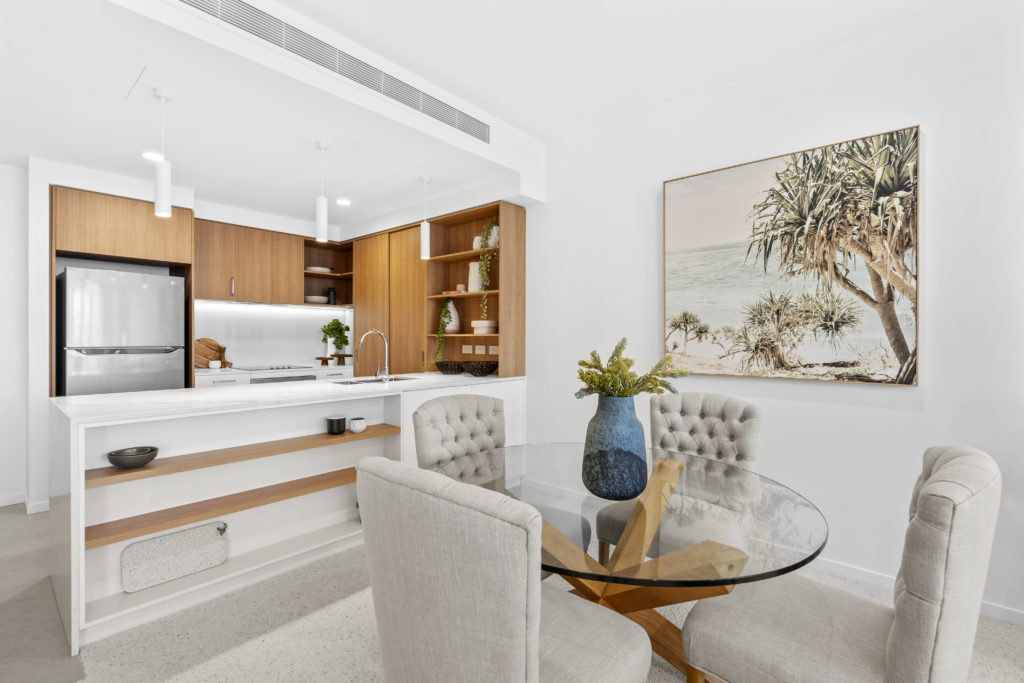
The Rise kitchen

Tucked away amongst lush greenery, The Rise provides residents with plenty of privacy in a secure community. While you will feel like you’re away from the hustle and bustle, you’ll still find everything you need right on your doorstep.

The Rise is just a stone’s throw from some of the region’s best beaches, stunning nature reserves, and the Coast’s largest shopping centre, Erina Fair. The village is also close to important amenities such as pharmacies and the Gosford Hospital, plus vibrant shopping and dining hubs.

Care and support you can count on

At The Rise, you will be able to enjoy the lifestyle you want now, with the security of knowing that there is care and support available that you can count on should you ever need it.

Our Village team is always ready to assist, you will always feel that you’re looked after. Plus you can leave behind your lawn mower and tool box as all apartments are serviced by a dedicated team who take care of gardening and maintenance. Leaving you to relax and live life on your terms.

Residents at The Rise also have access to RetireAustralia’s Home Care services. The reliable and experienced team offers assistance with household chores, meal preparation, showering, dressing and medication support, to name a few. Care is tailored to exactly what you need and funded either privately or via access to an approved government funded Home Care Package (HCP).

There’s also the added peace of mind of knowing that if you need extra care later on there are flexible transfer options to RetireAustralia’s very own alternative to aged care, Glengara Care in Tumbi Umbi and to Tarragal Manor Care Apartments which are just across the road in Erina.

We can’t wait to welcome you home


As the days inch closer to your move-in date, it can be a time filled with nervous anticipation. While you are ready to start enjoying your new home, there are some measures you need to take to prepare for your new life at Forresters Beach.

These include the legal requirements, all the way through to ensuring you have a hot cuppa and a comfortable bed on your first night. After welcoming many residents to our retirement villages, here is an overview of what you need to know.

The settlement process

Leading up to settlement, your sales consultant will provide you with regular updates regarding the construction process and formal notice before your apartment is due to be completed, so you have time to visit your new home to ensure you are happy to proceed and make arrangements to move.

If you have a home to sell, you should liaise with your solicitor in regards to the sale of your home. Your solicitor will maintain contact with RetireAustralia’s solicitors and keep them informed as to the status of the sale of your home and agreed settlement dates.
Once you are ready to confirm a settlement date, please notify your sales consultant, your solicitor or, if you don’t have a solicitor, RetireAustralia’s solicitors.

Our solicitors will then produce a settlement statement confirming what funds are required for settlement. This statement will be issued to your solicitor or direct to you.

The settlement statement will be provided to the sales administration to approve and then issued to your solicitor or direct to you with electronic fund transfer (EFT) details, so you know where to send the funds on settlement day.
On or before the day of settlement, you will arrange to have the funds sent to your solicitor or to RetireAustralia’s solicitors direct.

Once our solicitors receive the funds, they will notify RetireAustralia. In turn, your sales consultant will contact you to make arrangements for you to collect the keys to your new home.

Our solicitors will finalise the contract/agreement and arrange to have the title or lease formally registered at the titles office. Once the registered documents are received, RetireAustralia’s solicitors will arrange to send copies to you/your solicitor.

Prior to settlement (or sometimes at settlement) you will have the opportunity to walk through your apartment and complete a condition report to take a record of the apartment’s condition when you move in.

Get ready to connect

Once you know your settlement date you can start organising removalists and begin packing.

You will also need to organise the disconnection and reconnection of utilities and services. Some of these may seem obvious, but it can be easy to overlook when you’re busy moving and they may prove essential.

Services and utilities you will need to contact may include:

  • Electricity, gas and water
  • Insurance (home and contents, car)
  • Internet and phone
  • Redirect mail and newspaper/magazine subscriptions

You will also need to let key institutions and agencies know about your new address including:

  • Car registrations/Drivers licence
  • Electoral Office
  • Bank
  • Centrelink/Medicare


Moving day

The day has finally arrived and, as you know, it will be a big one. When you arrive at your new apartment, you should make sure all services, such as electricity, internet, phone etc. have been connected in your new home.

We always suggest that the first thing new residents bring in and have set up is their bed. Have pillows, sheets and blankets somewhere handy, so that if all else fails you have somewhere to sleep that first night.

We also recommend packing a box that’s clearly marked “essentials”, that contains a kettle, tea or coffee, toilet paper, toiletries, a towel and some snacks/breakfast items. This means that you can always have a hot cuppa and have some essentials on hand if you need a break or decide to call it a day.


In the village

In your first few days at Forresters Beach, your Village Manager will provide you with essential information, such as emergency procedures, important phone numbers and other information about life in your new community.

As you settle in, they will also let you know about the resident groups/committees that you can join if you so wish. As well as the activities that are available. You can then discover the village at your own pace.

“The first few days we didn’t really leave our home, because we were busy unpacking. We’d just bump into people randomly, but everyone was very friendly and welcoming,” says Judy, a RetireAustralia resident. “We then made a point of going to happy hour, so that we could get to know people.”  

Retirement living options: Retirement villages vs home

Is it worth moving into a retirement village or would you be better off remaining in your family home? We look at what you need to consider when making this decision.

As the years fly by, you may find yourself wondering where would be the best place to live in your retirement. For some people there’s no question, they want to stay in their family home surrounded by memories with everything they know close by. For others, they may be looking for a simpler, more stress-free life for their senior years. We look at two retirement living options available, including the considerations for staying in the family home versus living in a retirement village.

Staying in the family home

Choosing to spend your senior years in your family home means that you stay in an environment you know and love. A place where you’ve built a lifetime of memories and have your rituals and routines.  You will be surrounded by everything you know, a neighbourhood you’re familiar with and close to the social networks you’ve built over many years.

If you’re someone who values your independence and you have established routines that are important you, then this may be the right choice. Staying in the family works best for those with strong family and social networks, as loneliness and isolation is a higher risk for those ageing in their own home.

Things to consider when staying in the family home

  • Repairs and maintenance: by the time most Australians have reached their senior years, most of them have lived in their homes for more than 20 years. If this sounds like you, you should consider that the costs of maintaining older homes can be significant. Coordinating repairs along with ongoing home and garden maintenance can be demanding, so it’s worth thinking about how you’ll feel about this in the years to come.

    older person gardening
    Staying in the family home means upkeep of home repairs and gardening.

  • Accessibility and safety: How well will you be able to navigate your home if your mobility is compromised? Being open-minded about home modifications is important to ensure that your home continues to be a safe place for you as you age. A home can be full of fall hazards, as well as other potential safety problems. Getting a home safety assessment for ageing in place will give you peace of mind about this. It will also help you make an informed decision about what changes are needed to ensure your home is safe.
  • Isolation: You could become lonely and isolated living alone if your mobility or activity is ever limited. While you may know your community now, people move and neighbourhoods change.
  • Care and support: As the years go by, you may find you need help managing daily tasks and at some point, you may even need some level of nursing care. A great resource for understanding what options are available to you is the My Aged Care website.

Moving to a retirement village

Retirement villages are the most common and well-known retirement living option in Australia. A major feature of this style of retirement living option is the sense of community, with residents creating an informal support network and social groups. Increasingly, retirement villages also offer access to flexible care and support. This will give peace of mind, knowing that should your needs change in the future you can receive suitable care. Having the right support also means that you can stay safely in your home for longer.

Retirement villages are especially popular with both singles and couples aged over 65 years, who want more security and support while living independently. You can have an active social life and go travelling without worrying about day-to-day property maintenance or gardening needs that are taken care of by village staff.

Designed to provide safe and secure homes as we age, retirement villages should have no, or very few steps in the home (or the village), corridors and doorways are wider, bathrooms are adapted for mobility devices and each home is fitted out with a 24-hour emergency call button.

What are the benefits of living in a retirement village?

A range of living options

retirement village home
There are many living options when it comes to retirement village living.

There are several different types of retirement villages, and each offers a different range of accommodation choices from single family homes, townhouses, villas, and apartments.

Retirement villages can also have an array of amenities ranging from gyms, heated indoor swimming pools and billiards rooms through to tennis courts, bowling greens and more. Many offer services such as cleaning and laundry services, and transportation, as well as a diversity of sporting and social activities and facilities.

In many villages, small pets are welcome and residents love inviting family and friends to visit.

With so much choice, it is important to educate yourself on what each village offers and what suits your lifestyle. Be sure to visit a number of them before making a decision.

Knowing your costs

The vast majority of village homes are leasehold, meaning you do not own them. So, just like buying an apartment or townhouse, it is important that you read your contract and seek independent advice to review the contract before you sign on the dotted line.

Having a complete understanding of upfront, ongoing and outgoing village costs  is also important. One of the attributes of retirement villages that many people find attractive is the certainty it offers. From the day you move in, you will know the outgoing payment you will receive. In uncertain times, you may find it comforting to know where you stand financially. If that is you, a retirement village could be for you.

Care and support

Care staff taking blood pressure
Many retirement villages have onsite care available.

It’s important to consider how your care needs will be supported as you get older. Many retirement villages offer some form of onsite care, while others are co-located within an aged care home. While you may not need care now, you may in the future and the type of care and support provided in your retirement village will determine if you can remain living in your home or if you will need to move to a residential aged care facility.

What is it like living in a retirement village?

When Gordon Crawford moved into Tarragal Glen Retirement Village, he discovered a caring community that he wasn’t expecting. Without having to worry about maintaining a large home, Gordon now has time to enjoy life more and take up old and new hobbies.

“I loved that I was able to take up table tennis after a gap of 40 years and have now also embraced snooker for the first time ever!” says Gordon. “We enjoy social events such as BBQ Night where occasionally we have live music.  Coffee Corner, Lunch Box, Drinks at four.

“We now consider many of the residents here friends.  Friends who care about each other and keep an eye out for anyone having difficulties.”

For Chris and Judy Restom, residents at The Verge at Burleigh, they hadn’t considered moving to a retirement village when they decided to downsize from their large home, but it ended up being the perfect solution.

“We lived for 20 years in a big and beautiful home before we decided that maybe it was time to downsize,” says Chris. “We looked around and every place we liked had stairs. Then someone told us about retirement village living and we hadn’t really thought about it, but decided to have a look and thought ‘this is great!’. It’s got all the key things we need. They’ve put in everything to make life easy as we get older – like the size of the bathroom that can fit wheelchairs and fittings so you don’t trip.

“We are socially more active now than we were in our house. I reckon that’s good when people get older. Too many people have Nanas and Pops sitting alone in their room, contemplating their navels because there’s nothing to do. It’s very dispiriting.”


Want to discover whether life in a retirement village is right for you? Get your free guide to retirement village living.

 

Age is no boundary for these retirees and students

Programs bringing retirees and school students together have brought some wonderful and unexpected benefits at some RetireAustralia villages.

The past few years of COVID lockdowns and restrictions have been tough on all parts of our community. It’s not only older adults who have felt isolated, many teens and young people have missed out on interaction with friends and family. Two RetireAustralia villages have experimented with programs to help bring older and younger generations together and have been surprised by the benefits it’s brought.

Old People’s Home for Teenagers at Murray Gardens

Murray Gardens Retirement Village manager Robyn Anderson was intrigued when she was approached by a year 11 student from a local high school. Heather was looking to spend some time in the village as part of a community service program for her school curriculum.

“The week she was due to come was the same week the ABC was releasing the new series of Old People’s Home for Teenagers, so we asked Heather to watch Old People’s Home for Four-year-olds and do a little research,” says Robyn “We said we’d like to do the intergenerational experiment with her.”

To help make the most of Heather’s time in the village, Robyn put together a program for her to follow each day of the week-long visit and she says it was this program that was the key to success.

“It was amazing, actually, it was better than I could imagine,” says Robyn. “I was so surprised by how much the residents enjoyed it.”

A stitch in time

A student and retiree knitting together
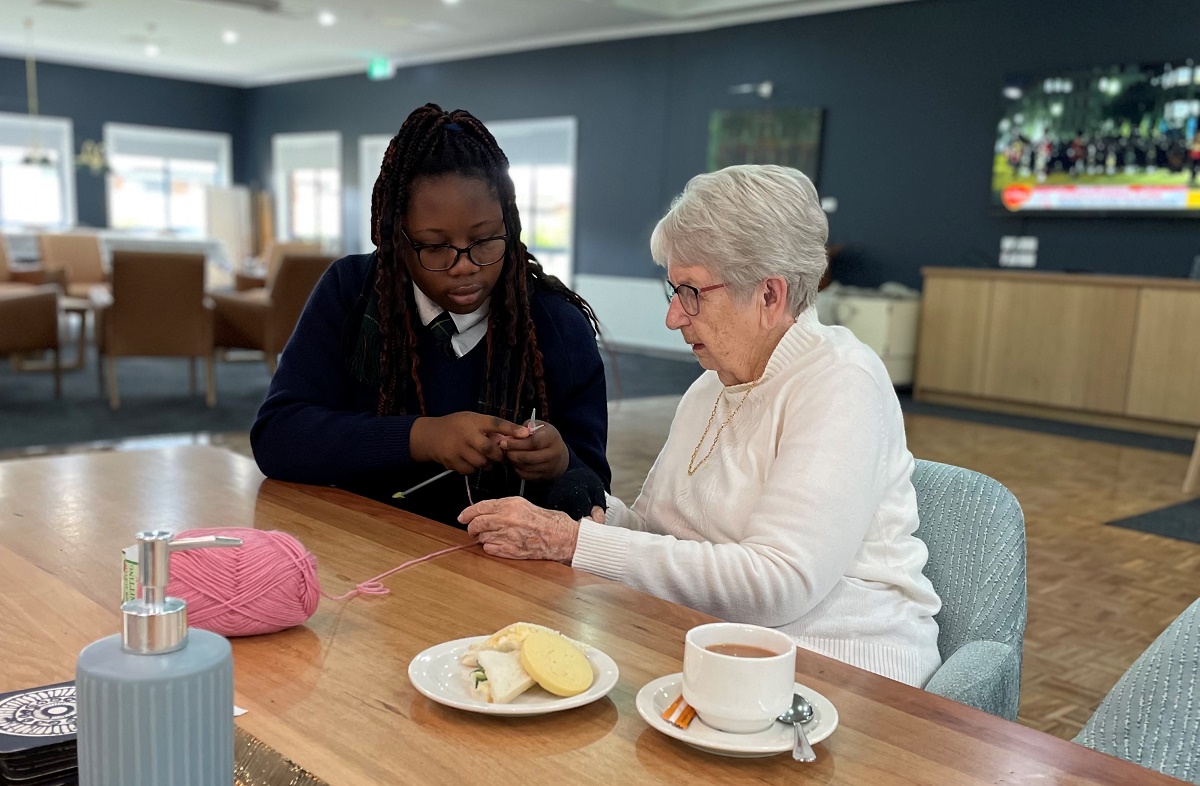
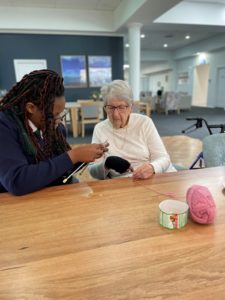
Heather learning to knit at Murray Gardens Retirement Village.

Part of Heather’s itinerary included knitting each day with a group of ladies Robyn calls “the Nonas”, the nonagenarians in the village. This first inkling Robyn had that this program was successful was the fact the Nonas would dress up for Heather’s visits. “When they put lipstick on, we know something special is going on,” says Robyn.

“They would sit at our big community table and teach Heather to knit. They shared with her why they knit and what it meant to them,” Robyn explains. “The Nonas suggested that maybe if she was stressing about a homework assignment or the night before an exam, she might like to pull out her knitting and could find that it was stress relieving.”

Building connections

Every lunchtime Heather sat at a different table to spend time and get to know all the residents. “Once the residents knew she was going to be on their table you could see them fussing about and dressing up, wanting to make a good impression on her,” says Robyn. “Our serviced apartment residents sit together for every meal, so when they went to their apartments and called family that night, they had something new to talk about, which was lovely.”

It wasn’t just the serviced apartment residents who benefited, Heather’s visit allowed Robyn to involve all parts of the village.

“Having Heather here gave me a good excuse to knock on the doors of our independent living residents,” says Robyn. “We have one lady who is quite isolated, the village is her family, and she has these beautiful citrus trees in her backyard. So, when I was putting together the itinerary, I rang her and asked if it would be alright if our student came down and collected some citrus for our kitchen. Heather went down and the hour had gone by and I had to get the maintenance team to go down there. The resident said ‘I don’t want her to leave’.”

Tea for more than two

Every morning, Heather was involved in the village morning tea which turned into a cultural experience. Coming from Zimbabwe, Heather was unfamiliar with some of the old-fashioned Australian treats she helped to put together each day, including cheese and gherkin bread, scones and even fairy bread.

Heather would then share the morning tea and chat with the residents as they came in to read the paper and have a cuppa.

“The serviced apartment residents and independent living residents used to socialise together, but COVID meant this happened less often,” says Robyn. “A recent boom in new independent living residents also meant that a lot of the residents didn’t know each other. Heather being at the morning tea and meeting a range of people allowed her to actually introduce the residents to each other, which was another lovely and surprising benefit.”

Robyn says other schools in the area have heard about their experience with Heather and have reached out about replicating the visit. Robyn says she would love to have more students come to the village as: “We just didn’t have enough Heather to go around!”

Love at first visit

Meanwhile in Armidale, Sue Nelson, the village manager at Newling Gardens Retirement Village, says COVID and the isolation of her residents prompted her to reach out to a local school just a block away.

“I contacted somebody at the school and we got chatting about it, and she just said that sounds like a great opportunity,” Sue explains. “So every Friday for an hour, the students come across and we organise an activity or two. We put it out to the residents and it was all very experimental.”

Sue wasn’t sure how the visits would work and was pleasantly surprised how it all came together and the residents enjoyed the visit.

“That first visit, the residents all sat around, you know one or two to a table,” Sue says. “The kids came over, but we told them beforehand to bring a photo of themselves or their family or their pet. Something that would start a conversation, and we said the same to the residents. It was amazing. The kids walked in sat down and it just clicked.”

During that first visit, one teacher pulled Sue aside and pointed out a student. “See this student over here,” she told Sue. “Normally he doesn’t interact at all with the other kids. Sits by himself in the playground and is just a quiet student. Look at him! He has a big smile on his face, and I don’t think he’s drawn breath.”

Expecting the unexpected

For Sue the most precious and special experiences have been the ones they haven’t planned and that happened right from that first visit.

“In one group there were two ladies, one who just lost her husband and the other had lost her daughter and they were speaking to a younger boy about 12,” Sue says. “They were asking what does mum do and what does dad do and then he broke down a little bit and had a few tears. He said ‘I lost my dad’. They said it’s ok. Everybody loses somebody and they talked about their experiences, and he talked about his thoughts. Things just happened without being planned, so it was a beautiful moment, absolutely beautiful.”

The program has been such a success and the school has so many students wanting to take part, Sue is looking at extending and expanding it.

“Now they want to do it every Friday for three hours. That’s going to be my next challenge,” says Sue. “But it’s well worth it, especially when you see what the residents and the students get out of it.”


Find a community you can call home


Finding the fountain of youth at Tarragal Manor

Betty Whitten’s 94 years aren’t slowing her down. Having an active life at Tarragal Manor keeps Betty happy and her family says she looks better than she’s ever done.

Betty Whitten’s 94 years aren’t slowing her down. Having an active life at Tarragal Manor keeps Betty happy and her family says she looks better than she’s ever done.

Moving to Tarragal Glen Retirement Village on the NSW Central Coast almost 30 years ago, was one of the most unexpected and best decisions of Betty’s life. Betty and her husband John had spent many happy visits to her older sister who lived in the village years before taking the plunge themselves.

“We used to come up and visit my sister, we’d stay for the weekend and go to any of the things that were on at the Country Club, a sausage sizzle and that kind of thing. We got to know some of the neighbours,” says Betty. “Then one day we came up to visit my sister and as we were leaving my husband said: ‘Maybe we should think of something like this’. I’d always said I wasn’t going into a retirement village, especially on the Central Coast as I was in Sydney. Anyway we went home and thought it over, and thought it’s a lovely village and we decided if we were going to go anywhere that was going to be it. And that’s what happened.”

Betty and her husband moved to the village and had 14 happy years together before he sadly passed away.

“My husband’s been gone quite a few years now, but we loved it when we were living independently over in the village. We had a nice villa with a nice outlook over the parkland  with lovely neighbours and everything. It was a very happy time there,” says Betty.

Time for a change

After her husband passed away, Betty continued to live in the village on her own for another 13 happy years, enjoying life in the community surrounded by good friends and neighbours. One Christmas, while her daughter was visiting from Tasmania, Betty announced that it might be time to move somewhere where she could get some extra help.

“My daughter had put my name down at a place in Tasmania, in case I ever wanted to go down there to live. But I said I wanted to go to The Manor, there’s people I know there and I’m still in touch with the village,” Betty explains. “My daughter was surprised, but I said if I go anywhere I want to go to The Manor where I still feel connected to the village. So I moved in here March 2020. It was one of the best moves I’ve ever made.”

The Manor, which forms part of Tarragal Glen Retirement Village, offers serviced apartments to cater for seniors who need extra household assistance, but still want to live independently.

“My family were very pleased when they knew I was coming into somewhere like this, where I was going to be looked after and a lot of the chores taken off my shoulders,” says Betty.

Life at The Manor

Betty Whitten loves life at The Manor. 

At the Manor, life hasn’t slowed down for Betty. While she likes to take it easier in the morning, her afternoons are spent catching up with friends and taking part in the many activities on offer, including Bingo, Trivia and Wordsearch.

“Over at the village, they’ve looked at our diary that’s printed in the Tarragal Times and quite a few of my friends over there have said ‘You do more over there in The Manor than we do!’” says Betty.

The fortnightly Happy Hour is another favourite time for Betty. “Ian, our pianist comes and plays,” says Betty.

“They serve wine and we usually just have two glasses of wine. I have mine topped up with orange juice so they don’t have to carry me upstairs,” Betty says laughing. “It’s just $4! Where do you go for an hour of beautiful music and two glasses of champagne for $4?!

“The pianist plays all the lovely tunes that we had during the war and we’ve grown up with since. And there’s a lot of foot-tapping going on, I can tell you that!”

With a cheeky sparkle in her voice, Betty seems much younger than her 94 years. She says that life at The Manor keeps her youthful.

“My grandson came out from England and I hadn’t seen him for four years. He said: “Grandma looks better now than she did four years ago!” So, it must suit me!” says Betty.

Next year will be Betty’s 30th year at Tarragal Glen and while she may not be the village’s longest resident (she knows of a neighbour who moved it a few months before she did), she is one of the happiest.

“I’m very happy here, that’s the bottom line. I’m enjoying it,” says Betty.

Find a community you can call home